Uganda is about the size of the UK and lies just north of the equator. It is now politically quite stable after Yoweri Kaguta Museveni became president in 1986.
The countries surrounding the southwest corner, The Democratic Republic of Congo (formally Zaire) and Rwanda, are not so stable though, so many parts of the country are unsafe. If you are planning to travel, do get advice from the British Embassy beforehand. 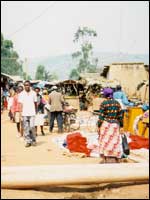
The market town of Kabale |
The weather may well be much cooler than you would expect and the countryside a lot greener. This is due to the altitude of the southwest corner, over 10,000ft high in the Ruwenzori mountains, and also due to the effects of Lake Victoria, the largest lake in Africa.
There are two rainy seasons, one between March and May and the other from September to December. The amount of rain is greatly affected by Lake Victoria, making the southwest corner far greener than the north and central parts of Uganda.
It is best to avoid the rainy season when you travel, other than that the weather is pretty much constant throughout the year, temperatures averaging between 22 and 24 degrees, 72 and 75 Fahrenheit. The main restraint on your planned journey should be safety. In much of the southwest the people are fairly self sufficient, banana trees and tea bushes are abundant. The area is quite sparsely populated, but those who live there complain about the overpopulated land. Each generation the land is split between the sons of the family, so they watch their patch get smaller and smaller. 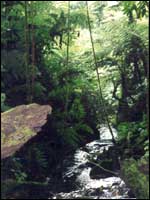
The Impenetrable Forest |
Right on the Congo boarder is Bwindi National Park which is home to many different species of monkeys - chimpanzees, Orangutans and also the ellusive Gorilla. It is known as the Impenetrable Forest and is where ‘Gorillas in the Mist’ was filmed.
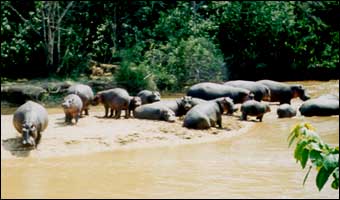
The number of people allowed to see the gorillas in one day is strictly monitored, so the waiting list at the park can get quite long. You could be lucky, but it would be wise to allow a couple of days for your trip into the forest. You’re not allowed to put your name down and return in a few days. Just further north of the mountains, the scenery changes dramatically, from lush forest to the grasslands of Queen Elizabeth Country Park. The grasslands are still quite green though, and not sun-scorched as you might imagine African grasslands to be. Elephants, lions, hippos and giraffe live here, as do an abundance of Ugandan cob (deer), wart hogs and buffalo. The majority of the villages in the southwest of Uganda have no running water or electricity, and never see foreigners. Expect to be stared at where ever you go, and anticipate to be followed by a group of fascinated children. You’ll be more of a spectacle to them than Uganda will be to you. |