Alex Crawford: ‘Send the right teams, don’t stop doing front line journalism’

Cathy Loughran
is an editor of the BBC Academy blog
Sky News’s South Africa-based special correspondent Alex Crawford has just received the British Journalism Review Charles Wheeler Award for outstanding contribution to broadcast journalism.
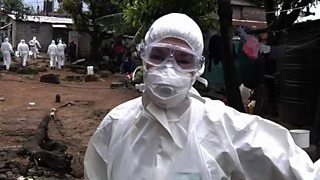
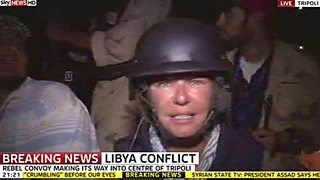
Already named RTS journalist of the year four times - and famously ahead of the competition when she rode into Tripoli with the Libyan rebels in 2011 (below) - Crawford also took this year’s Bafta for TV news coverage for her powerful special report from Liberia’s ebola front line (above).
I asked her about the risks and rewards of the job it took her 20 years to land:
What makes a good foreign correspondent?
It’s a deeply unfashionable thing to say but you need to be prepared to take some risks. I’m not talking about putting yourself in unnecessary danger. But, for instance, upping and taking your whole family abroad - in my case four children and a husband had to relocate to a whole new life in South Africa - is a massive, life-altering decision. And, yes, risky.
What you can count on is the rich variety of different cultures you’ll experience, as well as the adventures.
A big part of the job is about persuading people to talk to you when they don’t want to. So use a bit of charm, be interested in them, be personable - talk to people, don’t bombard them with questions. You need to build a relationship first.
When you’re starting out you may think you have to have a long list of questions to rattle through. Just be normal. You’re a person first; being a journalist is just part of that.
Get on with people, including your colleagues, your interpreters, locals who can help you get your story. And be prepared to make a few mistakes.
It took you about 20 years working as a print and TV journalist to get your first foreign posting. What made you persevere?
If you want something badly enough you need to persevere. Everyone told me I couldn’t do it. And of course I wanted other things, like a family and home life. Luckily I have a long-suffering partner, because this can be a lonely business for everyone concerned. And there’s no question that having a family makes what is already a very difficult job more difficult.
I know that having my children put the brakes on my career. That’s hard enough to manage in a normal job. I had five different rejections (for a foreign posting), including one when I was pregnant. Managers asked me what would happen if one of my children was ill. Even friends and supporters doubted I could manage it. I’m lucky and glad I finally got there.
Looking back, I’m sure those extra years prepared me a lot more, and I was certainly ready to go when the opportunity came - pretty match fit after so long on the sub’s bench.
How has the job changed during your decade of reporting from some of the most dangerous places on earth?
It’s changed massively, partly because technology has made the expectations and demands on correspondents so much greater. Technology has made the job more dangerous.
The whole Arab Spring also had a huge effect, changing the expectations of viewers and newsrooms alike when it comes to foreign news. Editors were suddenly inundated with dramatic live images of protest, bombs, destruction.
In the last Gulf War, and in previous conflicts, we just didn’t have that immediacy. With the events of the Arab Spring we weren’t embedded four miles from the action - we were in the middle of it. And not just in one country. Personally, I reported from Tunisia, Egypt, Libya, Bahrain and Syria.
Another change I detect is that audiences, but more specifically newsrooms, news editors and producers, have become numbed by seeing bombs and shootings on screen. So now, if you set off to trace Boko Haram in Cameroon or Nigeria, there's a danger that unless you come face to face with them everyone is terribly sceptical about - even unmoved by - the obvious death and destruction they leave behind.
It's up to us as journalists and film-makers to make sure we persuade our editors of the worth of covering issues despite there being no bombings and shootings on camera.
Is a true assessment of the risks in hostile environments ever possible?
I can see why the reaction to the Arab Spring has been more caution from newsrooms - it’s because of the immediacy of all this live material. Suddenly the guys in the offices are seeing it live for themselves. They all took fright, including all the big broadcasters. Understandably, they couldn’t have their people at risk of kidnap or execution.
But I’d suggest we’re now in danger of cramping the journalism because foreign reporting is such an unpredictable business. With the fear gripping newsrooms, I’d be wary of losing sight of the ‘calculated risk’.
You can close down as many risks as possible but you’re not going to get rid of them all. There are some things for which you can’t fill out a form…
Which is why editors have to have faith and trust in the people they send. Only send out the right teams; don’t stop doing the journalism at a time when the work of British journalists is among the most respected around the world.
Of all people, I’m absolutely not against taking all the safety measures you can. It’s just that some of the bureaucracy doesn’t fit with the world that’s out there.
Have you ever suffered trauma as a result of what you’ve seen and experienced in your job? And how have you coped with that?
Yes, I’ve definitely suffered trauma. They key is to recognise what’s happening to you and do something about it.
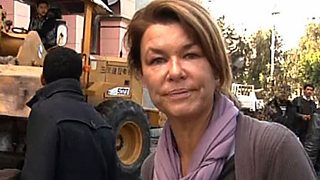
For me, the most traumatic experience was being trapped for two days in the Zawiya Mosque in Libya in 2011 - unable to get out and under fire from Gadaffi’s troops. (Crawford is pictured reporting from Zawiya below.) Afterwards Sky sent out an experienced counsellor who was extremely good for me because they were extremely ordinary. It stopped me feeling like a freak.
I remember an editor saying to me at the time that only someone who’s suffered trauma knows what it’s like. If you had a headache you’d take a tablet, so why not seek treatment for what are far more debilitating symptoms.
And you do ‘fill up’ over time. The more you see the more likely it will become too much, sooner or later.
What advice would you give to a young journalist who wants to be a front line reporter, in an increasingly freelance industry?
My worry for young people is that being close to the Arab Spring looked ‘exciting’ and may have inspired a whole load of aspiring foreign reporters. But, when you’re starting out, to go straight from student journalist to war reporter is practically suicidal. If you were interested in football you wouldn’t expect to play for Chelsea straight away!
There is so much more to foreign news than being in a war zone. And if you’re a sane person you shouldn’t want to be in a war zone.
There are an awful lot of freelancers out there and, because broadcasters are thinking twice about sending their own people into danger spots, there’s a gap to be filled. And it’s not good for the industry.
I think there have been some double standards here - companies so concerned about their own journalists’ safety but not always about where the pictures are coming from. I see the industry coming together to do something about that now, not before time.
But, honestly, what would I say to a young journalist starting out? When you’re young, with no responsibilities, the world is literally your oyster. With cheap air travel to Europe and further afield, just do it. Pick your country (within reason) and go and find a story.
There is potentially so much work out there, given the number of news channels. You need to be imaginative and learn to follow your gut instinct. Don’t worry too much about time, and don’t expect to make much money for a while.
For a start, you might not like it. But you may love it, and you’ll find that out pretty soon.
Once a foreign correspondent, always a foreign correspondent?
Foreign correspondents are very different, in the same way that sports reporters are. Different jobs attract totally different types. The job I do attracts risk-takers - not gamblers but people willing to give things a go, to live and work in different cultures, be as much at home in Afghanistan as Upper Street, Islington.
‘Travelling’ is for gap students. Foreign news journalists need to want to talk to people you wouldn’t normally come across - discover things you wouldn’t find out any other way.
You find your horizons become much wider. You start taking an interest in one country, then another, and suddenly the UK seems very small by comparison. The internet has made all news global news.
So it’s a great time to be in this business and there are massive opportunities for journalists in the digital world. But we should be careful that, amid all the new tools that are second nature to the digital generation, some of the old school journalism skills, learned by my generation, are not lost.
We shouldn’t think that iPads and Go-Pros are the only way forward. My message to managers is that you should embrace both (digital and traditional skills).
There’s an awful lot more to being a foreign correspondent than being able to cut pictures on your iPhone in 20 seconds flat.
Lyse Doucet: ‘Most international news is no longer foreign news’
Foreign assignments: Andrew Harding
Trauma in journalism: Sian Williams
Our special section on journalist safety
Rewards versus risks for war zone rookies
