Lyse Doucet: ‘Most international news is no longer foreign news’

Cathy Loughran
is an editor of the BBC Academy blog
The BBC’s chief international correspondent Lyse Doucet has received the Sandford St Martin Trust award for raising the profile of religion in the media and with the public. The awards have been given for excellence in religious and spiritual broadcasting for almost 40 years.
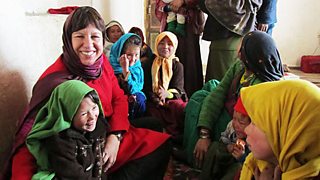
Lyse (pictured above on a 2011 assignment to Afghanistan) gave this interview about the award and her work to Sarah Parfitt, media consultant to the Trust. It is published here with the author’s kind permission:
Why do you think the Sandford St Martin Trust awards are important?
Religion, and belief in general, is one of the most important threads in some of the big issues of our time. People’s faith is, in some places, divisive and destructive. But in others it is a source of strength and solidarity.
The awards recognise the growing importance of understanding all faiths and people of no faith. They highlight the most compelling stories to help ensure they reach the widest audiences possible and enhance our appreciation of why these issues and beliefs matter so much.
Faith is a profoundly personal matter, but often highly political. That demands understanding, and I would say respect, in order to properly report on what are among the most sensitive, and often consequential, stories of our day.
You've worked as a foreign correspondent for more than 30 years, covering the Middle East for the past two decades - what motivates you?
I grew up in a small town in eastern Canada where religion, including Catholic and Protestant churches, were part of the fabric of a small community and the rituals of everyday life.
My work in journalism began in West Africa where faith is an integral part of culture and where people find ways to incorporate major religions such as Christianity or Islam, as well as traditional beliefs and customs, into their own identities. I have always been fascinated by the interplay between belief and culture, between religion and state.
Much of my journalism is rooted in the belief that, in essence, most stories are human stories. That is especially true when it comes to the coverage of conflict, including war. I am proudest of the stories that have revealed new issues and understandings and have broken news about significant events.
I also like to report on stories that can make audiences smile, if not laugh, since I have found that humour is a universal language, even in the most difficult of circumstances.
It is also increasingly clear that most international news is no longer foreign news. Many major stories of our time, including the ebola epidemic, the rise of the so-called Islamic State, or the migrants’ crisis, are not just about countries far from our shores. They also involve and have an impact on our own societies.
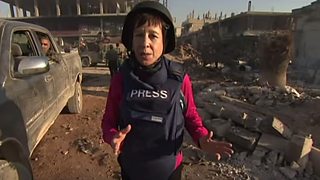
Lyse Doucet reporting for BBC News from the front line in Syria
What are the main challenges with your job?
The greatest difficulty is always to ensure you get as close as possible to the truth of any story. That means talking to as many people as possible and being on the ground for as long as possible.
But in some parts of the world, being a journalist has never been so dangerous. In parts of northern Syria, Iraq and Libya, journalists are now targets for kidnapping and killing by fighters of the so-called Islamic State and other extremist groups.
In other countries, other groups and criminal gangs also threaten journalists and act with impunity. Local journalists face the greatest risks, but foreign journalists are also not safe from growing scrutiny, harassment and sometimes attack.
When you are sent to a war zone, do you constantly worry about your personal safety?
Nothing matters more than the safety and wellbeing of the team. Most wars of our time no longer have distinct front lines, and in some places journalists are now targets. But the BBC and most major media now require very rigorous preparation in advance of any trips to high-risk areas.
But even with all the necessary precaution and preparation questions must continue to be asked on the ground. We have a fundamental principle that if any member of our team is hesitant about going in a certain direction we don’t go.
Journalists often focus more on the difficulty of getting a story rather than the danger of getting there. But it is crucial to do both.
As a child, did you always know that you wanted to be a foreign correspondent?
Yes, I still have the late slip from my local library for a book I took out as a teenager: How to be a Journalist.
What have you learnt from more than 30 years of being a foreign correspondent?
I have come to understand that people’s perception of reality often matters as much, and sometimes more, than the basic facts of any reality. That underlines again the importance of understanding why people see the world in certain ways and believe what they see to be true.
Can journalists afford to ignore religion? Depends what you believe
Insights on Syria from Lyse Doucet and other expert correspondents
Articles and analysis by Lyse Doucet: BBC News
