A stripped down telling of some of the world’s toughest stories

Benjamin Dix
is director of PositiveNegatives @PosNegOrg
The ideas behind PositiveNegatives were born from my time with the United Nations in north Sri Lanka. I was in the final UN evacuation from the conflict zone in the Tamil Tiger region in 2008.
Part of my personal healing process from that terrible experience was to tell these complex and emotional stories in a medium that I hoped would engage a diverse global audience. Inspired by the political graphic novels of Maus (Art Spiegelman) and Palestine (Joe Sacco), I teamed up with the wonderful artist Lindsay Pollock and we began to collect testimonies from Tamil asylum seekers in London, Zurich and Chennai and conceptualise our book The Vanni, pictured below. (These cartoons should be viewed in an up to date browser.)
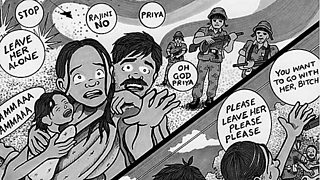
The Vanni then turned into my PhD in visual anthropology that focused on the inclusive methodologies of producing art from complex and traumatic testimony. The book is now 200 pages and will be finished at the beginning of 2016.
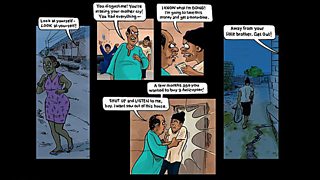
Using the methodologies from my PhD, we next produced Almaz: about a young Ethiopian woman who was abused by her employers in Saudi Arabia - a story based on real testimony. It was published by the BBC News website’s Magazine in 2014 and that’s where I was first introduced to BBC Focus on Africa editor Stephane Mayoux and producer Naomi Scherbel-Ball.
Between us we came up with the idea of telling the story of drug addiction in West Africa - an under-reported story but a major social issue in the region and directly linked to the global ‘war on drugs’.
The Focus on Africa team were amazing at gathering internal support for the project and getting so many BBC departments and language services on board.
I went to Guinea-Bissau for three weeks to gather the stories. In Bissau city I was introduced to a number of groups in various neighbourhoods who were addicted to crack cocaine. Unsurprisingly, it was difficult at first to bond with the groups as they were naturally suspicious of me.
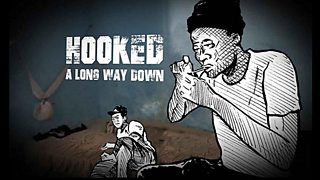
But after a few days one of the young guys approached me and began to ask questions about why I was hanging around. I showed him prints of our previous comics and he immediately understood, and wanted to be made into a comic book character! He became Buba, the protagonist in our latest production Hooked (below).
The methodology we use is designed to include the contributors in the production of our work. After about 10 days of talking, interviewing, observing and photographing the lives of Buba and his friends, I removed myself for a couple of days and wrote the first edit of the script. Then I returned to the group and spent many hours going through the words with them until they were happy with the story and the way it represented their lives.
Back in London I worked with my Focus on Africacollaborators to refine the script and started working with artist Tayo Fatunla, who is from Nigeria but lives in the UK. It was important for this project to have as much West African representation as possible. So, with the script approved by the contributors in Bissau and the artist from Nigeria, we were happy that the project had a good balance through the story and artwork.
Tayo worked tirelessly to produce the drawings while Naomi liaised relentlessly between multiple BBC departments to get Hooked on TV, web and mobile platforms in nine languages.
There was nothing comic strip about this collaboration.
Benjamin Dix is a professional photographer and is currently writing his doctorate in Anthropology: Artistic Representation of Violence at the University of Sussex.
Visual journalism: Motion Graphics
