Rewards versus risks for war zone rookies

Stuart Hughes
is a BBC World Affairs producer. Twitter: @stuartdhughes
The title - ‘Unprepared, inexperienced and in a war zone’ - was deliberately provocative. But it seemed to strike a chord. The article was shared widely online and provoked lively discussion on social networks.
Later this month, I’ll be chairing a panel at the Frontline Club in London which will examine the issues raised in the article. In many respects, the debate is nothing new.
Journalists have long begun their careers in the world’s hot spots. Robert Capa was in his early 20s when he took his iconic ‘Falling Soldier’ photograph during the Spanish Civil War. Age is no impediment to fine, sometimes even timeless, journalism.
What has changed though is the news industry itself. Tighter budgets and a decline in the number of staff jobs have made newsrooms more reliant on freelancers. At the same time the dangers facing journalists are greater than ever.
Ahead of the Frontline Club discussion, I canvassed opinions from a wide range of international journalists, from rookies to veterans.
The US writer Charles Glass summed up the current state of foreign news reporting. “The days of a specialist like David Hirst covering the Middle East from Beirut for the Guardian for more than 30 years, during which he developed his expertise, his Arabic and his contacts, are over,” he told me.
“There isn't a model to replace it, beyond daily decisions to cover big events as if they came out of nowhere. The void is filled by ambitious freelancers, some of whom are good and honest; others of whom are neither,” said Glass.
Most of the seasoned hands I spoke to were able to recount examples of ignorant, culturally insensitive or even downright dangerous behaviour by junior colleagues they’d met in the field.
“I’ve bumped into freelancers in Aleppo trying to make it without having done much research or having much regard to safety,” said the Daily Telegraph’s Middle East correspondent Richard Spencer.
“To be frank, those very aspects of their professional behaviour made it unlikely they would have much to offer journalistically. If you don’t know what you are doing, how likely are you to get a good story or picture?”
Jan Eikelboom, a reporter for the Dutch current affairs programme Nieuwsuur, agreed: “It seems Aleppo has become a magnet for young, inexperienced reporters and I find this a very worrisome development.”
“These kids are not only a danger to themselves, but also to the people whom they work with. Who is going help the wounded driver if nobody in the team even knows what a tourniquet is?”
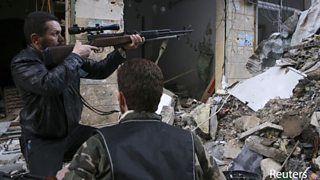
One Brazilian freelancer, Marina Darmaros, sent me a candid email just hours after returning from Aleppo (pictured). The Moscow-based reporter described her assignment in Syria as “terrible” and one which, in retrospect, she was “totally unprepared” for.
“In my opinion the Facebook era contributes to the fact that more of us are going to war - we are all connected now,” Darmaros told me. “Maybe we all imagine it’s safer than it really is, and that’s why we go.”
But, despite these concerns and criticisms, every fledgling correspondent I spoke to stressed the same fundamental problem. They are in a Catch 22 situation, desperately wanting to build a reputation in a market place where opportunities to make an impression are few and far between.
“Experience is the issue,” said Daniella Ritzau-Reid, an aid worker who is hoping to make the move into journalism.
“When faced with options such as returning to university or work experience at a local paper, heading back to the field and having a go is far more appealing. At what point do you simply have to jump in at the deep end?
Venetia Rainey, who currently works on the Daily Star newspaper in Lebanon, criticised the double standards of some more established colleagues: “I find it unfair, although I understand the concerns, that older journalists who have secure, regularly salaried jobs or else enjoy already established reputations see fit to lay into [young journalists].
“It's really, really hard to get into journalism these days. You can't expect people to turn down opportunities that instantly put them on a foreign editor's radar.
“You're never going to be able to stop young, aspiring journalists from going into dangerous places and it’s frankly hypocritical for those a generation or more above to frown on us for doing so,” Rainey told me.
Former Fox News and CNN reporter Chris Kline put his finger on the dilemma: “There is no substitute for experience and there’s only one way to get it, though there are few apprenticeships quite as risky as front-line journalism.”
Read part two of Stuart Hughes’s contribution to the ‘risks versus rewards’ debate on the College of Journalism blog tomorrow.
You can join the discussion in person at the Frontline Club on 27 February, or offer your thoughts using the Twitter hashtag #fcfreelance
How journalist safety and freedom of speech made the headlines in Finland.
The BBC College of Journalism and the University of Sheffield’s Centre for Freedom of the Media (CFOM) held a special briefing on journalists’ safety in London last October. Watch a video of the London symposium and read blog posts by some of the front-line journalists who attended the event:
