They pulled me off Mali to report on the Pope
Mike Wooldridge
is a BBC World Affairs correspondent
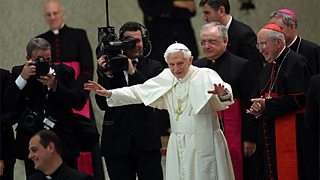
I stared at the computer screen for a full second or two. There was no other immediate corroboration. Could this be some kind of agency test message kept ready in the event that Pope Benedict might decide to do what no Pope had done for seven centuries, and have been sent out in inexplicable error?
I went across to the desk where the BBC world editor Jon Williams, assignment editor Simon Enright and world duty editor Barbara Groom sit and told them it was being reported that the Pope was resigning. From Jon there was a quick comment along the lines of ‘this had better not be a joke’.
But he was also lifting the phone to galvanise a deployment operation that would see colleagues rapidly heading for Rome from London, Brussels and elsewhere. And then ANSA's almost unbelievable report did start to come up on other wires and via the BBC's own ‘Vaticanista’, David Willey.
The World Affairs Unit has two former religious affairs correspondents: Emily Buchanan and me. Emily was quickly deployed to BBC World, and me to the News Channel. There was just enough time to print off a profile of Pope Benedict and a timeline of his life - to jog the memory - and to grab a notepad to jot down news lines from the evolving coverage.
Being a ‘presenter’s friend’ for the News Channel at the moment means being perched in front of the newsroom camera at New Broadcasting House as the channel is still broadcasting from Television Centre, and I well knew that I could be there for a long period.
That first stint was an hour or so, and the first ‘down the line’ with me was within seconds of getting the earpiece in and the mic clipped on. What was really needed from me was context and interpretation.
It is more than16 years since I finished my six-year spell as religious affairs correspondent and my job today as a world affairs correspondent means that I am rather more up to speed on Mali and Syria than I am on the Vatican.
In fact, what I was meant to be doing that day was going to Blackfriars to interview a visiting senior UN official about Mali. There was just time to send an all-too-brief message calling it off. Luckily the official was able to change his plans the next day to fit in a rearranged interview - which almost certainly had more air time than it would have done the previous day.
Fortunately for me, I had covered the Pope’s visit to the UK and the conclave that chose Joseph Ratzinger to succeed John Paul II. And last Monday that unmistakable adrenaline rush associated with truly big stories kicked in.
I drew on the times I’d seen the Pope and listened to him, and watched how others responded to him; on my own past coverage of the Vatican and the Roman Catholic Church in various parts of the world, and all the issues swirling around it; and on my continuing, deep interest in the phenomenon and influence of religion.
As the number of correspondents reporting on the shock resignation grew rapidly, I was asked to do a piece on global reaction to the announcement for the lunchtime radio news bulletins, to head swiftly to Westminster Cathedral to do lives for the News Channel and BBC World during the afternoon, and to do a piece for the 6pm Radio 4 News on the process of choosing a new Pope and on who might be likely to succeed Benedict. I collaborated with News online’s Michael Hirst, formerly of the Catholic journal The Tablet, on a similar but expanded piece for the BBC website.
The pressure of demands and the logistics can become overwhelming, but there were sources for fresh insight and interpretation. There were Catholic passers-by at Westminster Cathedral with their own take on Pope Benedict and the controversies he has faced. And it was useful to hear the comments of Church experts being interviewed just before me - some of them people I would have tried to ring if I had had the time.
Religious stories tend to be big. I have witnessed many millions of pilgrims bathing at a Kumbh Mela in India; covered the vote for women priests and the first being ordained in the Church of England; and the attempted assassination of Pope John Paul II in St Peter’s Square. Religion is a spectacularly unpredictable subject to cover - as the last week has proved once again.
Read the College of Journalism backgrounder on the Catholic Church.
Photograph: Getty
