Key points
Any A closed 2D shape bounded by straight lines. with three straight edges is a A three-sided polygon..
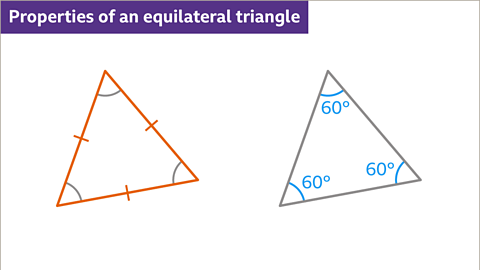
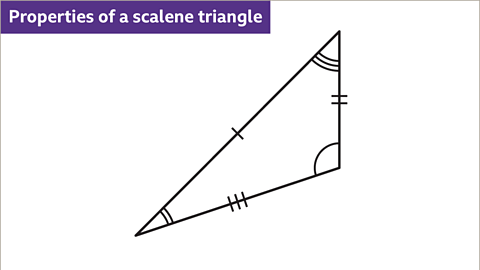
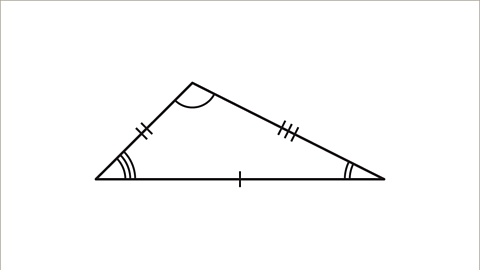
A triangle is classified by the comparative length of its Side of a polygon or a 3D shape. (sides) and by the size of its angles. These properties can be annotated on a diagram:
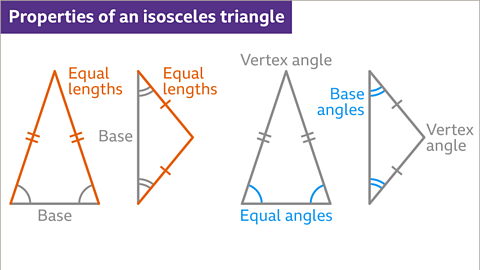
- Short lines marked on the side or edge of a shape. The same number of marks indicate equal lengths. are used to represent segments of equal length on diagrams.
- Curved marks inside the vertex of a shape. The same number of marks indicate angles are equal in size. at The point at which two or more lines intersect (cross or overlap). The corner of a shape. The plural form is vertices. are used to represent angles of equal measure.
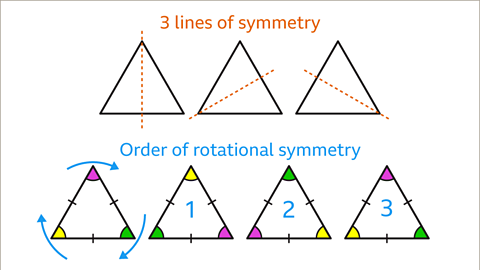
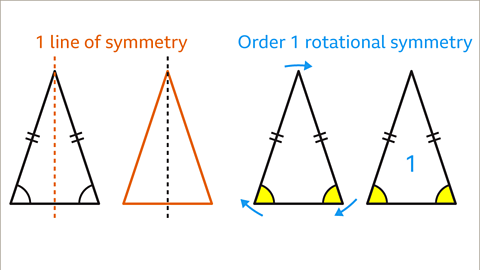
- Other properties relate to the symmetry that the triangle has.
Understanding different types of angles and that angles in a triangle sum to 180° can be helpful when classifying a triangle.
Recognising line symmetry and rotational symmetry will also help.
Recognise equilateral, isosceles and scalene triangles
To interpret a diagram:
- Recognise that Short lines marked on the side or edge of a shape. The same number of marks indicate equal lengths. indicate equal lengths.
- Recognise that Curved marks inside the vertex of a shape. The same number of marks indicate angles are equal in size. in The point at which two or more lines intersect (cross or overlap). The corner of a shape. The plural form is vertices. can be used to indicate equal angles.
To classify a triangle using comparative lengths or angles:
- Look for any hash marks on the sides.
- The same number of hashes indicate equal lengths.
- Different numbers of hash marks indicate different lengths.
- Look for arcs inside each vertex.
- The same number of arcs indicate equal angles.
- Different numbers of arcs indicate different angles.
To identify the symmetry of a triangle:
- Count how many ways the triangle can be cut into a pair of mirrored halves. This gives the number of lines of symmetry of the triangle.
- Count how many ways the triangle will fit into its outline in a full turn (360°). This gives the order of rotational symmetry.
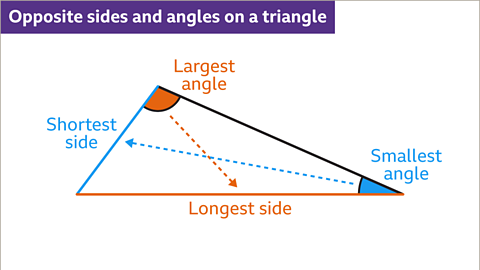
A unique set of properties relating to the comparative length of its sides and the comparative size of its angles help to identify All sides are equal in length. All angles are 60°., Two sides are equal in length. Two angles are the same size., and Each side is a different length. Each angle is a different size..
Examples

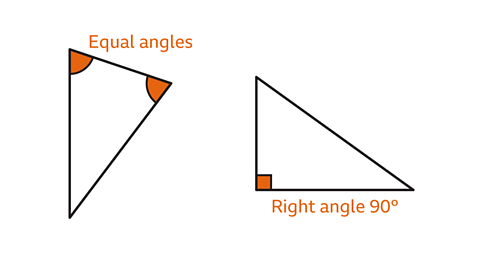
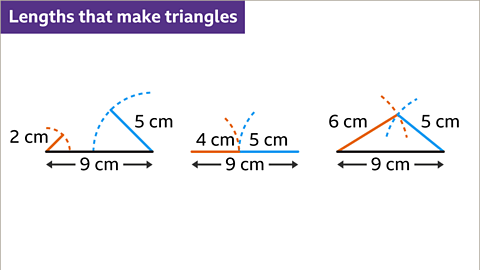
Image caption, Hash marks are used to show edges that are equal in length. The same number of hash marks shows lines that are equal in length.
1 of 10
Question
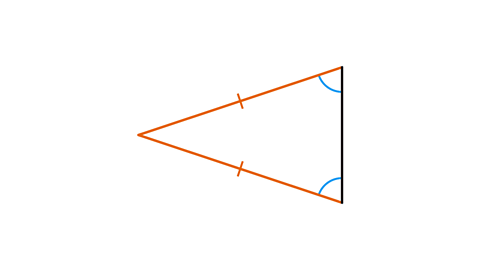
The triangle below is an isosceles triangle. Make a copy of the diagram on a piece of paper and mark on the correct annotation to show this.
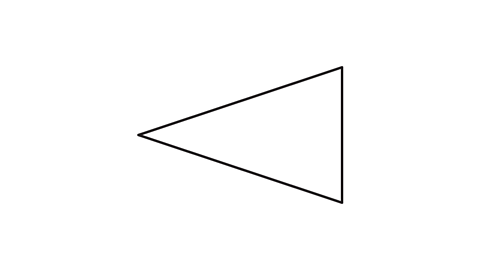
An isosceles triangle has two equal sides. One or more equal number(s) of hash lines on the equal sides are drawn on the diagram.
Two of the angles are equal. The equal angles are opposite the equal sides. They are marked with matching numbers of arcs to show that they are the same size.
Recognising acute-angled, right-angled, and obtuse-angled triangles
To classify a triangle using the specific size of its angles:
- Identify the type of angles in the triangle.
- Acute angles (less than 90°).
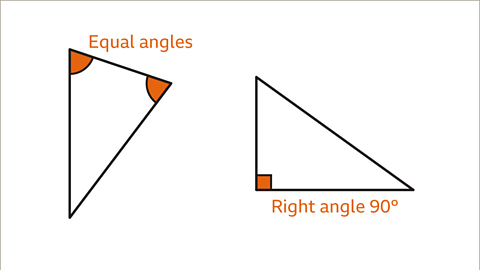
- Right angle (exactly 90°), marked with a square.
- Obtuse angles (greater than 90° and less than 180°).
- Using the combination of different types of angles, identify the triangle.
- An acute-angled triangle has three angles that are all less than 90°.
- A right-angled triangle has one angle that is exactly 90°.
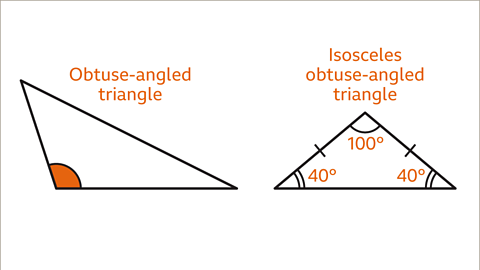
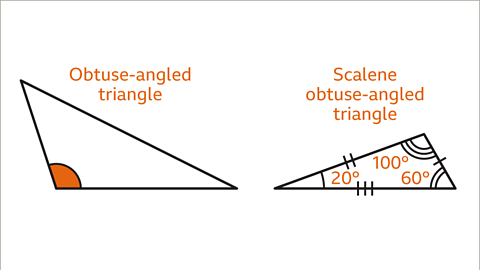
- An obtuse-angled triangle has one angle that is greater than 90°.
The triangles can be further classified as All sides are equal in length. All angles are 60°., Two sides are equal in length. Two angles are the same size. or Each side is a different length. Each angle is a different size. by comparing the size of the angles. It is possible for each triangle described by its angle to have more than one classification.
Examples
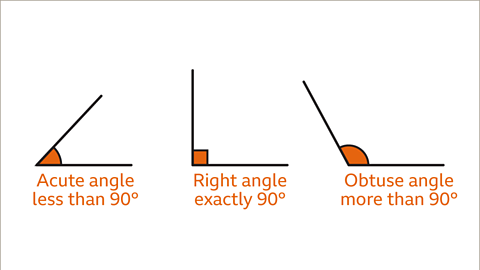
Image caption, A triangle may be described by the size of its angles, eg acute-angled, right-angled or obtuse-angled. An acute angle is less than 90°. A right angle is exactly 90°. An obtuse angle is greater than 90° and less than 180°, a straight line.
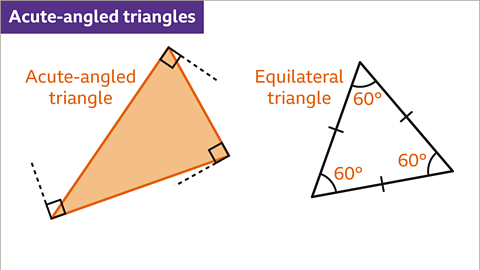

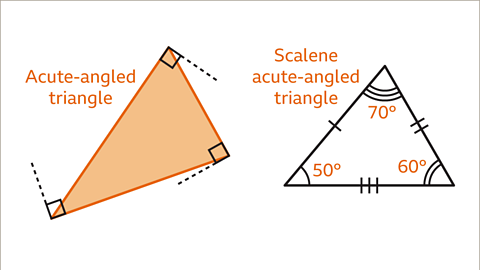
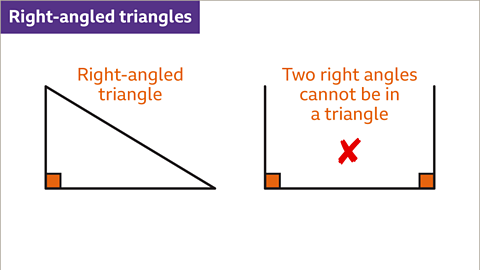
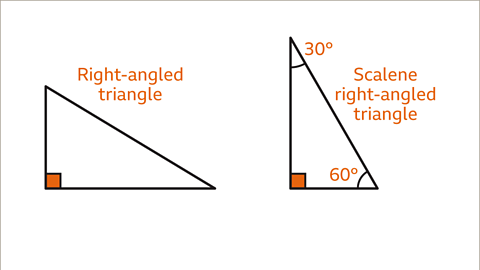
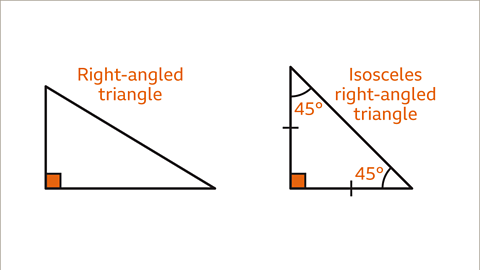
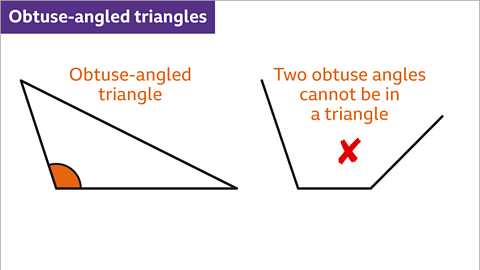
1 of 10
Questions
Question 1: What type of triangle has angles of 35°, 65° and 80°?
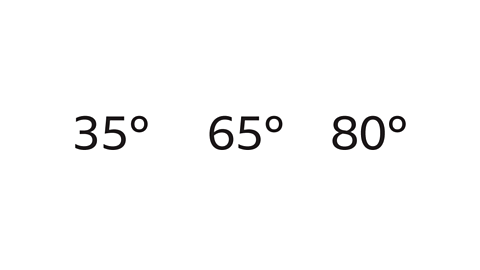
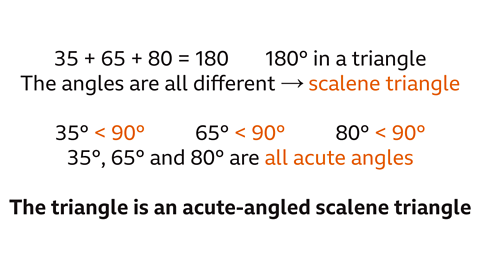
The three angles add up to 180°, so it is possible to draw a triangle.
Each angle is different, they are all less than 90°. The angles are inside a scalene triangle.
The angles are all acute angles.
The triangle is an acute-angled scalene triangle.
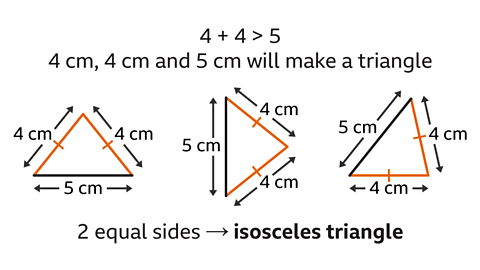
Question 2: What type of triangle has sides with lengths 4 cm, 5 cm and 4 cm?
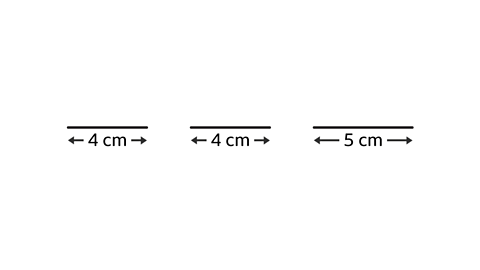
The two shorter sides have a total length that is greater than the longest side.
4 + 4 > 5
This means that a triangle can be drawn with the lengths 4 cm, 4 cm and 5 cm.
Two sides are the same length. The triangle is an isosceles triangle.
Practise working out properties of triangles
Practise working out properties of triangles with this quiz. You may need a pen and paper to help you with your answers.
Quiz
Real-life maths
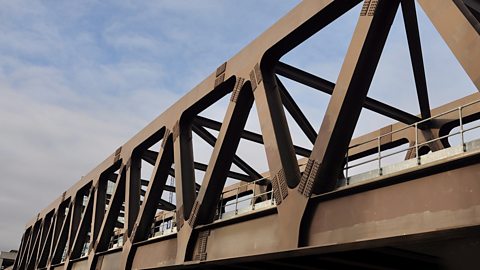
A triangle is a rigid shape. This fact is put to good use in constructing scaffolding. Separate lengths of iron pipework are fixed together with diagonals across any four-sided shapes.
This gives rigidity to the overall structure, which is essential for safety. This type of construction is also seen in bridges, cranes and mobile launcher platforms used for space rockets.
Play Sudoku with BBC Bitesize!
Every weekday we release brand new easy, medium and hard Sudoku puzzles. Perfect for testing your skill with numbers and logic.

More on Shapes
Find out more by working through a topic
- count2 of 4
- count3 of 4

- count4 of 4