Key points
All A 2D shape with 4 edges and 4 vertices. are A closed 2D shape bounded by straight lines. with four Side of a polygon or a 3D shape.. They are classified by the comparative lengths and position of their edges.
The angles in a quadrilateral always sum to 360°.
The properties of a quadrilateral include additional facts relating to their A line joining two non-adjacent vertices (corners) of a polygon. and their An imaginary line which splits a shape equally in two, where both sides are a reflection of each other..
A specific property may apply to more than one quadrilateral.
Properties of squares, rhombuses, and rectangles
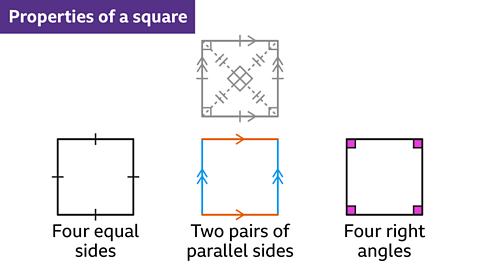
To classify a A 2D shape with 4 edges and 4 vertices. as a A regular quadrilateral. All four sides are equal in length and all four angles are right angles. a A quadrilateral with two pairs of parallel sides. All sides are equal. Opposite angles are equal. or a A quadrilateral with opposite pairs of sides that are both equal in length and parallel. All four angles are right angles., check for the following properties.
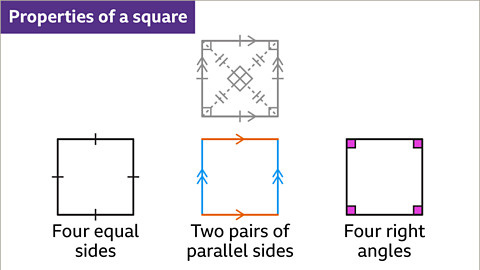
A square has:
- Four sides equal in length.
- Two pairs of parallel sides.
- Four right angles.
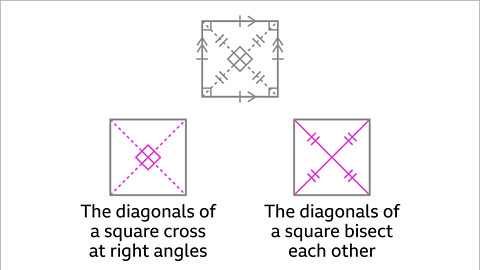
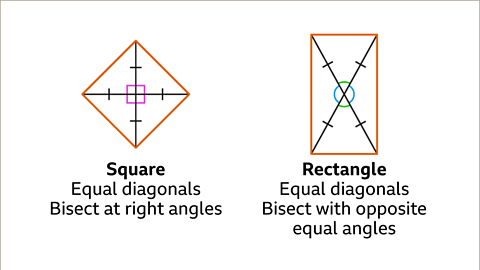
- A line joining two non-adjacent vertices (corners) of a polygon. that are equal in length.
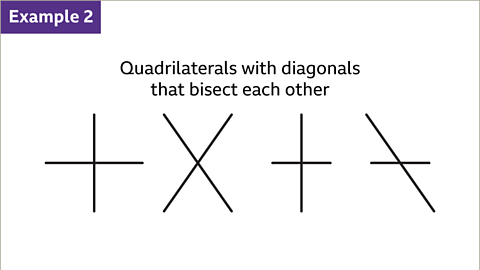
- Diagonals that To divide into two equal sections, cut in half. each other and are Perpendicular lines are at 90° (right angles) to each other. .
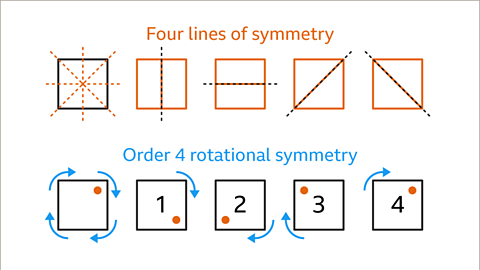
- Four An imaginary line which splits a shape equally in two, where both sides are a reflection of each other..
- A 2D shape has rotational symmetry about a point if it looks the same after a rotation through an angle greater than 0° and less than 360° about that point. of Used to describe rotational symmetry. A shape, such as a square, has order 4 rotational symmetry, for example, because it will fit into its outline four times in a complete turn.
A rhombus has:
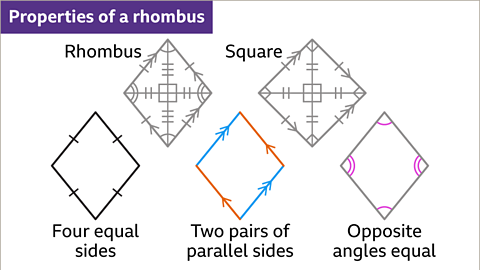
- Four sides equal in length.
- Two pairs of parallel sides.
- Two pairs of equal opposite angles.
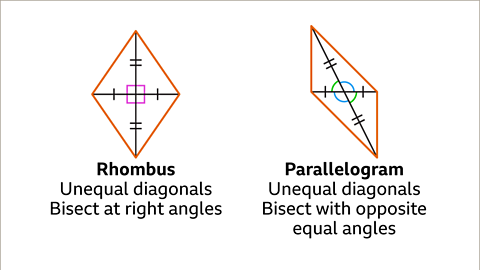
- Diagonals that bisect each other and are perpendicular.
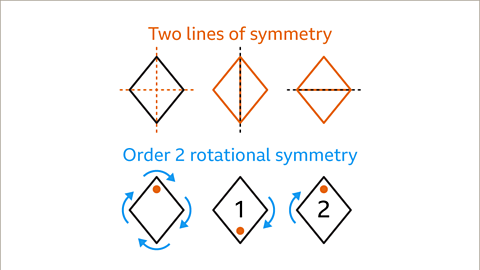
- Two lines of symmetry.
- Rotational symmetry of order 2
A rectangle has:
- Two pairs of opposite sides that are equal in length.
- Two pairs of parallel sides.
- Four right angles.
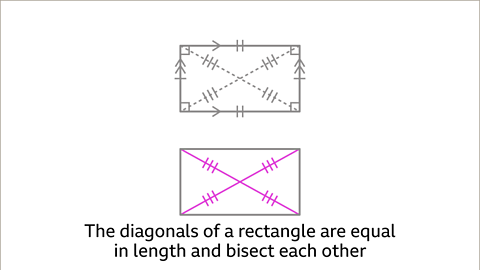
- Diagonals that are equal in length.
- Diagonals that bisect each other.
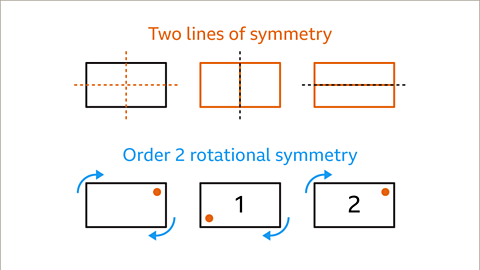
- Two lines of symmetry.
- Rotational symmetry of order 2
Examples
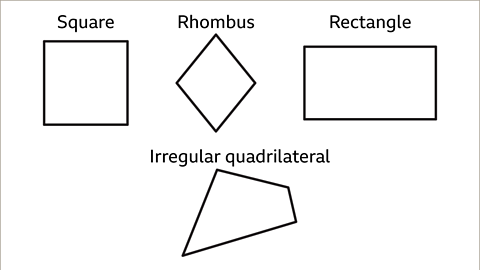
Image caption, All quadrilaterals have four sides and four angles. The lengths and position of the edges help to identify the quadrilateral. A quadrilateral that is not a specific type is called an irregular quadrilateral.

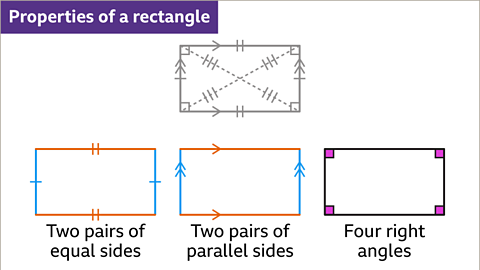
1 of 10
Question
Name a polygon with four sides that are all equal in length.
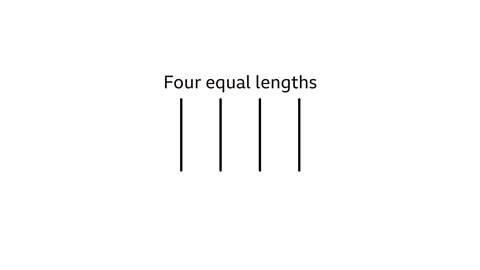
A polygon with four sides is a quadrilateral.
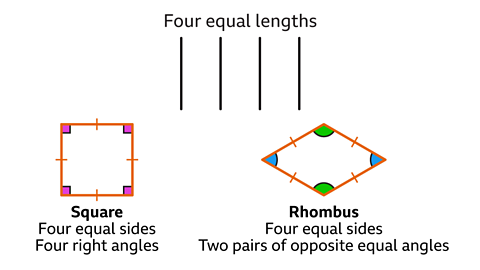
Four equal lengths can form two different quadrilaterals.
The quadrilateral with four equal sides and four right angles is a square.
The quadrilateral with four equal sides and two pairs of opposite equal angles is a rhombus.
Properties of parallelograms, kites and trapeziums
To classify a A 2D shape with 4 edges and 4 vertices. as a A quadrilateral with opposite pairs of sides that are both equal in length and parallel. Opposite angles are equal., A quadrilateral with exactly one pair of parallel sides. or a A quadrilateral with adjacent pairs of sides that are equal in length. One pair of opposite angles are equal. , check for the following properties.
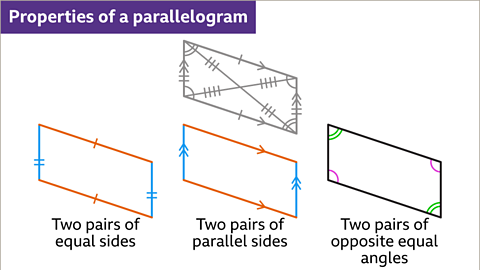
A parallelogram has:
- Two pairs of opposite sides that are equal in length.
- Two pairs of parallel sides
- Two pairs of equal opposite angles
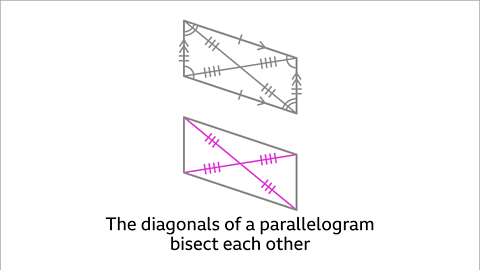
- A line joining two non-adjacent vertices (corners) of a polygon. that To divide into two equal sections, cut in half. each other.
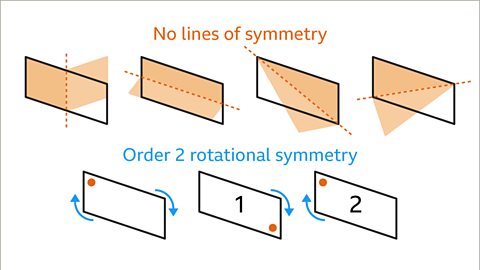
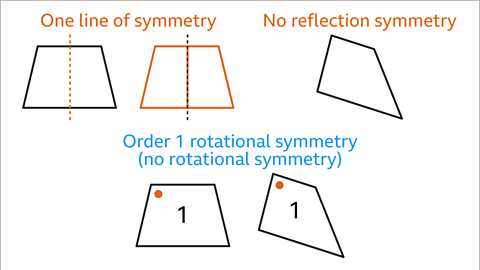
- No reflection symmetry
- A 2D shape has rotational symmetry about a point if it looks the same after a rotation through an angle greater than 0° and less than 360° about that point. of Used to describe rotational symmetry. A shape, such as a square, has order 4 rotational symmetry, for example, because it will fit into its outline four times in a complete turn. 2
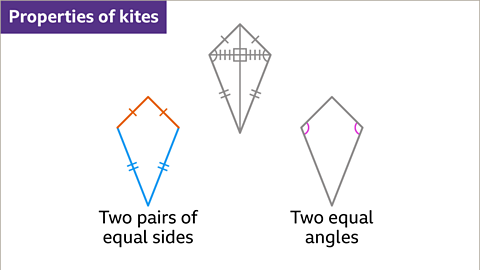
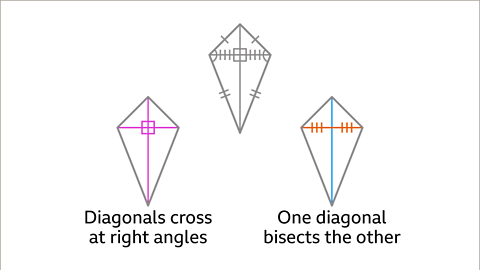
A kite has:
- Two pairs of Two angles or sides that lie next to each other. sides that are equal in length.
- One pair of opposite equal angles.
- Diagonals that are unequal in length.
- One diagonal is bisected by the other.
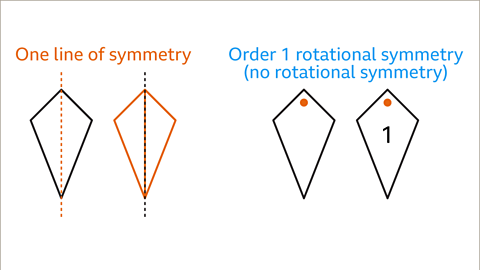
- One line of symmetry.
- Rotational symmetry of order 1
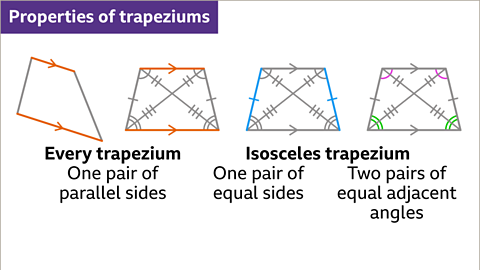
A trapezium has:
- One pair of unequal parallel sides.
- Diagonals that are not equal in length.
- No reflection symmetry
- No rotational symmetry.
An isosceles trapezium has:
- One pair of unequal parallel sides.
- Two non-parallel equal sides.
- Two pairs of adjacent equal angles.
- Diagonals that are equal in length.
- One line of symmetry.
- No rotational symmetry.
Examples

Image caption, Parallelograms, kites and trapeziums have four sides and four angles. The lengths and position of the edges help to identify the quadrilateral.

1 of 10
Questions
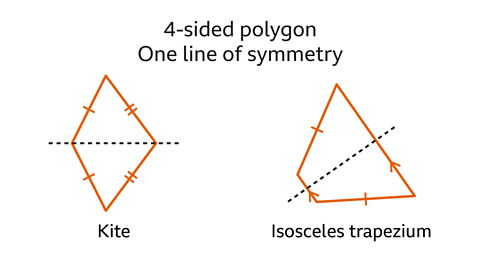
Question 1: Which quadrilaterals have exactly one line of symmetry?
The quadrilaterals with exactly one line of symmetry are a kite and an isosceles trapezium.
The line of symmetry cuts the shape into two mirrored halves.
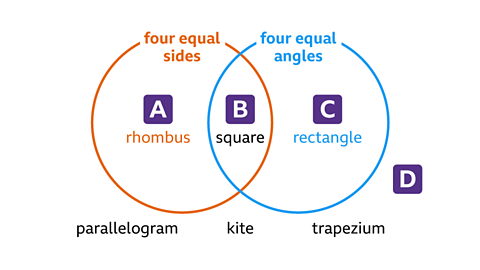
Question 2: On a copy of the Venn diagram, place the quadrilaterals square, rectangle, rhombus, parallelogram, kite and trapezium in the correct regions.
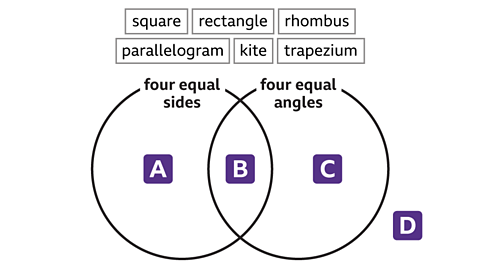
Region A contains the rhombus, it has four equal sides and does not have four equal angles.
Region B contains the square, it has four equal sides and four equal angles.
Region C contains the rectangle, it has four equal angles and does not have four equal sides.
Region D contains the parallelogram, the kite and the trapezium. These quadrilaterals do not have four equal sides, they do not have four equal angles.
Identifying quadrilaterals by their properties
To identify a quadrilateral by a property, keep the following in mind.
- Consider known facts:
- equal side lengths
- parallel sides
- equal angles
- diagonal properties
- reflection symmetry
- rotational symmetry
Remember: a property may apply to more than one quadrilateral.
Examples
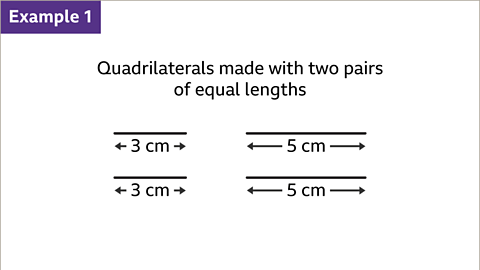
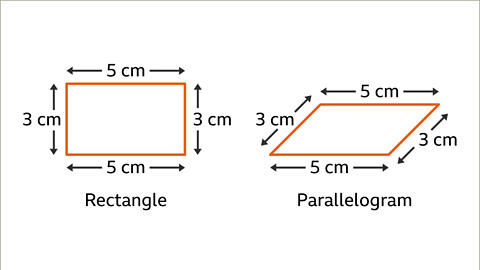
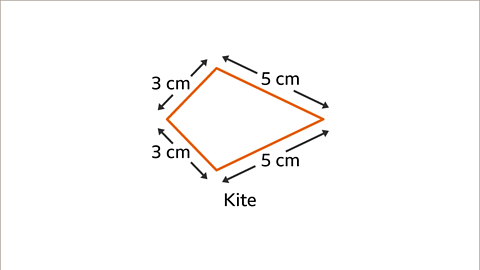
Image caption, What quadrilaterals can be created from two lines that are 3 cm long and two lines that are 5 cm long?
1 of 6
Practise finding the properties of quadrilaterals
Practise working out properties of quadrilaterals with this quiz. You may need a pen and paper to help you with your answers.
Quiz
Real-life maths
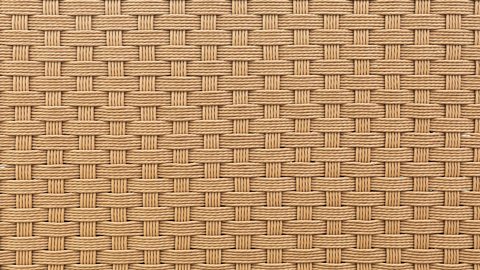
Properties of A 2D shape with 4 edges and 4 vertices. can be important in design. All quadrilaterals can tessellate. This means a single quadrilateral can be used to create a repeating pattern to cover a surface with no gaps. Geometric wallpaper and fabric designs often show tessellating patterns.
Quadrilaterals are used as the default shapes in all sorts of design software, including gaming, architecture, fashion and laser printing. A ‘basket weave’ design for use on fabric, wallpaper or even a web page is created by a series of rectangles, for example.
Revise for your exams with BBC Bitesize
Get ready for the GCSEs with quizzes, past papers, flashcards, podcasts and more resources!

More on Shapes
Find out more by working through a topic
- count3 of 4

- count4 of 4
- count1 of 4