Key points
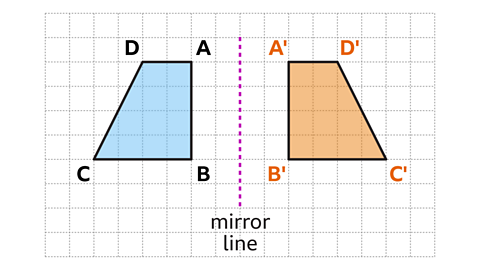
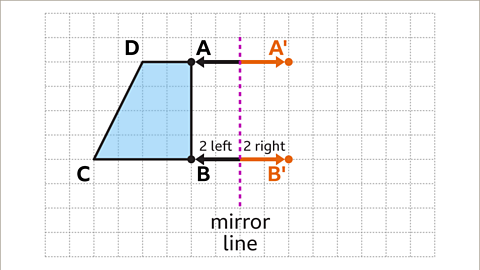
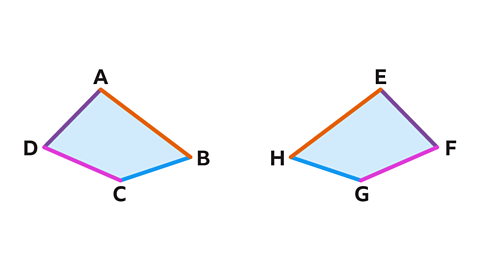
A A reflection is a mirror image of the shape. An image will reflect through a line, known as the line of reflection. is one of the four types of A change in position or size, transformations include translations, reflections, rotations and enlargements.. A shape can be reflected across a line of reflection to create an image. The line of reflection is also called the mirror line.
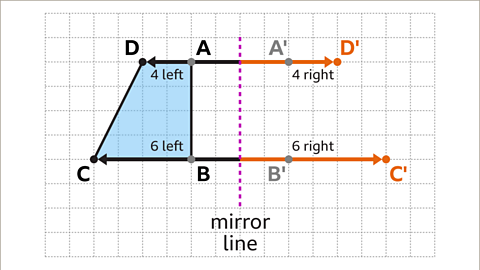
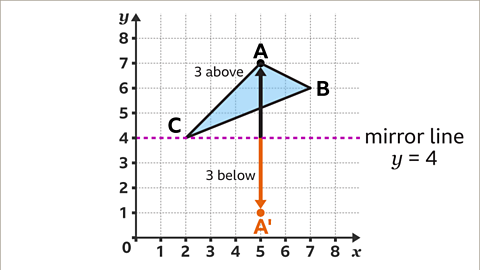
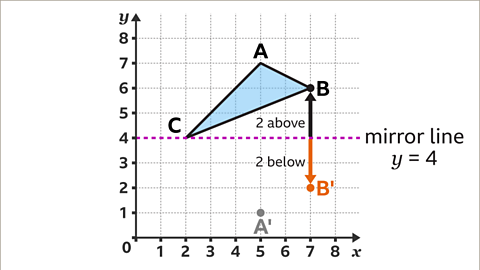
Each The point at which two or more lines intersect (cross or overlap). The corner of a shape. The plural form is vertices. on the original shape is the same Perpendicular lines are at 90° (right angles) to each other. distance from the mirror line to its corresponding vertex on the image.
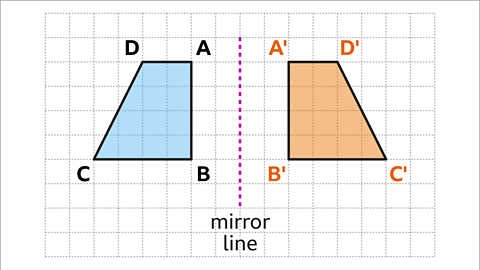
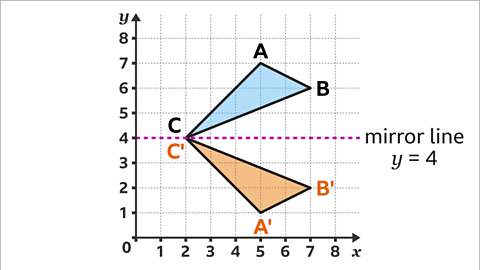
The new shape is Shapes that are the same shape and size, they are identical. to the original shape.
When reflecting shapes in non-vertical mirror lines, rotating the paper to make the mirror line vertical can help to visualise a problem.
When reflecting shapes, a good understanding of symmetry and naming and plotting coordinates can be helpful.
Reflecting in vertical and horizontal lines
Reflections can be shown on a grid or on sets of axes.
To work out the position of the image after a reflection:
Pick a vertex on the shape (object).
Work out the perpendicular distance to the mirror line by counting the amount of squares on the grid.
Count the same perpendicular distance from the mirror line to the opposite side of the mirror line. This will be the position of the reflected vertex.
Repeat the process for additional vertices.
If a vertex is on the mirror line, it will be A vertex or line segment that does not change after a transformation. under the reflection.
Examples
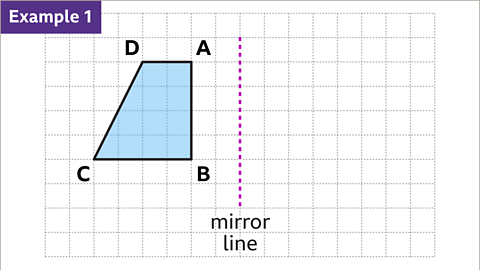
Image caption, Reflect shape ABCD in the vertical mirror line.
1 of 9
Question
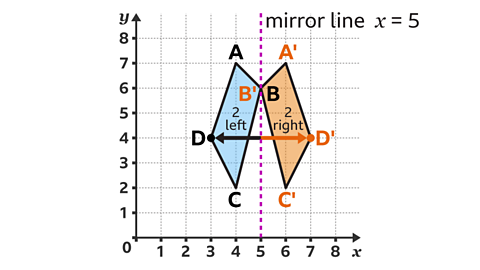
Quadrilateral ABCD is reflected in the vertical line \(x\) = 5. What are the co-ordinates for the reflection of vertex D?

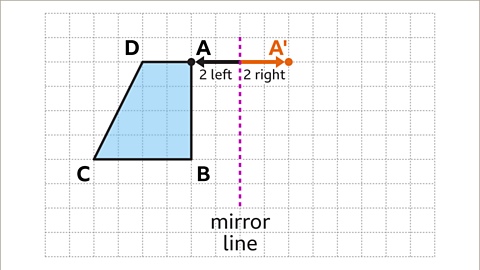
Vertex D, at (3, 4), is two squares left of the mirror line.
The corresponding vertex D' is two squares right of the mirror line.
Vertex D' has the co-ordinates (7, 4).
Reflecting in diagonal lines
To reflect a shape in a diagonal line, a small adjustment to the method needs to be made. Since the mirror line is a diagonal, the perpendicular distance is also diagonal.
To reflect a shape on a diagonal line:
Pick a vertex on the object shape.
Work out the perpendicular distance to the mirror line. This is done by drawing a line from the vertex which passes through the diagonal of each square on the grid until the mirror line is reached.
Count the same perpendicular distance from the mirror line to the opposite side of the mirror line. This will be the position of the reflected vertex.
Repeat the process for additional vertices.
Examples
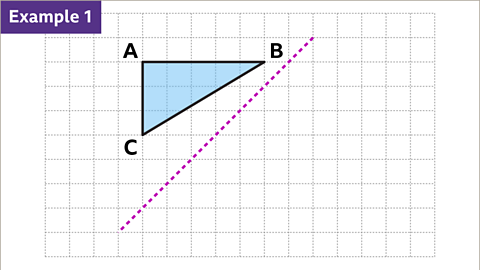
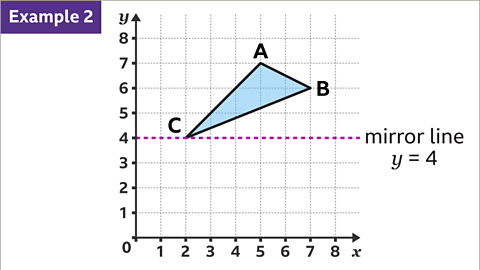
Image caption, Reflect triangle ABC in the diagonal mirror line.
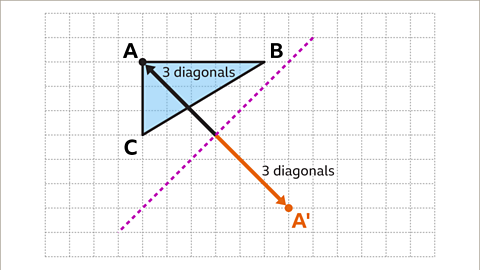
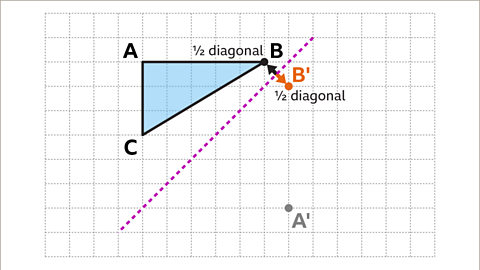
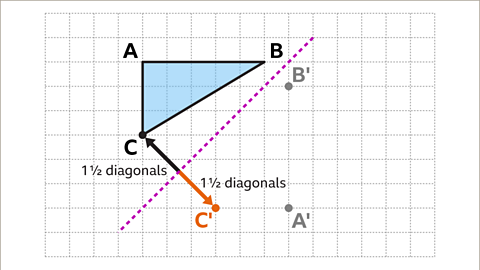
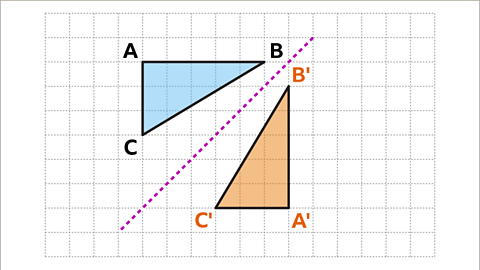
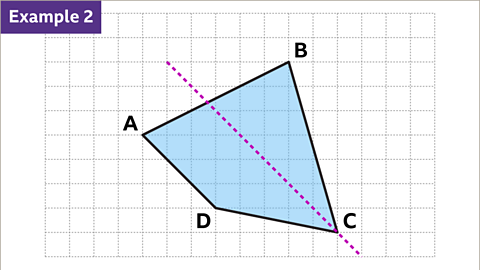
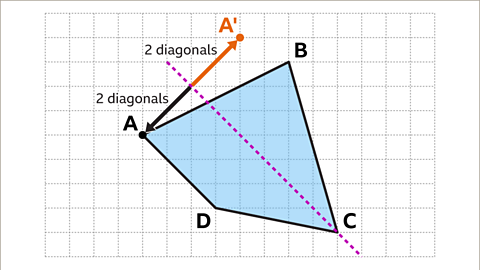
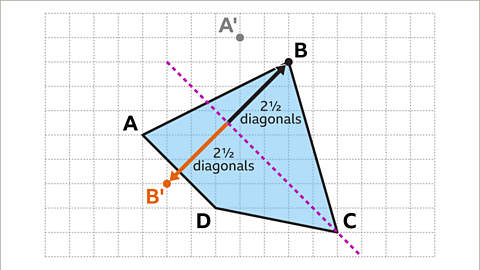
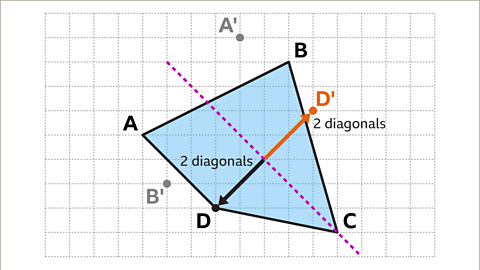
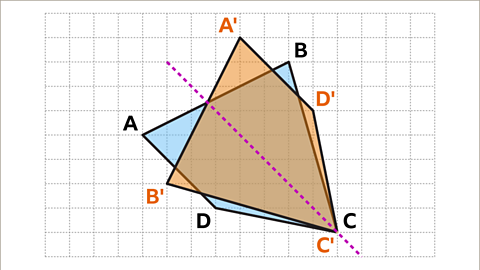
1 of 10
Question
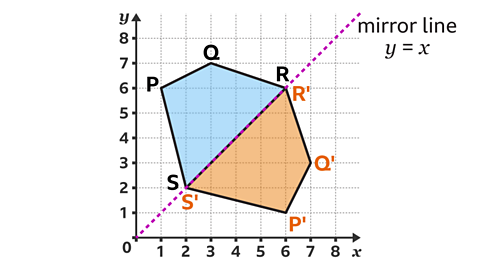
Shape PQRS is reflected in the diagonal line, \(y\) = \(x\). In the reflected image, which coordinates would be invariant?
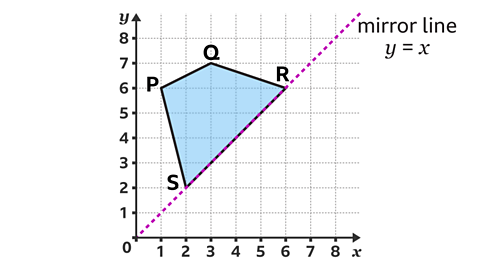
If a vertex is on the mirror line, it will be invariant under the reflection.
Vertices R (6, 6) and S (2, 2) are on the mirror line. Therefore, under the reflection they would be invariant.
Practise reflecting shapes
Quiz
Practise reflecting shapes with this quiz. You may need a pen and paper to help you work out your answers.
Real-life maths
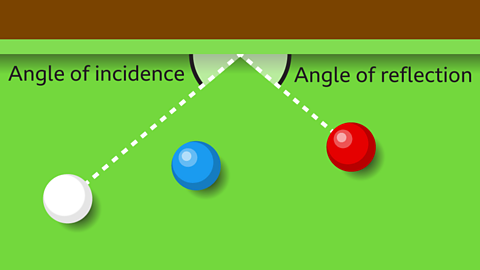
In the game of snooker, a player may choose to bounce the cue ball off the edge of the table (cushion) to strike the ball they need to hit.
The The path a moving object takes. of the ball after it hits the cushion is a reflection. The angle of incidence is equal to the angle of reflection.
Play Sudoku with BBC Bitesize!
Every weekday we release brand new easy, medium and hard Sudoku puzzles. Perfect for testing your skill with numbers and logic.

More on Symmetry and transformations
Find out more by working through a topic
- count6 of 6
- count1 of 6
- count2 of 6
- count3 of 6