Key points
An A transformation of a shape which results in a shape increasing or decreasing in size. is a type of A change in position or size, transformations include translations, reflections, rotations and enlargements..
An enlargement increases or decreases the size of the shape (The starting shape prior to a transformation.). The new shape (The resultant position of a shape after a transformation.) is a similar shape.
The increase in size from one shape to another is called a The ratio between corresponding sides in an enlargement..
The position of the enlarged shape is determined by a point called the A point which defines the position of an enlarged shape..
- If a The point at which two or more lines intersect (cross or overlap). The corner of a shape. The plural form is vertices. and the centre of enlargement share the same point, that point will be A vertex or line segment that does not change after a transformation. under the enlargement.
When enlarging shapes, a good understanding of similar shapes and naming and plotting coordinates can be helpful.
Scale factors
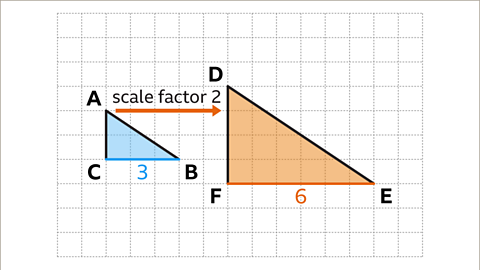
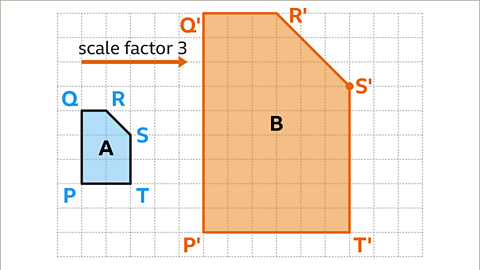
When a shape is enlarged, the length of each side is multiplied by the same value. This value is called the For two similar geometric figures, the ratio of corresponding edge lengths..
For example, to enlarge a shape with the scale factor of two, the length of all sides would be multiplied by two. Since the new shape is similar, all of the angles would be the same size.
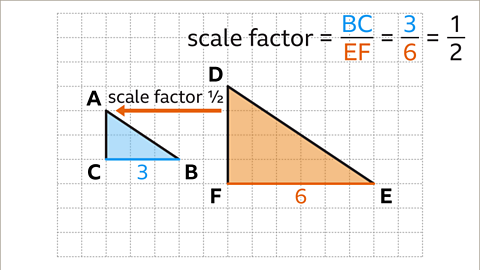
A scale factor greater than one produces a larger shape. A scale factor between zero and one results in a smaller shape.
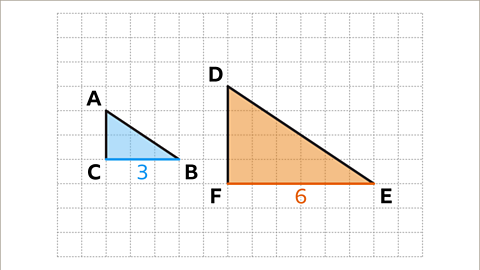
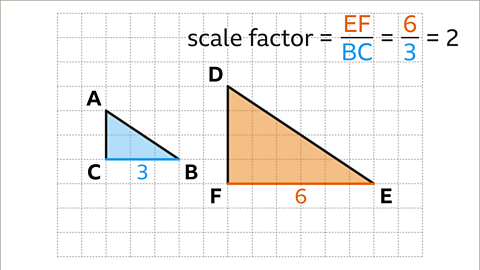
When given two shapes, a scale factor can be worked out by dividing corresponding sides.
Examples
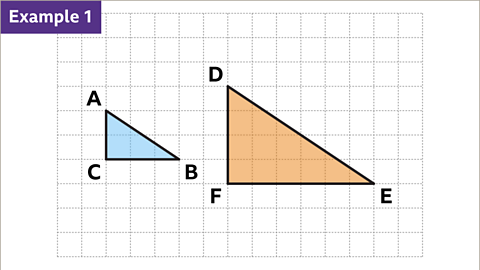
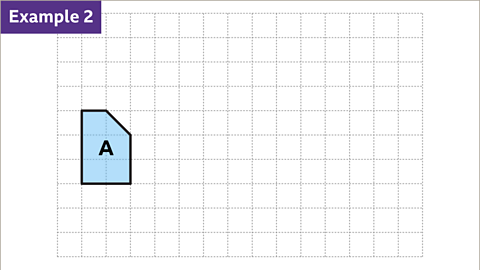
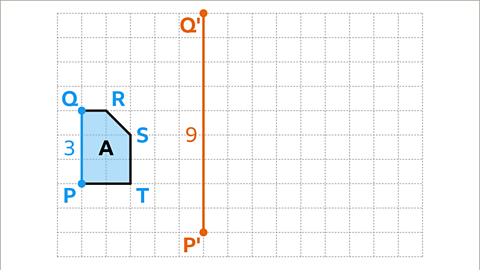
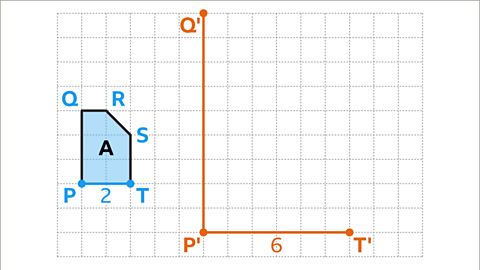
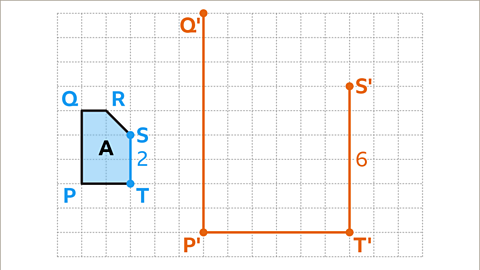
Image caption, Triangle DEF is an enlargement of triangle ABC.
1 of 10
Question
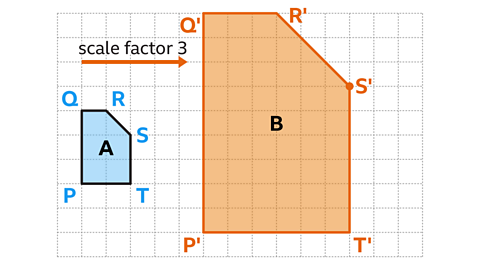
Shape D is an enlargement of shape C. What is the scale factor that takes shape C to shape D?
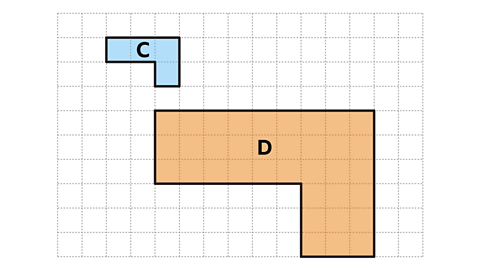
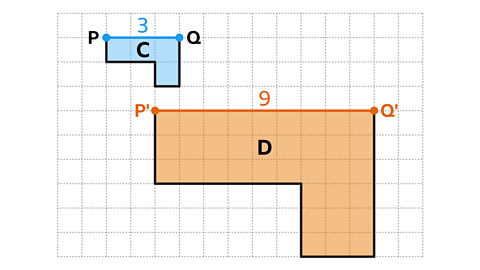
- The scale factor can be calculated by dividing a pair of corresponding sides.
- Using the horizontal line segment labelled PQ in shape C, PQ has length three squares. The corresponding line segment P'Q' in shape D is nine squares long.
- Scale factor = \( \frac{PQ}{P'Q'} \) = \( \frac{9}{3} \) = 3
- Shape D is an enlargement of shape C by a scale factor of three.
Enlarging by an integer scale factor
Enlarging by a positive Integers are numbers with no fraction or decimal part. They can be positive, negative or zero. 42, 8, and 10000 are examples of integers. scale factor increases the size of the shape. When using a centre of enlargement, the final position of the new shape can be determined.
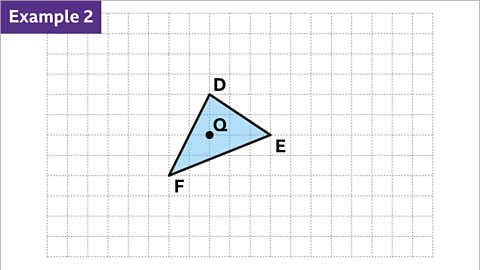
To work out the position of the image after an enlargement:
- Pick a The point at which two or more lines intersect (cross or overlap). The corner of a shape. The plural form is vertices. on the shape (object).
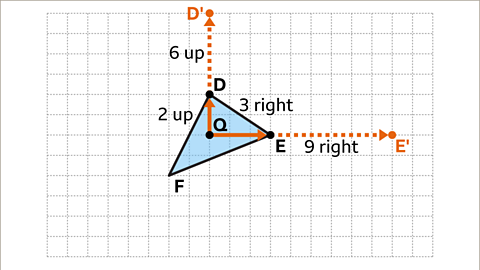
- Count the distance between the centre of enlargement and the vertex. This can be broken down into The right-left direction on a graph or map. Parallel to the horizon. and A line that is perpendicular to the horizon.A change in position of a shape..
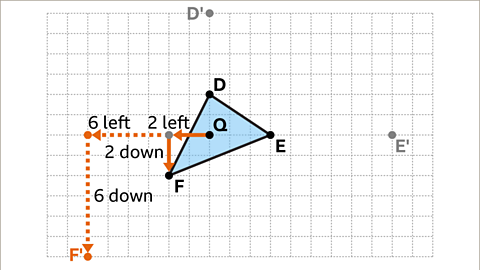
- Multiply these displacements by the scale factor.
- Using these values, count from the centre of enlargement to find the position of the corresponding vertex.
- Repeat the process for additional vertices.
The answer can be checked by drawing lines through corresponding points on the object and image. These will meet at the centre of enlargement.
Examples
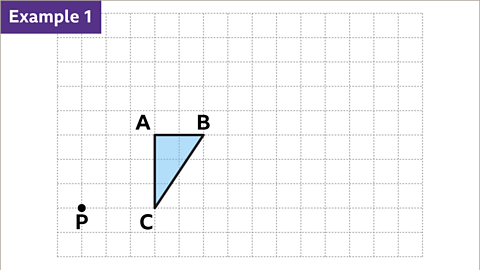
Image caption, Triangle ABC is to be enlarged by a scale factor of two, using point P as the centre of enlargement.
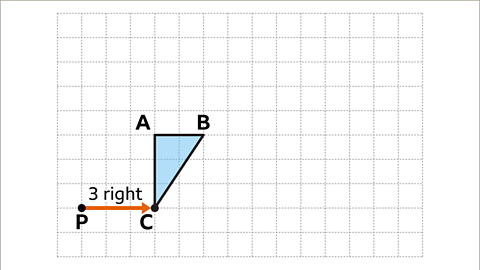
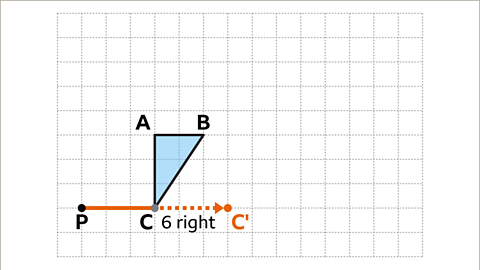
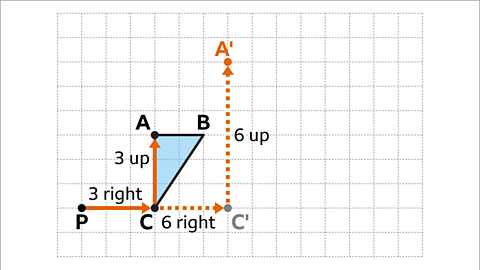
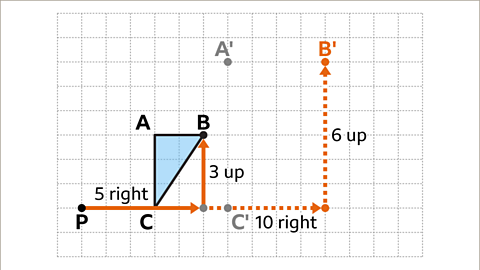
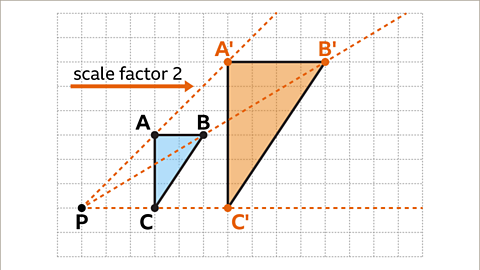

1 of 10
Question
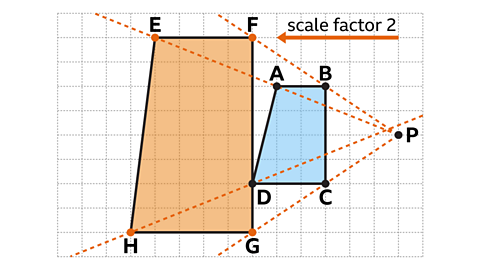
Shape EFGH is an enlargement of shape ABCD. It has been enlarged using a scale factor of two, with point P as the centre of enlargement.
One vertex on the enlarged shape EFGH is in the wrong position. Which is the incorrect vertex?
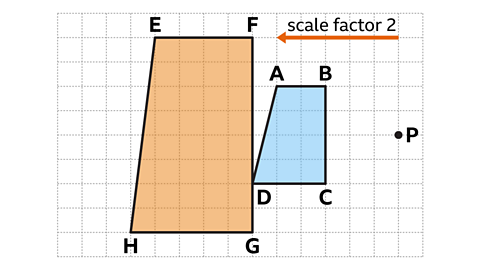
- Vertex H is the incorrect vertex
- The answer can be checked by drawing dashed lines through pairs of corresponding points.
- These lines should all meet at the centre of enlargement, point P.
- The line through H and D does not intersect with P, so vertex H is incorrect.
- This could also be checked using the scale factor of two. In the enlarged shape, GH should be double the length of CD.
GH = CD × 2
GH = 3 × 2
GH = 6
- Line segment GH is only five squares long. The correct position for H is one square further to the left.
Enlarging by a fractional scale factor
Enlarging by a A scale factor larger than zero but smaller than one. decreases the size of the shape.
To enlarge a shape by a fractional scale factor, the same method as enlarging by an integer scale factor can be used.
Multiplying the displacements by a fraction will result in a smaller distance between the centre of enlargement and a corresponding vertex.
Examples

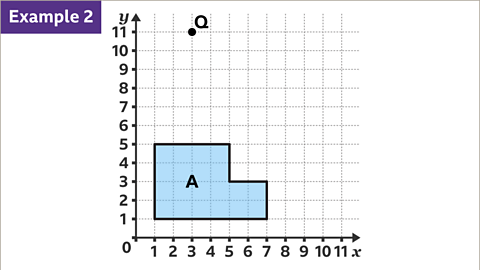
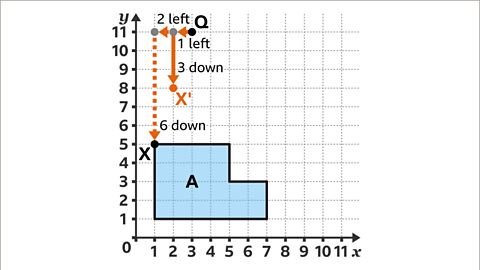
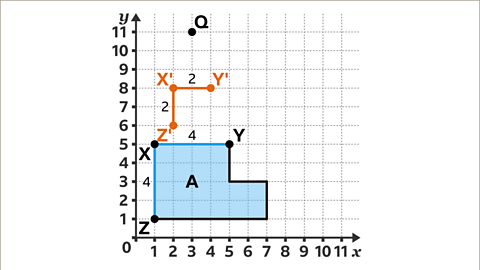
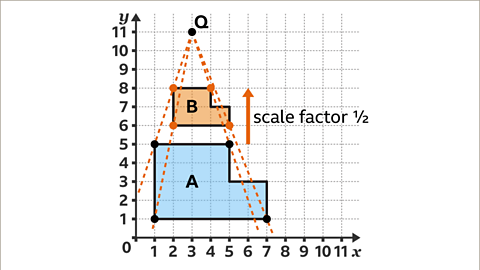
Image caption, Shapes can be enlarged on sets of axes. Enlarge triangle ABC by a scale factor ⅓. Use point P with the coordinates of (1, 10) as the centre of enlargement.
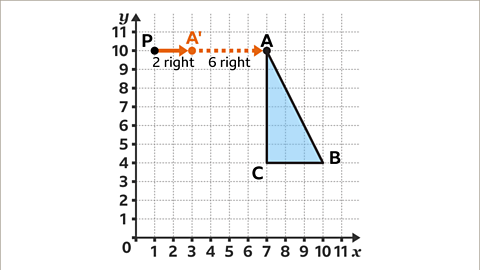
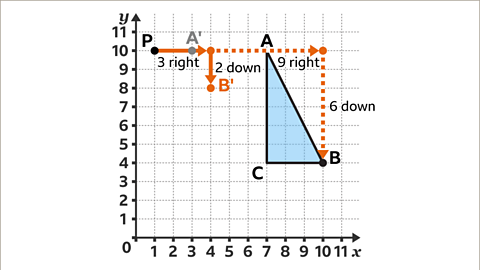
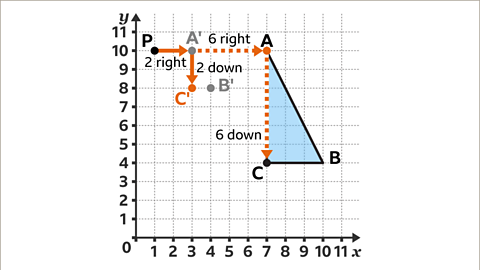

1 of 9
Question
Triangle PQR is to be enlarged by a scale factor \( \frac{1}{2} \), with point Z as the centre of enlargement and with the coordinates (1, 2).
What is the new coordinate of vertex Q in the enlargement?
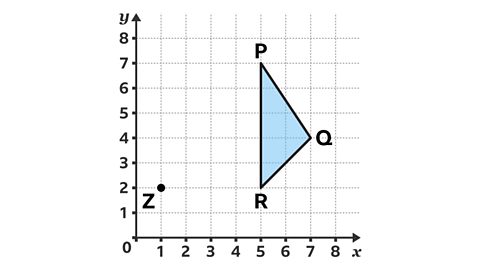
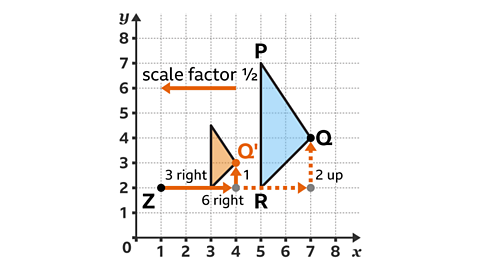
Vertex Q is six squares to the right and two squares above the centre of enlargement.
Multiply this displacement by the scale factor of a \( \frac{1}{2} \)6 × \( \frac{1}{2} \) = 3 and 2 × \( \frac{1}{2} \) = 1The corresponding point Q' needs to be three squares to the right and one square above the centre of enlargement.
Vertex Q' has the coordinates (4, 3).
Practise enlarging shapes
Quiz
Practise enlarging shapes with this quiz. You may need a pen and paper to help you with your answers.
Real-life maths

A professional photographer can produce photos of different sizes. The most common photo size is approximately 4 inches by 6 inches. The length is 1.5 times longer than the width.
Photographs can be enlarged to produce bigger images, such as those that may be used in newspapers or magazines.
Play Sudoku with BBC Bitesize!
Every weekday we release brand new easy, medium and hard Sudoku puzzles. Perfect for testing your skill with numbers and logic.

More on Symmetry and transformations
Find out more by working through a topic
- count1 of 6
- count2 of 6
- count3 of 6
- count4 of 6