Key points
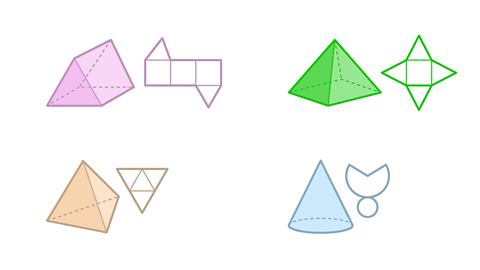
- A Three-dimensions, length, width, and height. shape can be made from a Two-dimensions, length, and width. shape called a A group of joined 2D shapes which fold to form a 3D shape..
- The two-dimensional shapes that form a net can be arranged in different ways for a particular 3D shape. The relationship of faces, The point where two lines meet is called the vertex. In a 3D shape this is the corner point. and edges must remain the same. There are eleven different nets that will form a cube.
- An A pattern of lines or dots arranged at regular intervals and angles of 60°. A useful background for drawing three dimensional (3D) objects. is used as a guide for drawing a 3D shape on paper.
Video
Watch the video to learn how 3D shapes, such as a cube, can be created from nets, an arrangement of 2D shapes.
Let's talk about nets. More specifically, mathematical nets.
A net in maths is a flat 2D shape that can be cut out and folded to form the 3D shape. Put another way, a net is a plane figure composed of polygons, that by folding and joining can form a polyhedron.
A net will always be made up of the same number of connected 2D shapes as there are faces on the 3D shape, excluding folding flaps of course.
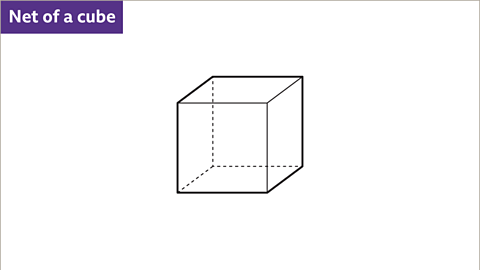
For example, this cube net becomes this die. Or this cuboid net could become this shipping container.
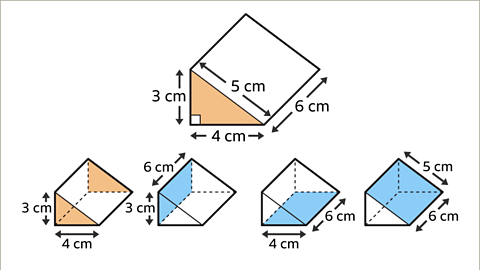
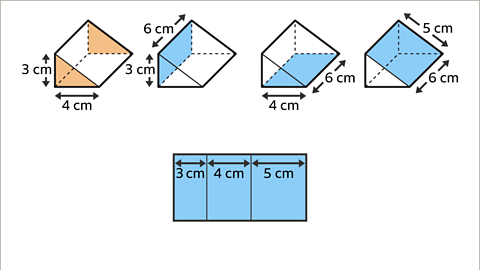
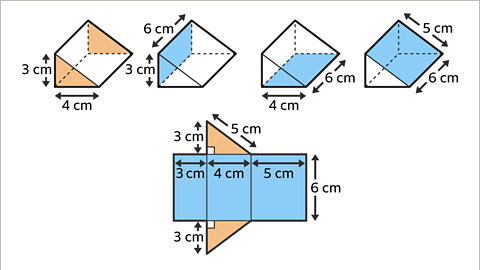
The net of a triangular prism will be made of three rectangles and two triangles - a bit like a tent.
And the net of these pyramids will become, well, The Pyramids!
How to draw the net of a cube and a cuboid
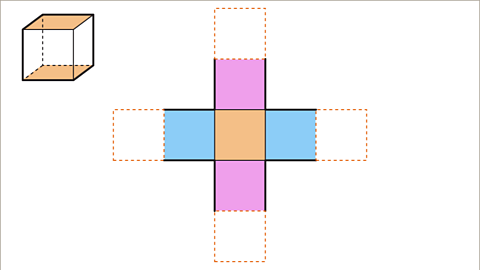
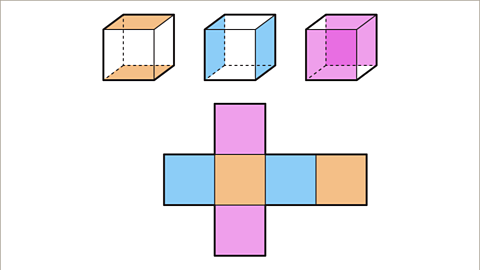
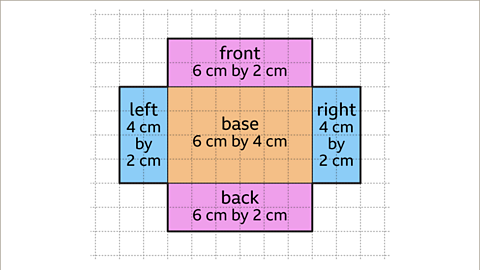
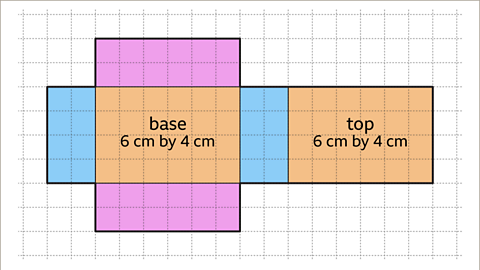
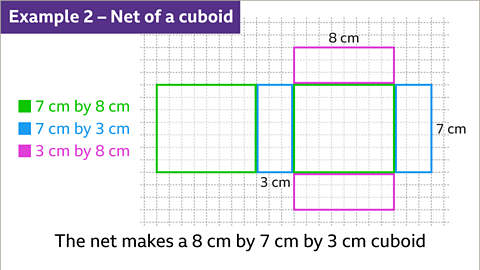
To draw a net of a A 3D shape with six square faces. or a A 3D shape with six rectangular faces. The opposite faces are congruent., imagine the Three-dimensions: length, width and height. shape is being unfolded. Each face is a A quadrilateral with opposite pairs of sides that are both equal in length and parallel. All four angles are right angles. or square.
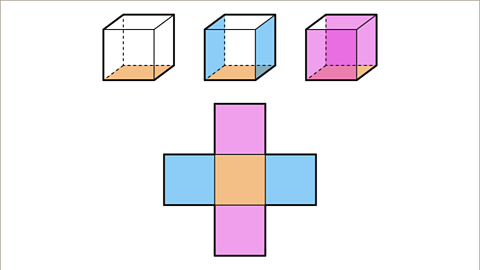
Draw the The face that the shape rests on. , which has the same dimensions as the top face.
Draw the faces that are attached to the base face.
Draw the top face attached to an edge of the front or back, or left or right face.
The top face must not touch the base face at all (edge or vertex). The top and base faces do not touch on the 3D shape, this is also true on the net.
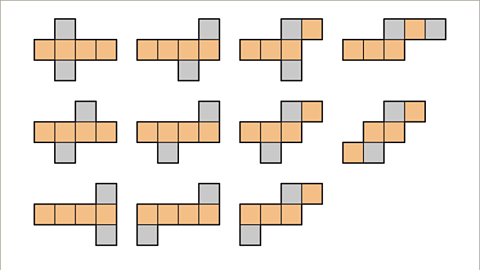
The net of a cube is called a hexomino. Hex is a prefix in Greek meaning 'six'. The net is made up of six congruent squares joined together along their edges. There are eleven different ways of arranging the square for a correct net of a cube.
Examples
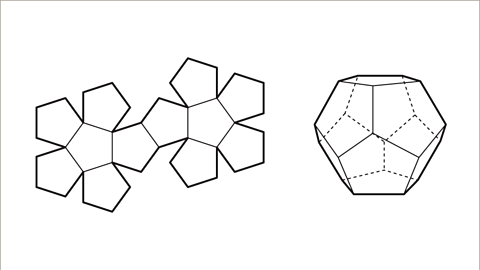
Image caption, A net is a 2D shape that folds to make up a 3D shape. The net of a dodecahedron (a platonic solid with twelve pentagonal faces) is made up of 12 regular pentagons.
1 of 10
How to draw the nets of a prism and a pyramid
To draw the net of a triangular A 3D shape with a constant polygon cross-section.:
- The net is made up of three rectangles and two triangles.
- For a The face that results from slicing through a solid shape. that is an equilateral triangle, the rectangles are Shapes that are the same shape and size, they are identical..
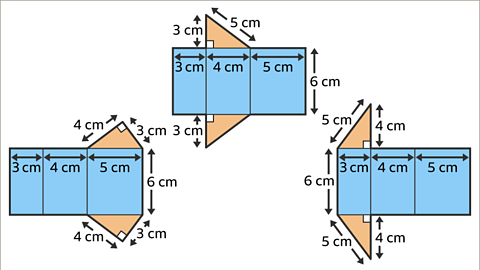
- For a cross-section that is an Two sides are equal in length. Two angles are the same size., two of the rectangles are congruent.
- For a cross-section that is a Each side is a different length. Each angle is a different size., the rectangles are all different.
- The rectangles are drawn next to each other, joined along the dimension that is the length of the prism.
- A triangle is drawn at each end of one of the rectangles, making sure that when folded the edge lengths match exactly.
To draw the net of a prism with a regular A 2D shape with three or more edges and vertices. cross-section:
- The net is made up of congruent rectangles and two polygon ends.
- The number of rectangles is equal to the number of sides of the polygon. One dimension of a rectangle is the length of the prism, the other is the side-length of the polygon cross-section.
- The rectangles are drawn next to each other, joined along the dimension that is the length of the prism.
- The polygon is drawn at each end of one of the rectangles.
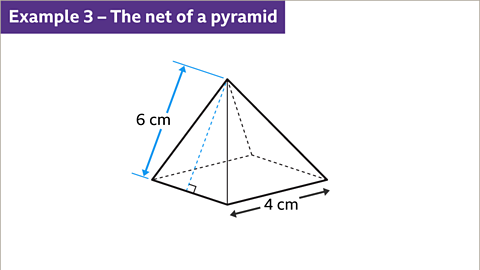
To draw the net of a A 3D shape with a polygon-shaped base and a pointed apex. Named by the shape of its base, such as square-based or hexagon-based.:
- The net is made up of the base polygon and congruent isosceles triangles attached to each side of the base.
- The measurements given are the side-length of the polygon and the height of each triangle. The height of the triangle is the On a pyramid the height of an isosceles triangle face, the distance from the apex to the midpoint of the base. of the pyramid.
- Draw the base shape.
- On each side of the base draw an isosceles triangle.
Examples
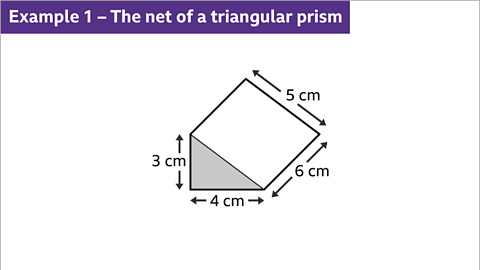
Image caption, Draw the net of a triangular prism.
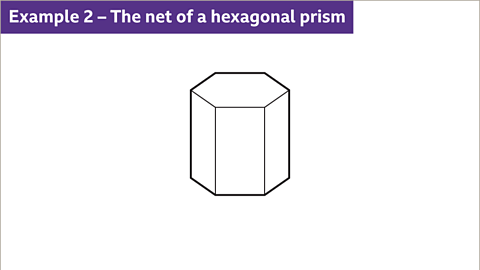
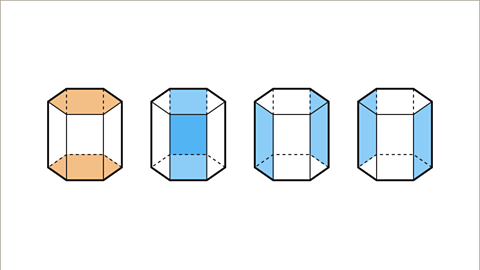
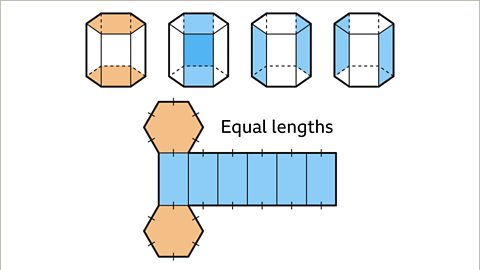
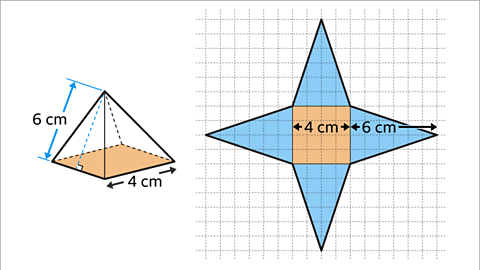
1 of 10
Question
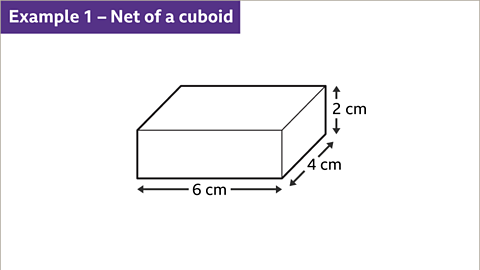
A cuboid is drawn on isometric paper. What are the dimensions of the cuboid?
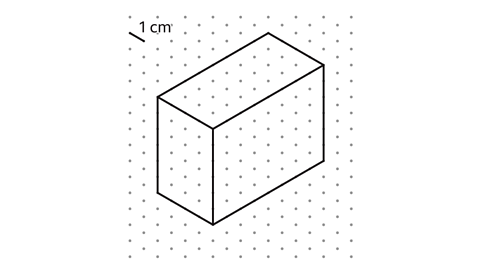
Each oblique line down from left to right is 4 cm long.
Each oblique line up from left to right is 8 cm long.
Each vertical line is 6 cm long.
The dimensions of the cuboid are 4 cm, 8 cm and 6 cm.
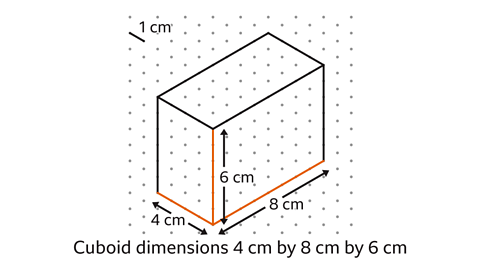
How to draw a 2D representation of a 3D shape
A 3D shape may be drawn on plain paper as a sketch or on an A pattern of lines or dots arranged at regular intervals and angles of 60°. A useful background for drawing three dimensional (3D) objects..
To draw any 3D shape with a constant The face that results from slicing through a solid shape. on plain paper:
- Use faint lines when drawing, so that they can be made heavier or lighter as needed when complete.
- Draw the shape of the cross-section.
- Draw the same shape higher and to the right of the original shape.
- Join the corresponding vertices.
- For a solid 3D shape, rub out the edges that would be hidden from view.
- For a skeleton 3D shape, make the hidden edges dotted lines.
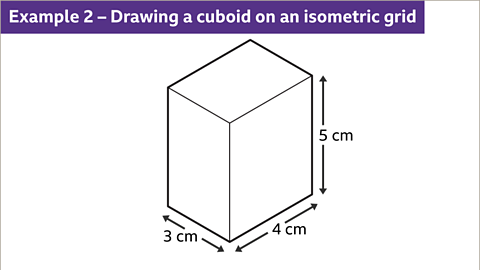
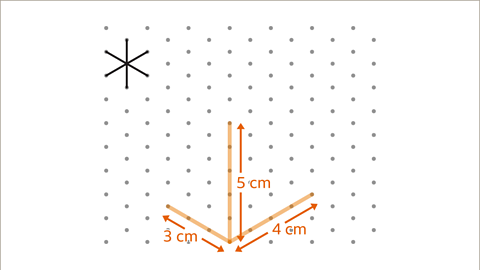
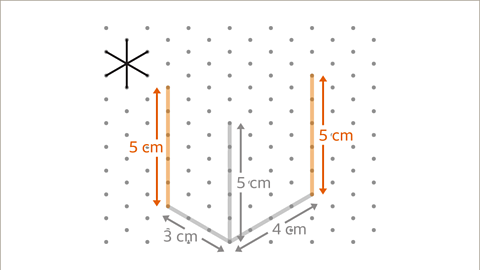
To draw a A 3D shape with six rectangular faces. The opposite faces are congruent. on an isometric grid:
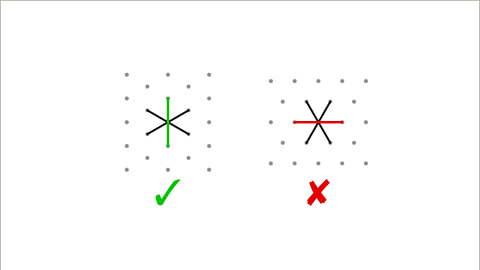
- First make sure the paper is the right way round. The correct orientation is when the longest line is vertical.
- Pick a dot, draw a vertical line for the height of the cuboid and draw A line that is slanted, neither horizontal nor vertical. to the left and up, and to the right and up for the dimensions of the base of the cuboid.
- Draw vertical lines at the ends of the oblique lines.
- Draw the top face of the cuboid with two pairs of parallel lines.
Examples
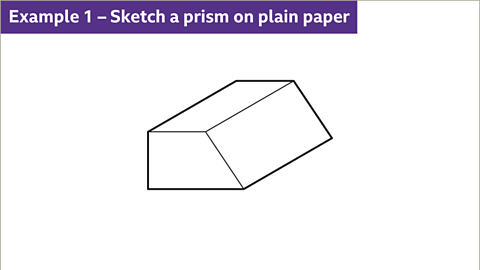
Image caption, Sketch a prism on plain paper.
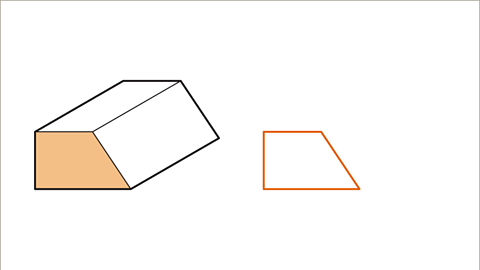
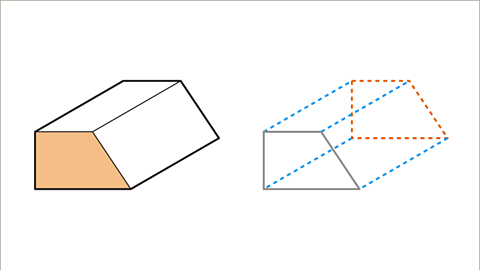
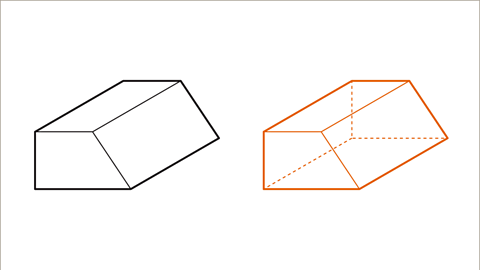
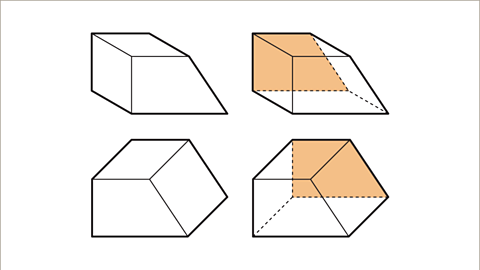
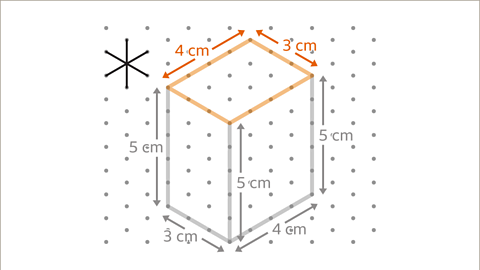
1 of 10
Question
On plain paper draw a copy of this 3D shape.
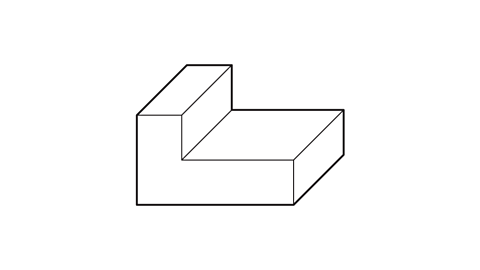
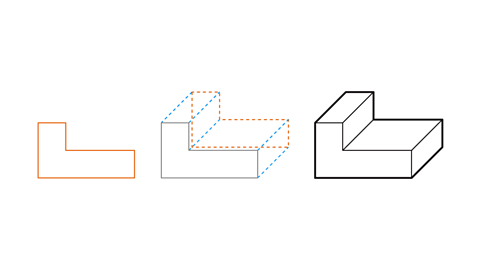
To draw the 3D shape:
Draw the front face of the 3D shape (this is an L-shape).
Draw a copy of the front face, up and to the right of the original.
Join corresponding vertices with straight lines.
Rub out the hidden line. The shape is complete.
Practise your understanding of 3D shapes and nets
Quiz
Practise applying your knowledge of 3D shapes and nets with this quiz. You may need a pen and paper to help you with your answers.
Real-life maths
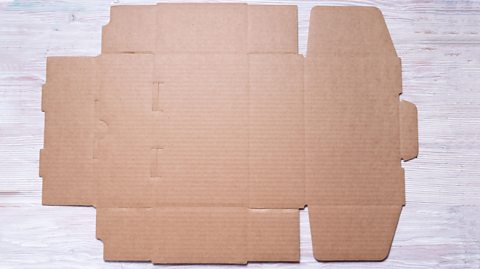
Nets can be used in any organisation that packs goods. Flat cardboard is punched with nets that include flaps for fixing or with additional flaps for folding up into boxes.
The machinery used will punch out the net and fold it up into the box or container ready to be filled.
The design of the net is such that card waste is kept to a minimum and the fixing together of the net is straight forward. Some machines will staple the boxes, others will tape and others will fold without any other fixing.
Play Sudoku with BBC Bitesize!
Every weekday we release brand new easy, medium and hard Sudoku puzzles. Perfect for testing your skill with numbers and logic.

More on Shapes
Find out more by working through a topic
- count1 of 4
- count2 of 4
- count3 of 4

