Key points
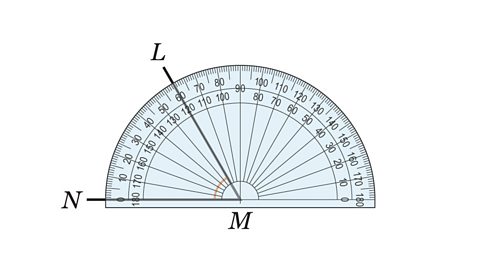
An angle is the amount of turn between two lines. Angles are measured in degrees with the symbol °.
Angles can be sorted into types depending on how big they are: An angle less than 90°., An angle of 90°., An angle between 90° and 180°., An angle of 180° that forms a straight line. and An angle between 180° and 360°..
Angles can be labelled with 3 letters (eg DEF) to show which angle is being referred to. The middle letter is where the angle is, while the other two letters show which lines enclose the angle.
When measuring or drawing angles, count from zero on the A semi-circular (or sometimes circular) tool used to measure angles.. This could mean following the inside row or the outside row of numbers, depending on the position of the angle.
Types of angle and estimating angles
Angles are based on parts of a full turn, which is 360°.
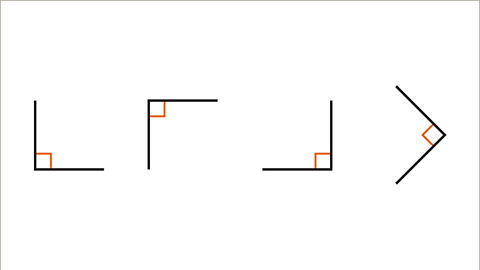
A quarter turn is 90° and is called a right angle.
A half turn is 180° and is known as a straight angle (or angle on a straight line).
A three-quarter turn is 270°.
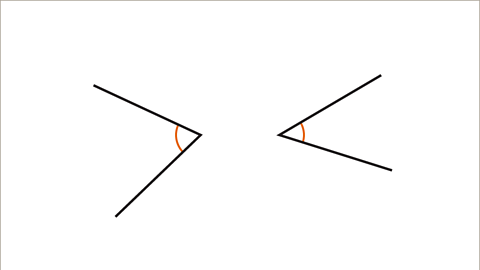
- An acute angle is less than 90°.
- An obtuse angle is between 90° and 180°.
- A reflex angle is between 180° and 360°.
The size of an angle can be To guess roughly or give an approximate value. without using a protractor. To do this, the type of angle should be considered.
Example
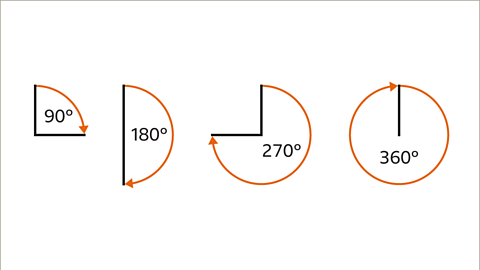
Image caption, The four angles that are used most often are those based on quarter turns.
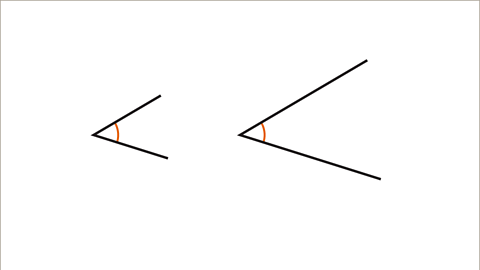
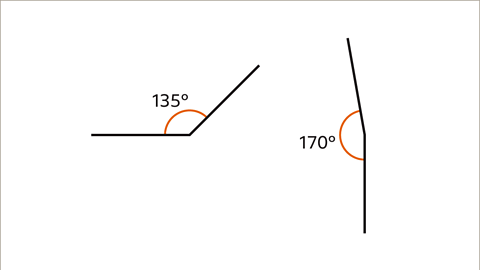
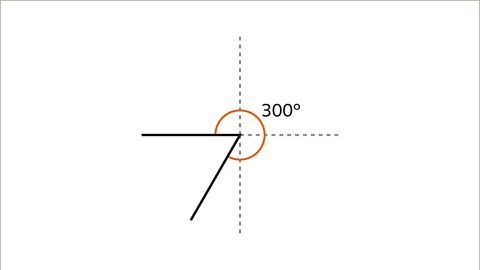
1 of 6
Question
For each example, name the type of angle and estimate its size (to the nearest 10°).
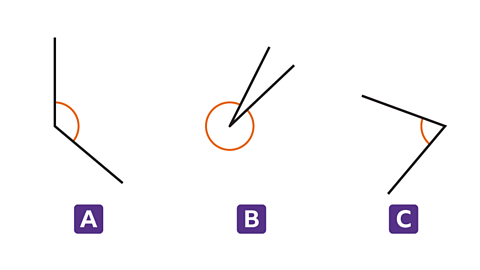
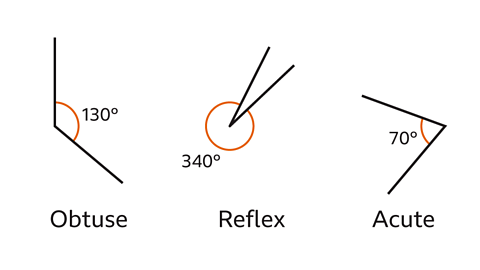
Angle A is obtuse. Obtuse angles are between 90° and 180°. A good estimate for this angle is 130° because it is around halfway between 90° and 180°.
Angle B is a reflex angle. Reflex angles are greater than 180°. A good estimate for this angle is 340° because it is almost a full turn.
Angle C is an acute angle. Acute angles are less than 90°. A good estimate for this angle is 70° because it is almost 90°.
Any estimate that is 10° away from the true measurement is still a very good estimate.
Naming and measuring angles
When there are lots of lines on a diagram, it is handy to use letters to make it clear which angle is being talked about.
Angle CAB would be the angle made when travelling from point C to point A to point B.
A protractor is used to measure angles.
To measure an acute or obtuse angle, follow these steps:
Place the cross on the protractor over the vertex (corner) of the angle.
Place the bottom line on the protractor along one of the lines of the angle. There will be a zero on the line.
Check whether the zero is on the inside row (closer to the centre of the protractor) or the outside row (closer to the edge of the protractor).
Follow the numbers from zero around the protractor to read off the angle measurement. The angle could be measured in a Travelling in the same direction as the hands on a clock. or Travelling in the opposite direction to the hands on a clock. direction depending on which row is being followed.
To measure a reflex angle, measure the acute or obtuse angle instead and subtract this from 360°.
Examples
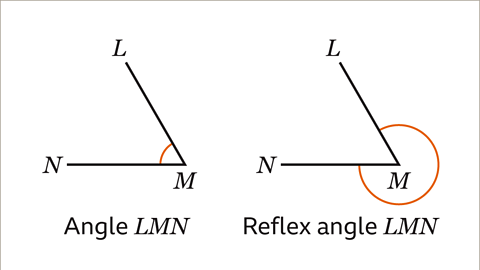
Image caption, Angle LMN is shown on the left. If the reflex angle LMN is needed instead, it will be labelled specifically as ‘reflex angle LMN’, like the picture on the right-hand side.
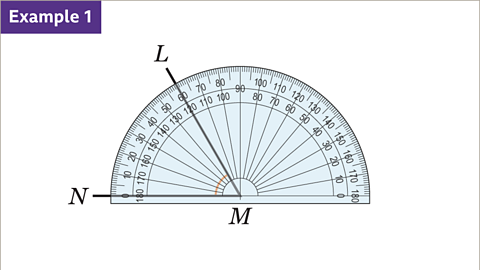
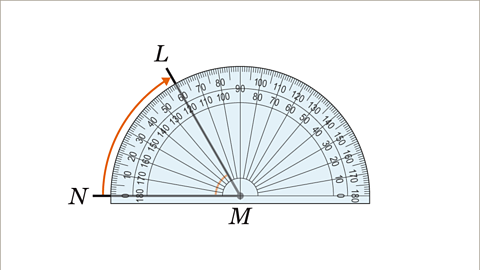
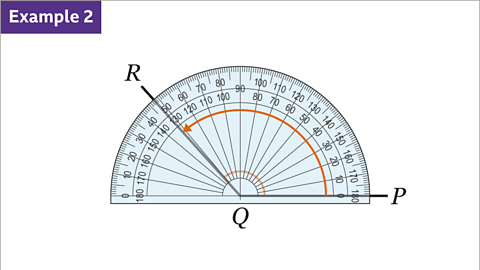
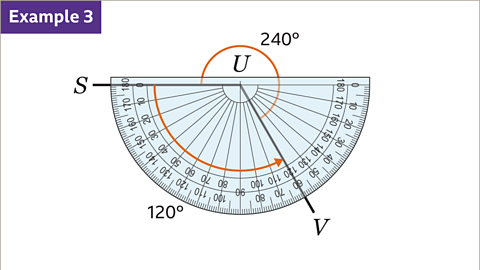
1 of 5
Questions
Question 1:
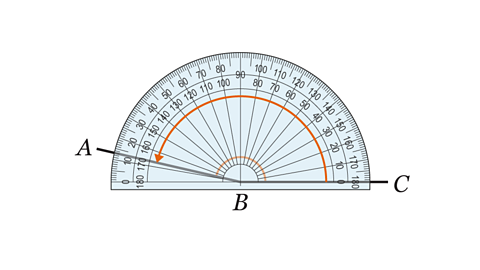
Measure the angle ABC.
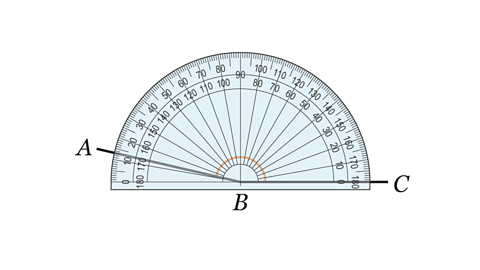
The angle is 167°.
Measure anti-clockwise from zero, using the inside row of numbers.
Question 2:
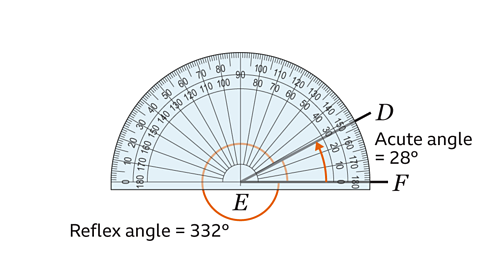
Measure the reflex angle DEF.
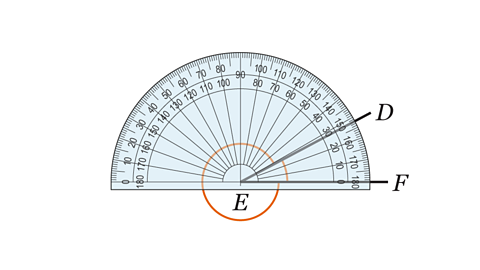
To measure the reflex angle DEF, it is easier to measure the acute angle DEF anti-clockwise from line EF.
This is 28°.
Then, subtract this angle from 360° to find the reflex angle.
360° \(-\) 28° = 332°.
The reflex angle is 332°.
Drawing angles
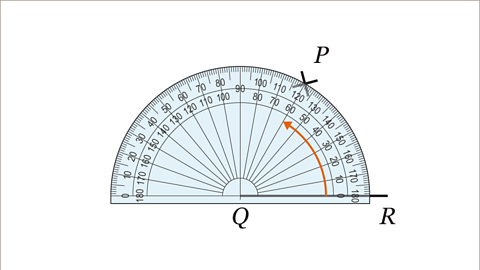
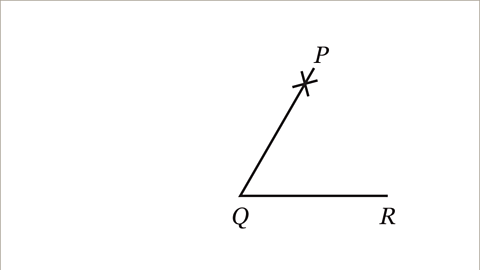
To draw an acute or obtuse angle, for example PQR = 60°, follow these steps:
Draw the line QR.
Place the cross on the protractor on the point Q, and the bottom line over the line QR.
Use the protractor to measure 60° from the zero line, and make a mark at 60°. This is point P.
Draw a line from the mark to point Q.
Protractors usually stop at 180°, which means reflex angles cannot be drawn by just following this method.
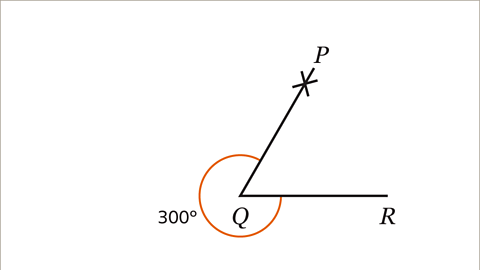
To draw a reflex angle, for example PQR = 300°, calculate what the acute angle PQR would be instead.
The acute angle is 360° \(-\) 300° = 60°.
Then, follow the same steps as above to draw an angle of PQR = 60°, then label the reflex angle as 300°.
Example
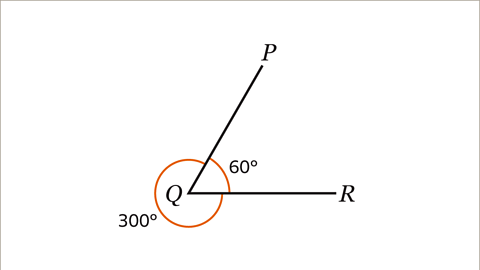
Image caption, To draw a reflex angle such as PQR = 300°, it is easier to draw the ‘other’ angle, then show the reflex angle as the angle required. The ‘other’ angle is found by subtracting 300° from 360°. 360° – 300° = 60°.

1 of 5
Practise drawing and measuring angles
Quiz
Practise drawing and measuring angles with this quiz. You may need a pen, paper, ruler and protractor to help you with your answers.
Real-life maths
When fitting solar panels, panels should be tilted at a certain angle to make sure they absorb as much energy from the sun’s rays as possible.
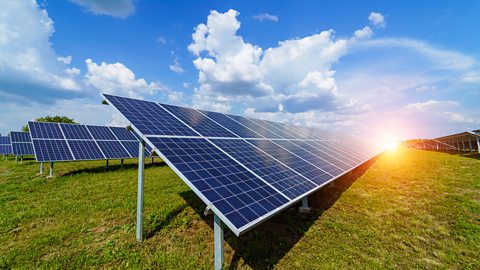
An angle of 0° would be flat to the ground, whereas a 90° angle would be upright.
The most effective tilt angle to be measured can vary and depends on where the solar panels are located in the world.
For example:
- London, UK - 35°
- Madrid, Spain - 30°
- Mexico City, Mexico - 20°
Revise for your exams with BBC Bitesize
Get ready for the GCSEs with quizzes, past papers, flashcards, podcasts and more resources!

More on Angles
Find out more by working through a topic
- count2 of 7
- count3 of 7
- count4 of 7
- count5 of 7

