Key points
Lines that cross each other are called Lines which meet at a point.. The point at which they cross is known as the The location where two or more lines meet..
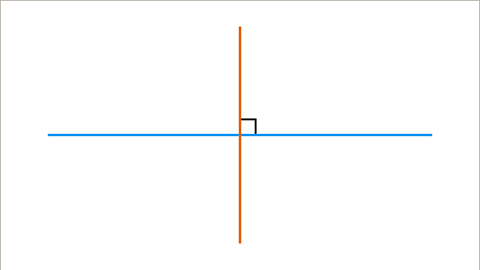
- If two lines meet at a An angle which measures exactly 90°. Right angles are represented by a small square., they are called Perpendicular lines are at 90° (right angles) to each other. lines.
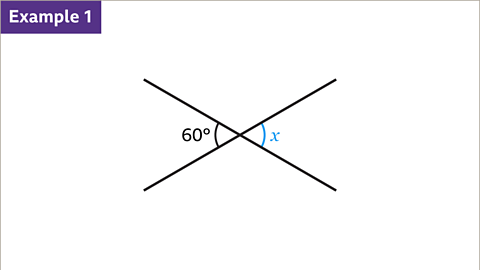
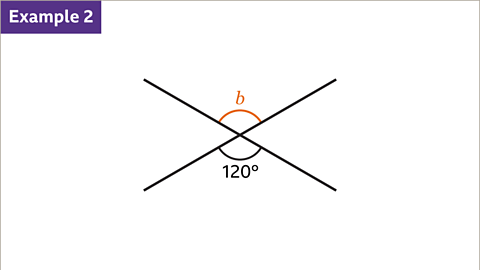
- At the point of intersection, the vertically opposite angles are equal.
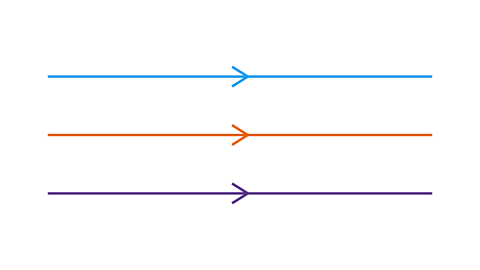
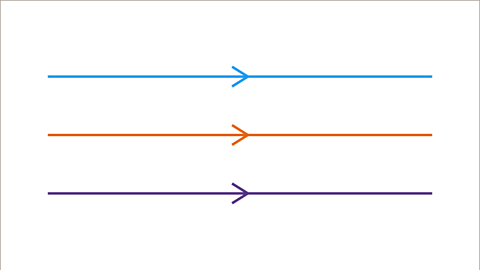
Straight lines that remain the same distance apart and never intersect are known as Lines which never meet and stay the same distance apart. Parallel lines are indicated by a pair of arrows..
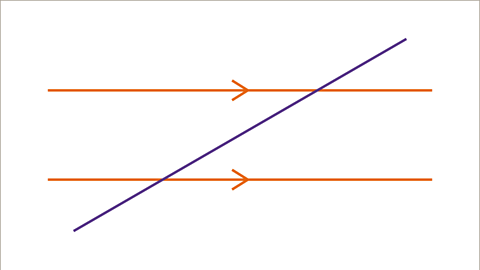
If a line passes through two or more parallel lines, it is known as a A line which crosses a set of parallel lines.. A transversal intersection forms various types of angles with the parallel lines:
- Angles on opposite sides of the transversal within the parallel lines. on parallel lines are always equal.
- Angles at the same position within each intersection. on parallel lines are always equal.
It is useful to remember that Two angles or sides that lie next to each other. angles on a straight line add up to 180° and that angles in a triangle add up to 180°.
Understanding intersecting and parallel lines
Two or more lines which cross at a point are referred to as Lines which meet at a point..
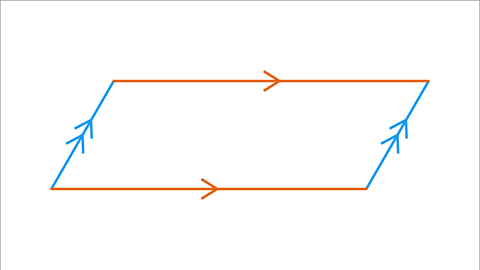
Two or more lines which remain the same distance apart and never touch are referred to as Lines which never meet and stay the same distance apart. Parallel lines are indicated by a pair of arrows..
Parallel lines are indicated by arrows going in the same direction.
If there is more than one set of parallel lines in a diagram, different numbers of arrows are used.
Examples
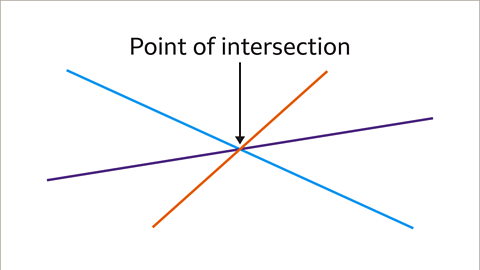
Image caption, The three lines in this image are intersecting. They intersect at a common point. This is called the point of intersection.
1 of 5
Question
How many pairs of parallel lines are shown in this diagram?
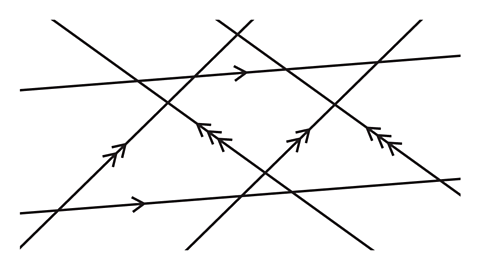
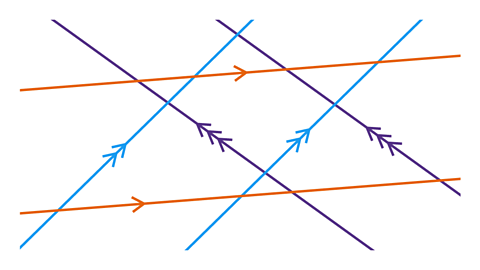
In this diagram there are three pairs of parallel lines.
Each pair has a different number of arrows.
Angles in intersecting lines
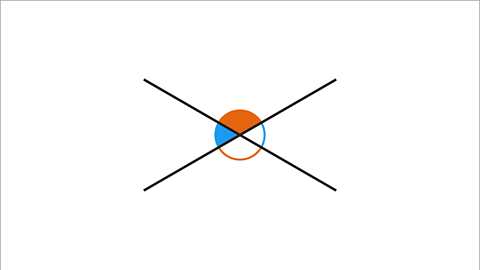
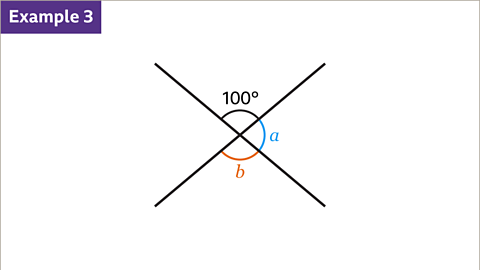
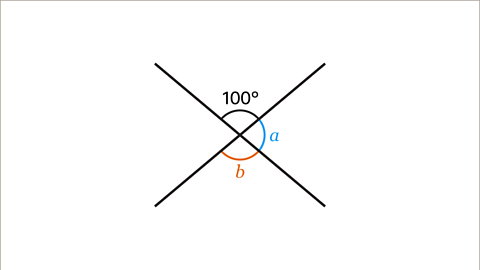
When two lines intersect, the opposite angles are equal.
The opposite angles that are found at the The location where two or more lines meet. are known as Opposite angles which are formed at the point of intersection of two lines..
Example
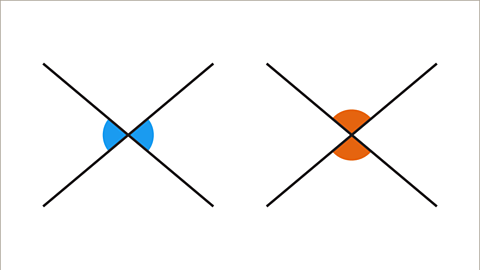
Image caption, In these pairs of intersecting lines, the opposite angles are equal. They are referred to as vertically opposite angles.
1 of 6
Question
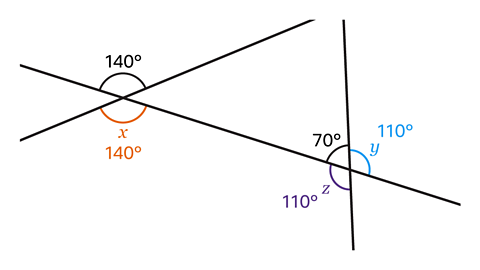
Work out the size of angles 𝒙, 𝒚 and 𝒛.
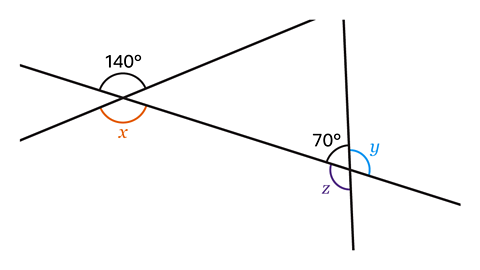
- Angle 𝒙 is vertically opposite 140°. Vertically opposite angles are equal, so angle 𝒙 = 140°.
- Angle 𝒚 and 70° are adjacent angles on a straight line. Adjacent angles on a straight line add up to 180°, so angle 𝒚 = 110°.
- Angle 𝒛 is vertically opposite angle 𝒚. Vertically opposite angles are equal, so angle 𝒛 = 110°.
Angles in parallel lines
When a A line which crosses a set of parallel lines. intersects a pair of parallel lines, the angles at both points of intersection are related. These angles can be found using different connections. One of these connections is Angles on opposite sides of the transversal within the parallel lines..
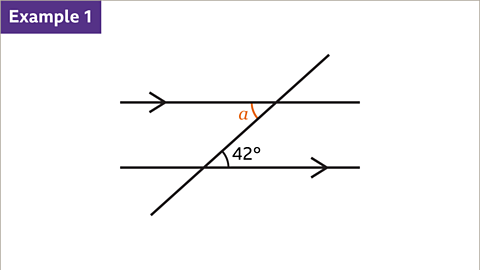
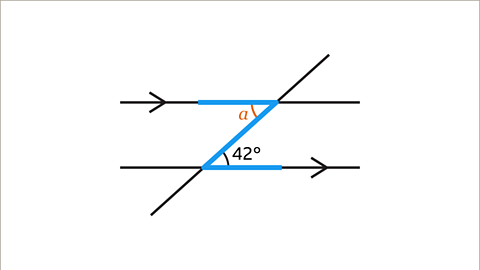
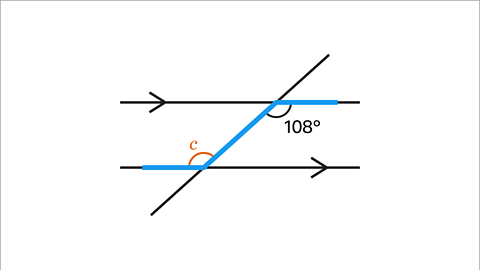
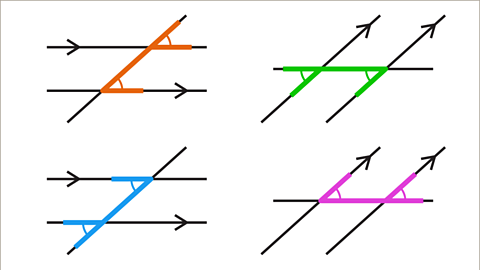
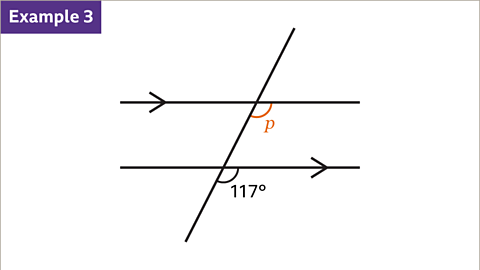
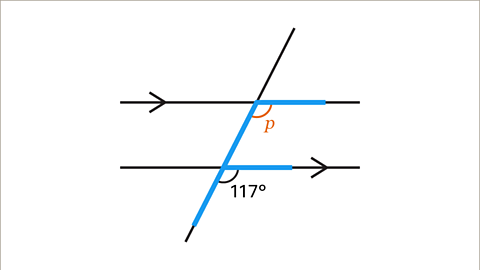
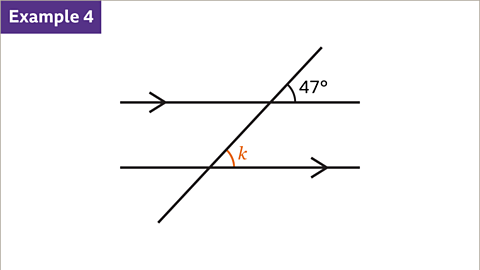
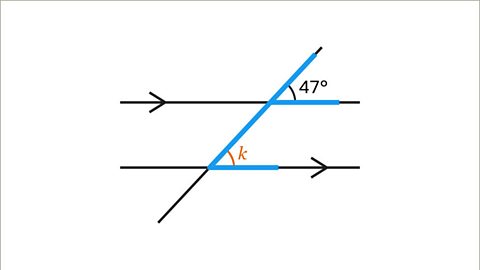
- Alternate angles are on opposite sides of the transversal within the parallel lines.
- Alternate angles are always equal in size.
- When looking for alternate angles, it can be helpful to look for a Z-shape.
- The Z-shape can be backwards, sideways or upside down.
Another of these connections is Angles at the same position within each intersection..
- Corresponding angles occur at the same position within each intersection.
- Corresponding angles are always equal in size.
- When looking for corresponding angles, it can be helpful to look for an F-shape.
- The F-shape can be backwards, sideways or upside down.
Examples
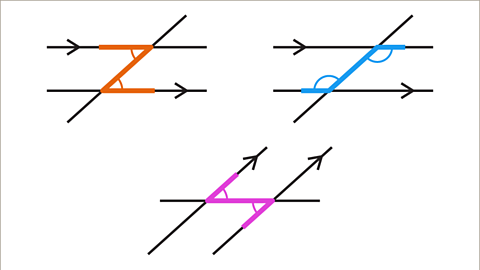
Image caption, These images all show alternate angles. The angles on opposite sides of the transversal within the parallel lines are always equal.

1 of 10
Questions
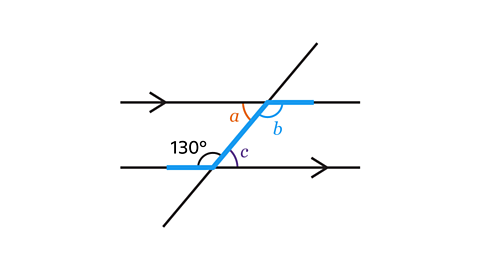
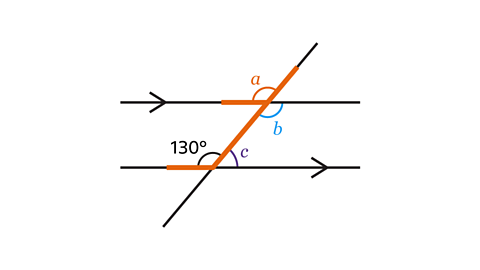
Question 1: Which angle is alternate to 130°?

- Angle 𝒃 and 130° are alternate angles.
- Remember to look for a Z-shape when spotting alternate angles.
Question 2: Which angle is corresponding to 130°?
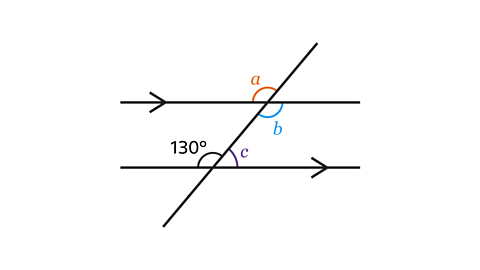
- Angle 𝒂 and 130° are corresponding angles.
- Remember to look for an F-shape when spotting corresponding angles.
Practise finding intersecting and parallel lines
Practise finding intersecting and parallel lines with this quiz. You may need a pen and paper to help you with your answers.
Quiz
Real-life maths
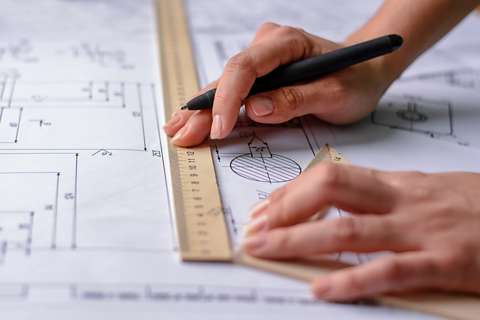
Angles in parallel lines are particularly useful in architecture.
Architects use angles in parallel lines to make sure buildings are stable. If the top and bottom of a building are parallel, the building should not topple. This can be checked by confirming that the corresponding, or alternate, angles at the top and bottom are equal.
Play Sudoku with BBC Bitesize!
Every weekday we release brand new easy, medium and hard Sudoku puzzles. Perfect for testing your skill with numbers and logic.

More on Angles
Find out more by working through a topic
- count4 of 7
- count5 of 7

- count6 of 7
- count7 of 7