Key points
A polygon is a closed 2D shape with at least three sides.
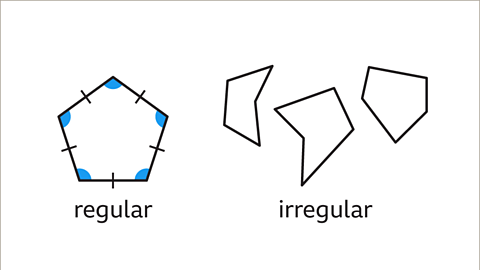
- A regular polygon is a polygon with all equal sides and angles.
- An irregular polygon is a polygon where this is not the case.
- Knowing the difference between regular and irregular polygons can help when working out the size of missing angles.
In order to work out the size of missing interior angles in polygons, it is important to know what the interior angles add up to:
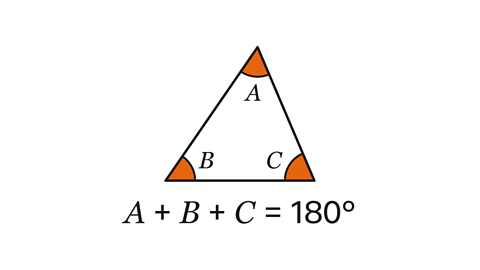
- The interior angles of a triangle sum to 180°.
- The interior angles of a A 2D shape with 4 edges and 4 vertices. sum to 360°.
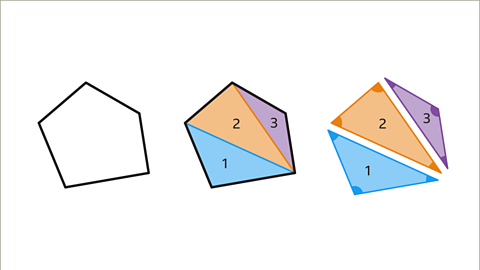
- The interior angles of a A pentagon is a polygon that has five sides. sum to 540°.
- In general, the interior angles of any polygon sum to (number of sides – 2) × 180°.
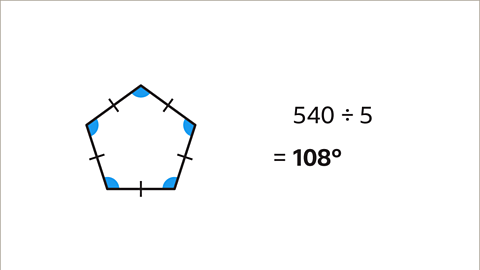
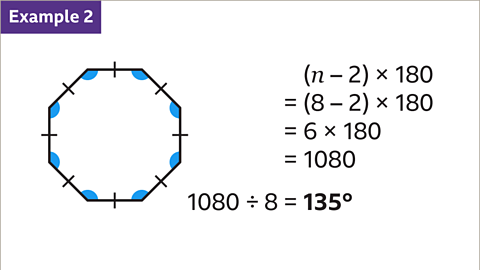
To find the size of one interior angle of a regular polygon, divide the sum of the interior angles by the number of sides.
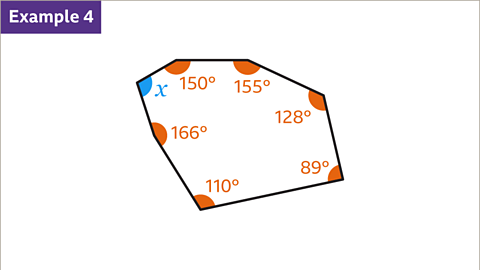
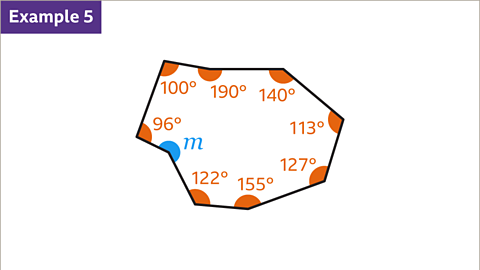
To find the size of a missing interior angle in an irregular polygon, subtract the sum of the given angles from the sum of the interior angles.
Video
Watch the video to learn how to calculate the sum of the interior angles of any polygon.
A polygon is any closed plane or 2D shape with multiple straight sides. Circles are not polygons because they're curved rather than having straight sides.
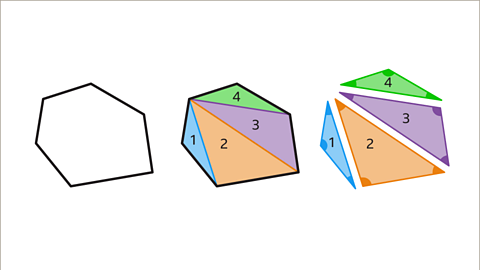
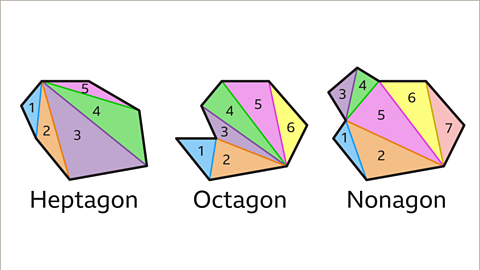
There's a way to calculate the sum of the interior angles of any polygon. To start, all polygons can be divided into a number of triangles. This is useful because of the fact that the interior angles of any triangle add up to 180 degrees.
The sum of the interior angles of the polygon will equal the number of triangles drawn, times 180 degrees. But it's not actually necessary to draw all of those triangles. Each polygon will always divide into two triangles fewer than the number of its sides. A hexagon will have four triangles. An octagon will have six triangles.
So the sum of the interior angles of a polygon can be found by taking the number of sides, subtracting 2 and then multiplying by 180
The sum of the interior angles of an octagon is 1080 degrees.
Finding the sum of interior angles in polygons
The angles inside a shape are known as The angles inside a shape..
The interior angles in any triangle sum to 180°.
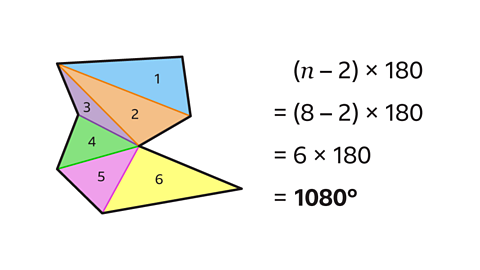
Any A 2D shape with three or more edges and vertices. can be divided into two triangles (less than the number of sides of the polygon).
The sum of the interior angles of any polygon can be found using the formula:
sum of interior angles = (number of sides – 2) × 180°
- It can be useful to remember some key polygons and the sum of their interior angles:
| Polygon | Number of sides | Formula | Sum of interior angles |
|---|---|---|---|
| triangle | 3 | (3 – 2) × 180 | 180° |
| quadrilateral | 4 | (4 – 2) × 180 | 360° |
| pentagon | 5 | (5 – 2) × 180 | 540° |
| hexagon | 6 | (6 – 2) × 180 | 720° |
| \(n\)-sided polygon | \(n\) | (\(n\) – 2) × 180 | (\(n\) – 2) × 180° |
Examples
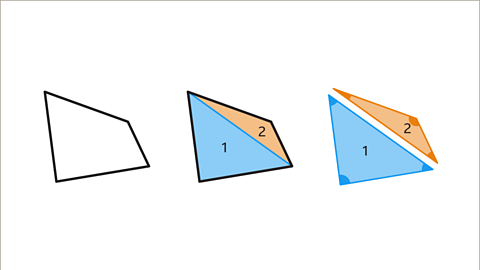
Image caption, The reason interior angles in a quadrilateral sum to 360° is because a quadrilateral can be divided into two triangles. The interior angles in each triangle sum to 180° so two triangles together sum to 360°.
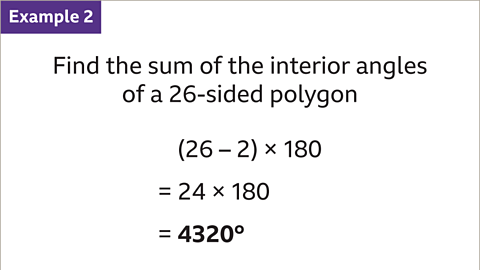

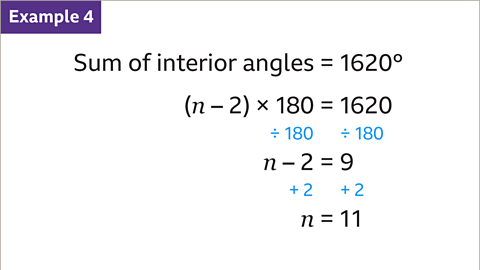
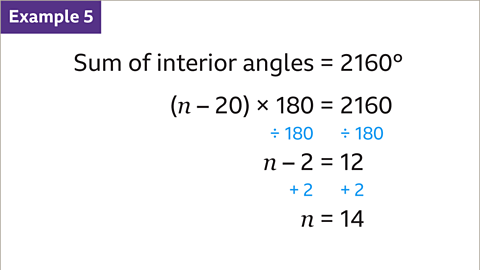
1 of 10
Question
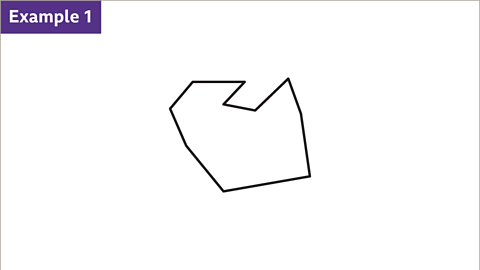
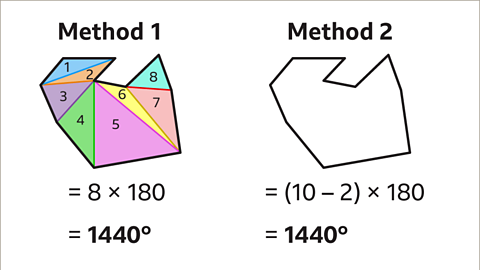
What do the interior angles of this irregular octagon sum to?
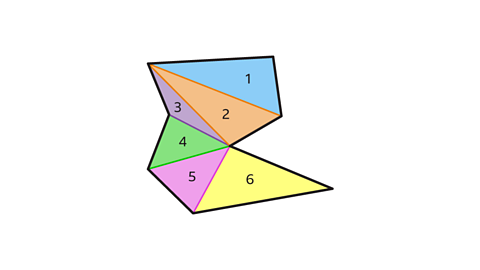
The interior angles in an octagon sum to 1080°.
Using the formula:
sum of interior angles = (\(n\) – 2) × 180°
= (8 – 2) × 180 = 6 × 180 = 1080
Finding missing interior angles in polygons
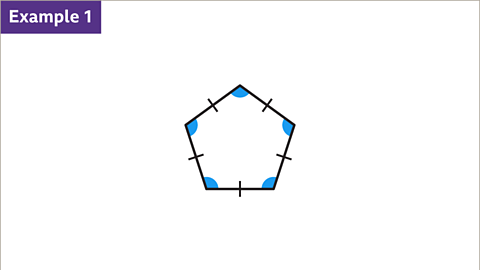
A regular polygon is a polygon with all sides and angles equal.
- Short lines marked on the side or edge of a shape. The same number of marks indicate equal lengths. on each side indicate which sides are equal. If all sides are marked with a single hash mark, the polygon is regular.
- If the sum of the The angles inside a shape. is known, dividing by the number of sides will give the size of one angle.
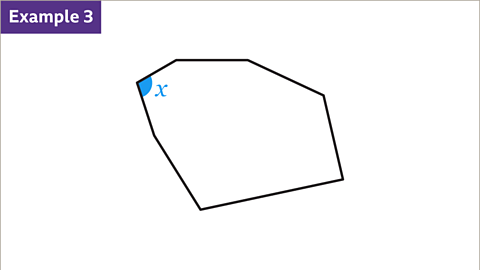
An irregular polygon is a polygon with all sides and angles not equal.
- It is not possible to find the size of one angle in an irregular polygon unless all other angles are known.
Examples
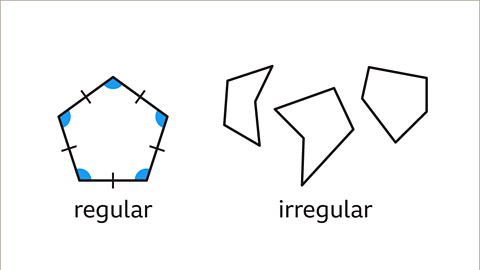
Image caption, These polygons are all pentagons. Only the one on the left is regular. This is indicated by the hash marks on each side showing that they are equal.
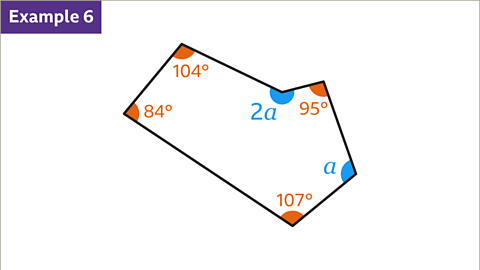
1 of 8
Question
Find the size of angle \(z\).
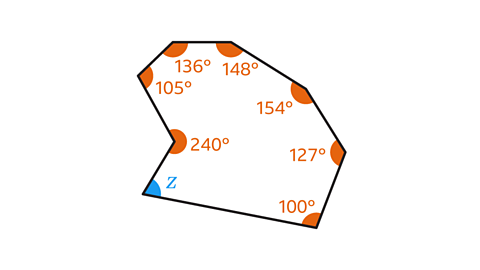
This is an irregular octagon.
The sum of the interior angles in an octagon is (8 – 2) × 180 = 6 × 180 = 1080°.
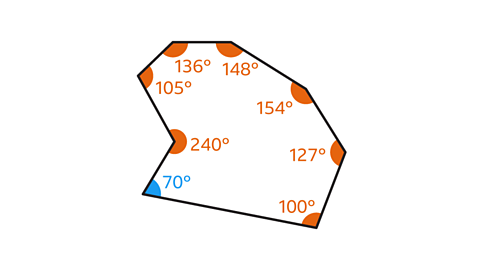
The known angles add up to 240 + 105 + 136 + 148 + 154 + 127 + 100 = 1010
To find the final missing angle, \(z\), subtract 1010 from 1080
1080 – 1010 = 70
Angle \(z\) is 70°.
Practise the sum of interior angles of polygons
Practise finding the size of interior angles of polygons with this quiz. You may need a pen and paper to help you with your answers.
Quiz
Play Sudoku with BBC Bitesize!
Every weekday we release brand new easy, medium and hard Sudoku puzzles. Perfect for testing your skill with numbers and logic.

More on Angles
Find out more by working through a topic
- count7 of 7
- count1 of 7
- count2 of 7
- count3 of 7