Key points
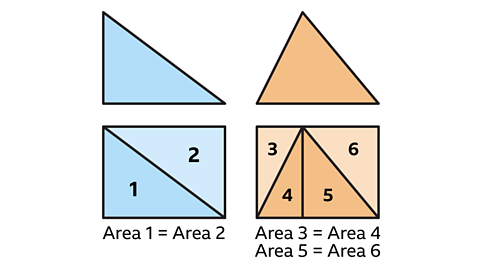
A good understanding of calculations for the circumference of a circle and the area of a circle is useful when calculating the surface area and volume of a A 3D shape with a constant circular cross-section across its length..
A cylinder is a Three-dimensions: length, width and height. shape with a circular The face that results from slicing through a solid shape. .
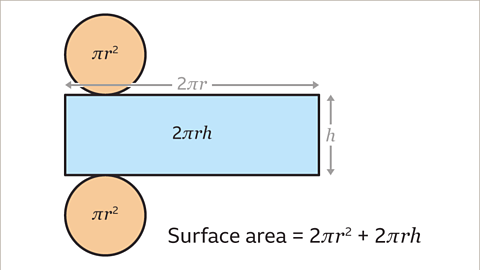
The total The total area of all the faces of a 3D shape. Measured in square units, such as cm² and m². of a cylinder is made up of two circular One of the flat surfaces of a solid shape. and a curved surface which makes a rectangle if flattened out. Surface area is measured in square units, such as cm² and m².
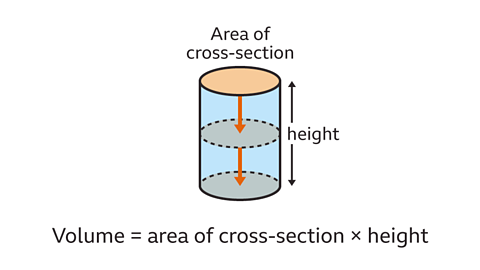
The The amount of space occupied by a 3D shape, measured in cubic units, such as cm³, mm³ and m³. May also be referred to as capacity. of a cylinder is the A measure of the size of any plane surface or 2D shape. Area is measured in square units, for example, square centimetres or square metres: cm² or m². of its cross-section, a circle, multiplied by its height. Volume is measured in cubic units, such as cm³ or m³.
Calculate the area of a cylinder
A cylinder is made up of two Shapes that are the same shape and size, they are identical. circles that are directly opposite one another, and a rectangle.
Calculations may be carried out numerically using a decimal approximation for Pi is used to represent the ratio of a circumference of a circle to its diameter, denoted with the Greek symbol π (pi), such as 3۰14 or 3۰142. Workings may also be written symbolically in terms of π. This means that the result is given as a multiple of π.
On a scientific calculator, the S
⇔
D button is used to convert a value in terms of π to a decimal value.
To calculate the surface area of a cylinder:
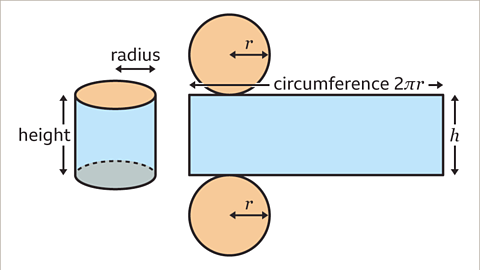
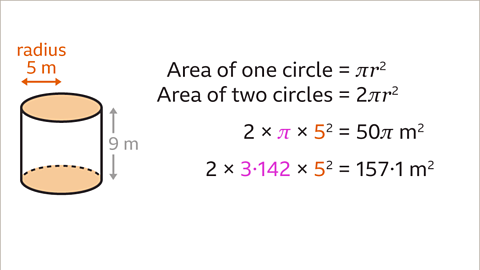
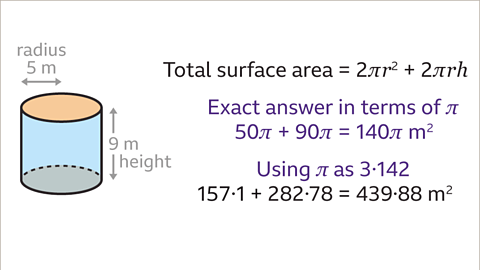
- Work out the area of the two circular faces (2 × π\(r\)²).
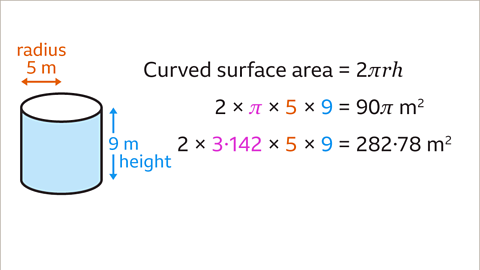
- Work out the curved surface area, this is the rectangular face (2π\(r\) × \(h\)).
- Sum the area of the circles and the rectangle.
The expression for working out the total surface area of a cylinder is
2π\(r\)² + 2π\(rh\).
\(r\) is the radius of the circular cross-section and \(h\) is the height of the cylinder.
If the diameter, \(d\), of the circular cross-section is given, this is halved to find the radius.
Depending on the orientation of the cylinder, the length of the cylinder is its height.
Example
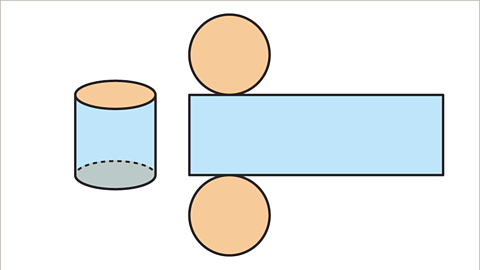
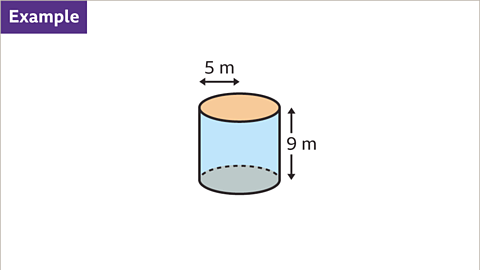
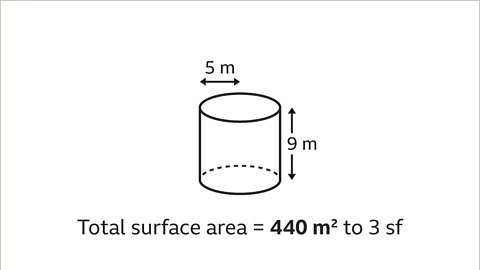
Image caption, A cylinder is made up of two congruent circles and a rectangle. The circles are the top face and the base face of the cylinder. The circles are directly opposite each other. The rectangle is the curved face around the cylinder.

1 of 9
Question
Use the formula to work out the surface area of the cylinder.
Use the approximation π = 3۰14. Give your answer to the nearest mm².
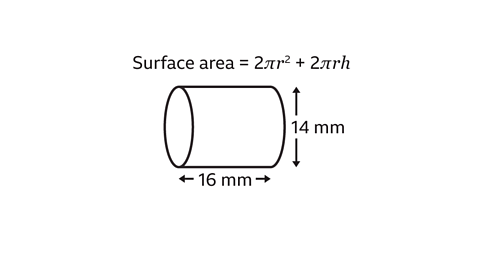
The diameter of the circular cross-section is 14 mm.
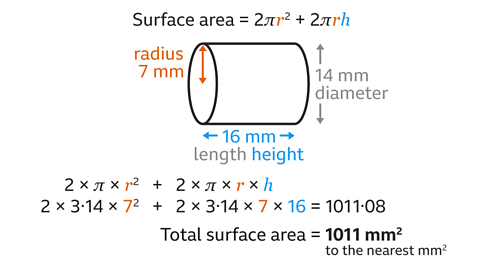
The radius is half of the diameter. The radius of the circular cross-section is 7 mm.
The length of the cylinder is 16 mm. The length is also the height of the cylinder.
Substitute the values of \(r\) = 7 and \(h\) = 16 into 2π\(r\)² + 2π\(rh\) and work out the calculation.
Surface area = 2 × π × 7² + 2 × π × 7 × 16
Surface area = 2 × 3۰14 × 7² + 2 × 3۰14 × 7 × 16
Surface area = 1011۰08
The total surface area of the cylinder is 1011 mm² to the nearest mm².
Calculate the volume of a cylinder
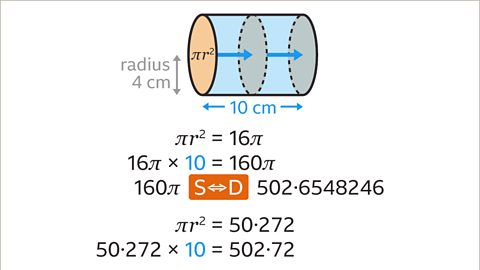
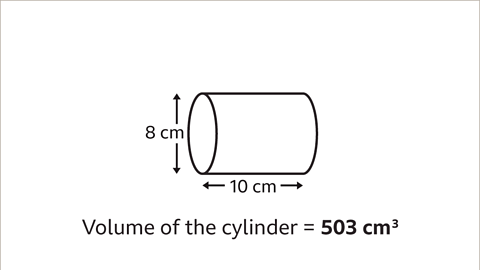
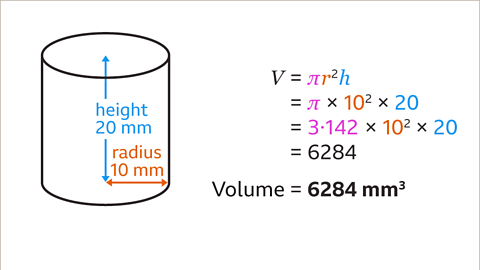
The volume of any cylinder is the area of the cross-section multiplied by its height.
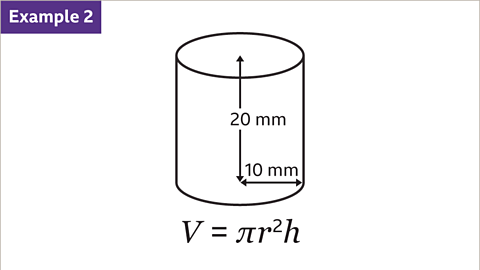
This is given by the formula \(V\) = π\(r\)²\(h\) , where \(r\) is the radius of the circular cross-section and \(h\) is the height of the cylinder.
To work out the volume of a cylinder:
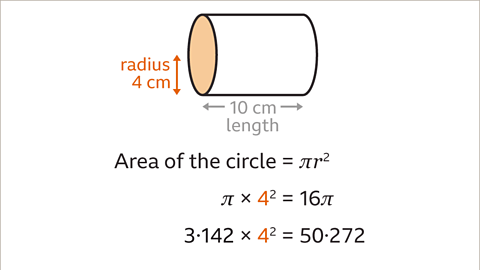
- Find the area of the cross-section using the formula for the area of a circle, \(A\) = π\(r\)².
- Multiply by the height of the cylinder.
Examples
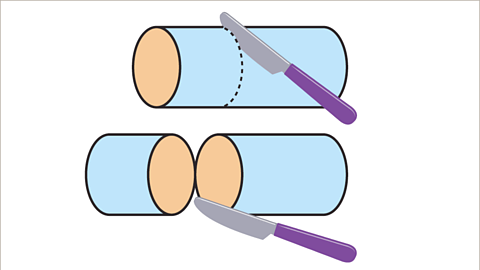
Image caption, Imagine that a solid cylinder is sliced open. The face that is revealed is called the cross-section. The cross-section of a cylinder is a circle. The cross-section is the same all the way through the cylinder.

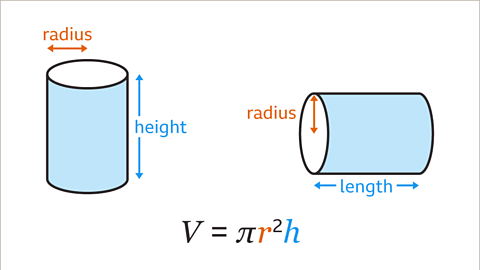
1 of 10
Question
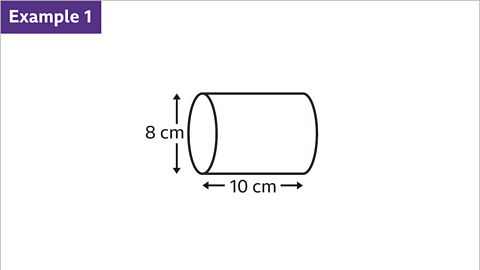
What is the volume of the cylinder? Use the approximation π = 3۰14
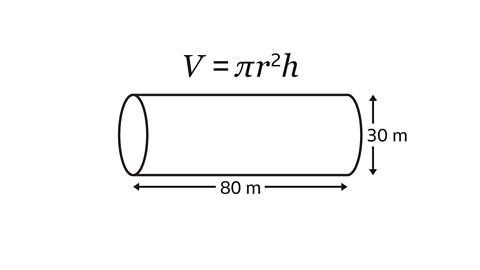
The diameter of the cylinder is 30 m.
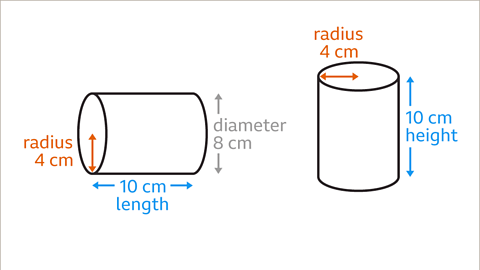
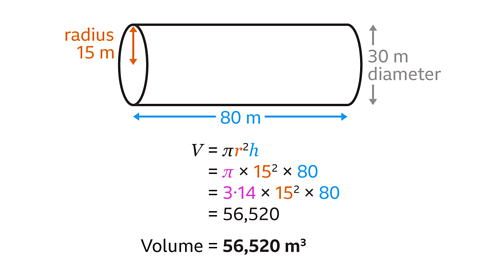
The radius is half of the diameter. The radius of the cylinder is 15 m.
The length of the cylinder is 80 m. The \(h\) in the formula is the cylinder’s height or length, which means \(h\) = 80
Substitute the values of \(r\), 15, and \(h\), 80, into the formula (\(V\) = π\(r\)²\(h\)) and work out the calculation.
3۰14 × 15² × 80 = 56,520
The volume of the cylinder is 56,520 m³.
Practise finding the surface area and volume of cylinders
Practise working out the surface area and volume of cylinders with this quiz. You may need a pen and paper to help you with your answers.
Quiz
Real-life maths
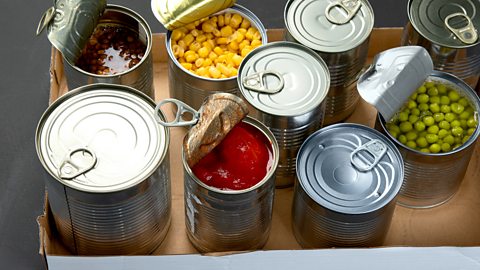
Certain foods, such as baked beans, vegetables, fish and meat, are commonly sold in cylinder-shaped tins. Cylinders pack efficiently into boxes for shipping, taking up approximately 90% of the available space.
Their circular cross-section also means that the tins can withstand pressure when stored. The food contained in them has a long shelf life.
To make the tins accurately, manufacturers need to calculate the surface area plus a small amount of extra area for the seams. The volume of the cylinder shape will determine the quantity of food that can go inside a tin.
Play Sudoku with BBC Bitesize!
Every weekday we release brand new easy, medium and hard Sudoku puzzles. Perfect for testing your skill with numbers and logic.

More on Perimeter, Area, Volume
Find out more by working through a topic
- count11 of 11
- count1 of 11
- count2 of 11
- count3 of 11