Key points
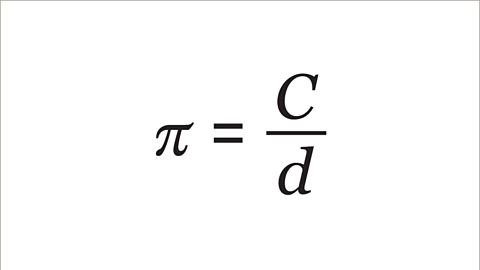
All circle calculations use the constant π (pi). The The distance around a circle; its perimeter. divided by the The distance across the circle, circumference to circumference, through its centre. gives π. This works for all circles because they are mathematically similar. The circumference is a length and is measured in units, including centimetres and metres.
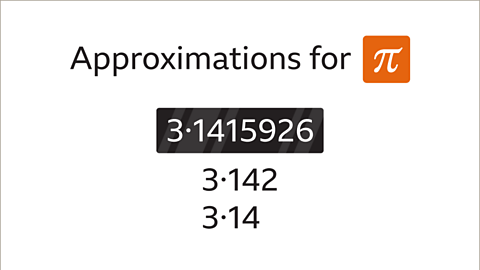
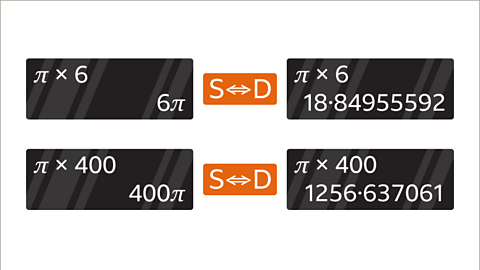
Pi is an A value that cannot be expressed exactly, such as √2 and π. An approximate value for pi is used in calculations; 3۰142 and 3۰14 are commonly used. A modern calculator uses the An irrational number. This includes the square roots that cannot be written as an exact decimal and special values like π. notation of the symbol π which can be changed to a decimal approximation using the S
⇔
D key, which gives 3۰141592654The ability to round a number to a number of decimal places or to a number of significant figures means that answers can be written to an agreed degree of accuracy.
Video
Watch the video to learn how circles and circumference play an important role in the work Steph does as a football coach, and why circles play a useful part in sport generally.
Bobby: So, tell me about your role as a sports coach.
Steph: Yeah, so I’m mainly a football coach, I work with a brilliant group of under 14s girls, and I take their training sessions, manage them on match days, basically just make sure they get to play as much football as possible, enjoy it as much as possible and learn as much about the game as possible.
Bobby: So does the size of teams you manage vary?
Steph: This season, we’re playing eleven a side. Last season, we played nine, a couple of years ago we played seven, so as you go through the age groups, you progress from five a side, to seven, to nine, to eleven. And with that, the pitch size varies as well.
Bobby: How important is it to get the measurement of these pitches accurately done?
Steph: Yeah, so it’s really important. So, the main reason that we move through team sizes and pitch sizes as players get older is to match their development. So, how far might they be able to kick a ball, for example? How far might they be expected to run?
The other element is fairness, so in football, you’re not always playing on the same pitch. You might be playing on a training pitch, on a match pitch, at home, away. So obviously, to make sure that in a league, forexample, all of the games are fair, all of the games need to be played on the same size pitch.
Bobby: And how are these pitches actually measured then?
Steph: So, there is a groundskeeper that will do that. They will come and they will draw the lines on the grass. They use something called a measuring wheel and that wheel clicks every time it goes one metre, so the groundskeeper knows when they’ve got the right distance.
Bobby: Ah, and mathematically, the wheel that they use has to have a circumference of one metre? And to make sure that’s accurate, we can multiply the diameter, which goes through the centre of the wheel, by the ratio of pi which is about 3۰14, to give us one metre.
So, where else do we see circles in football and other sports?
Steph: Oh, all over. In football, you’ve got the centre circle where the whole game kicks off. You’ve even got the ball, so it’s really important again for fairness that the ball is the same size. And I know at elite levels, they’ll measure that, they’ll check that before a game kicks off.
It’s in other sports too, so cycling, for example, the wheels are circles. Then you’ve got Olympic sports, so things like hammer throw will start in a circle and people will have to spin themselves around in a circle.
Bobby: It just goes to show that circles and circumferences are so valuable throughout sport.
Steph: Oh, definitely.
Understanding the circle and π (pi)
To understand the circle, particular vocabulary must be learnt:
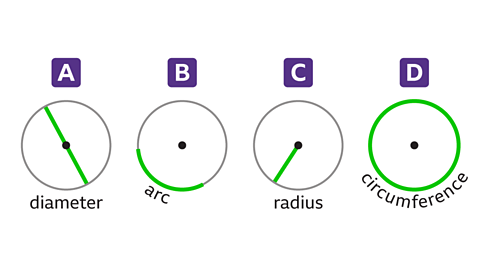
- The of a circle is its The total distance around a shape..
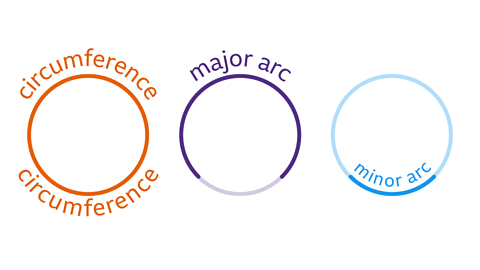
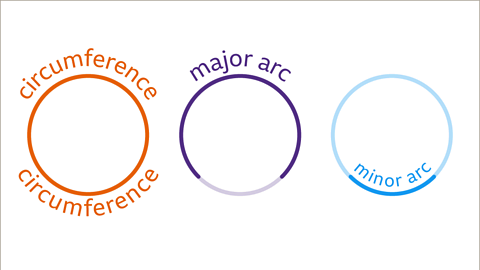
- An Part of the circumference. Named as major for over half of the circumference and minor for less than half of the circumference. is part of the circumference.
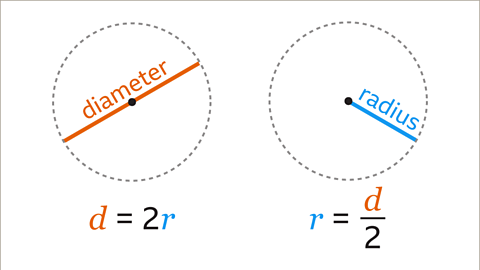
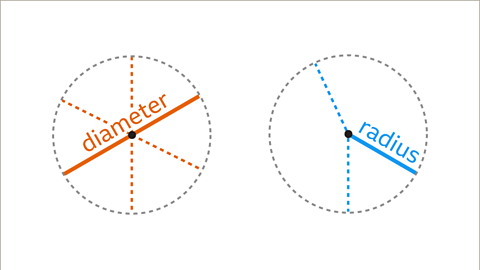
- The The distance across the circle, circumference to circumference, through its centre. is the whole distance across the circle through its centre.
- The The distance from the centre of the circle to the circumference. is the distance from the circumference to the centre of the circle.
- The radius is half the diameter.
What is π (Pi)?
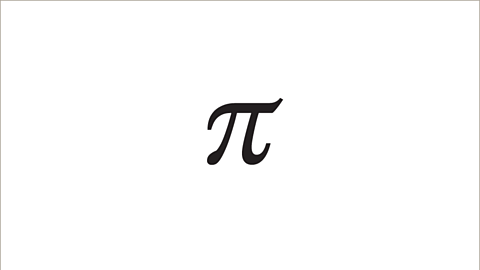
- Pi is used to represent the ratio of a circumference of a circle to its diameter, denoted with the Greek symbol π is the ratio of the circumference of a circle to the length of its diameter.
- For all circles, the circumference divided by the diameter gives π.
- Pi (π) is a constant.
- π is an A value that cannot be expressed exactly, such as √2 and π, it cannot be expressed exactly so approximations are used in calculations. π is rounded most often to 3۰142 or 3۰14. The π button on a calculator gives greater accuracy.
- When using the π button the answer may be given in terms of π. The surd display can be changed to a decimal value by pressing the S
⇔
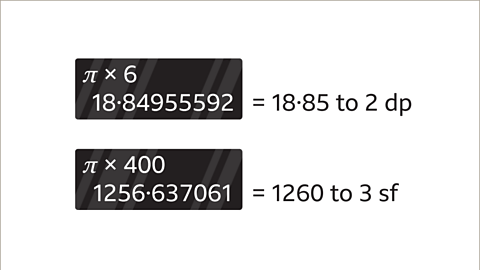
D button. - The final answer is rounded to the degree of accuracy asked for in the question. This may be a specific number of decimal places or significant figures.
Example
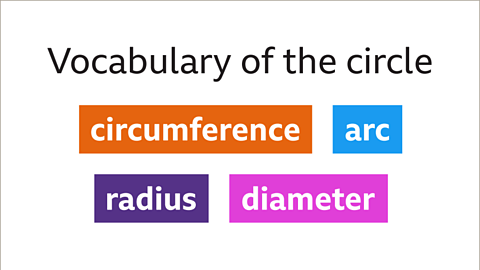
Image caption, The vocabulary of the circle includes the terms circumference, arc, diameter, and radius.
1 of 9
Question
Name the highlighted part of each circle.
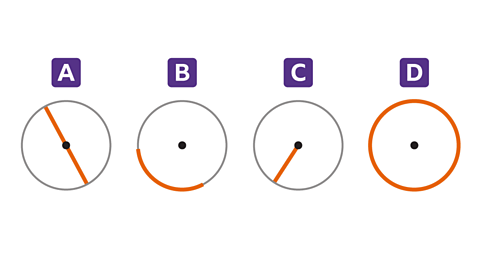
A shows the diameter. This is the distance across the circle, through its centre.
B shows an arc. This is part of the circumference. It is a minor arc as it is less than halfway around the circle.
C is a radius. This is the distance from the centre of the circle to the circumference.
D shows the circumference. This is the perimeter of the circle, the distance around the shape.
Calculate the circumference of a circle
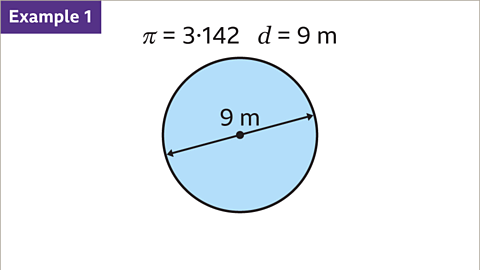
To find the of a circle use the given approximation for π or the π button on a calculator and either the The distance across the circle, circumference to circumference, through its centre. or the The distance from the centre of the circle to the circumference..
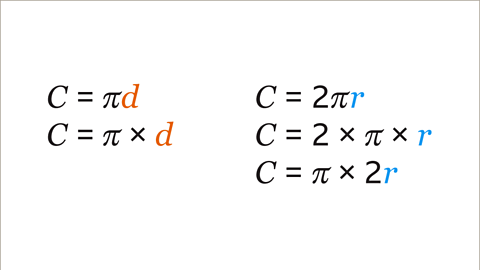
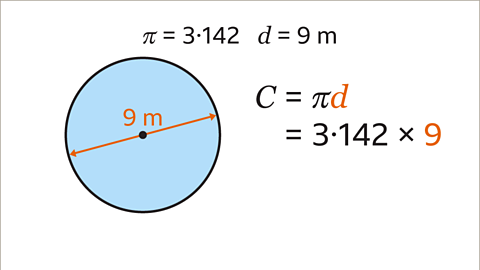
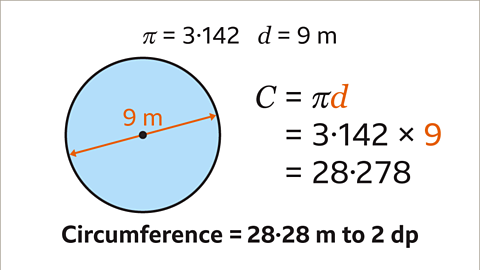
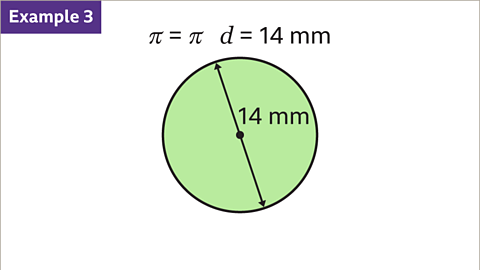
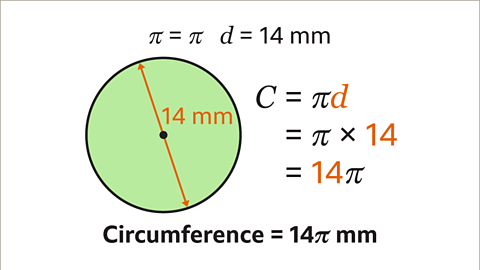
- The formula for the circumference when using the diameter is 𝑪 = π𝒅
- Substitute the value of the diameter into the A fact, rule, or principle that is expressed in words or in mathematical symbols. Plural: formulae..
- Multiply π by the diameter of the circle.
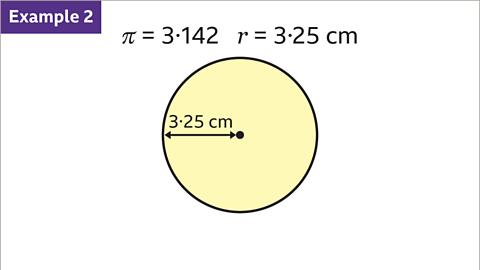
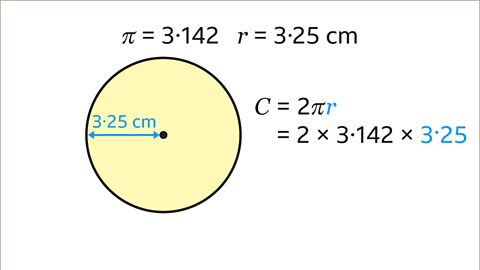
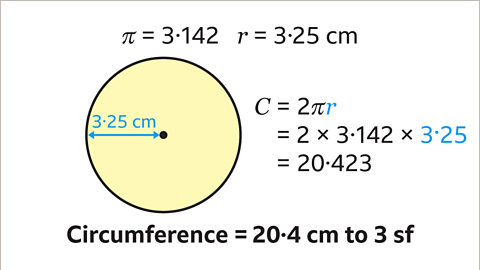
- The formula for the circumference when using the radius is 𝑪 = 2π𝒓
- Substitute the value of the radius into the formula.
- Multiply 2 by π then multiply by the radius, or multiply π by double the radius. (Double the radius is the same as the diameter).
- Round the answer to the degree of accuracy asked for in the question. This may involve rounding to a number of decimal places, dp, or rounding to a number of significant figures, sf.
To find the circumference in terms of π.
- When the π button is used on a calculator the answer is automatically given in terms of π. Working without a calculator, the circumference is the diameter value written before π.
Examples
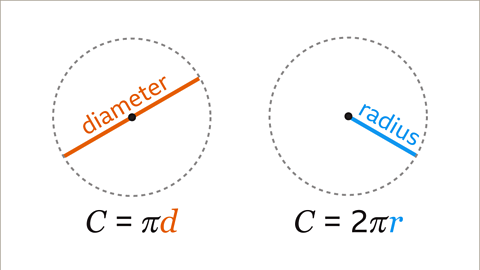
Image caption, The formula for the circumference of a circle uses either the diameter or the radius of the circle.
1 of 10
Question
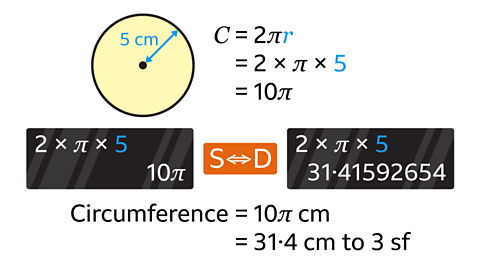
What is the circumference of a circle with a radius of 5 cm? Give the answer in terms of π and to 3 significant figures.
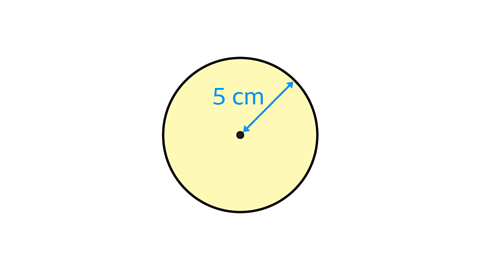
The formula for the circumference of a circle is 𝑪 = 2π𝒓.
Substitute the value of the radius into the formula and calculate.
2 × π × 5 = 10π
2 × π × 5 = 31۰41592654
The circumference of the circle is 10π cm which is31۰4 cm to 3 sf.
Calculate the diameter or radius of a circle, given its circumference
To work out the diameter and the radius of a circle from its circumference.
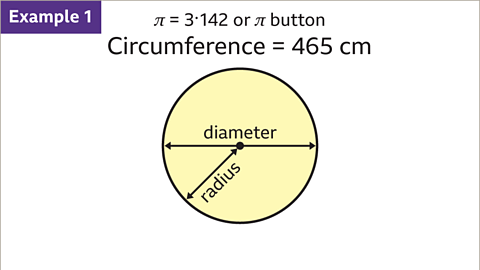
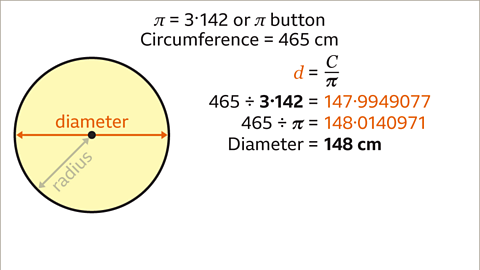
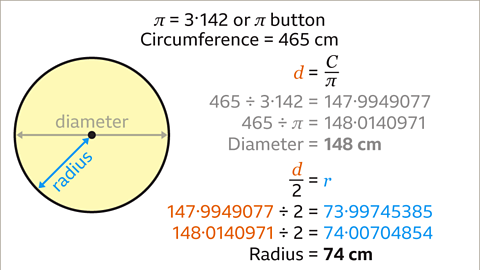
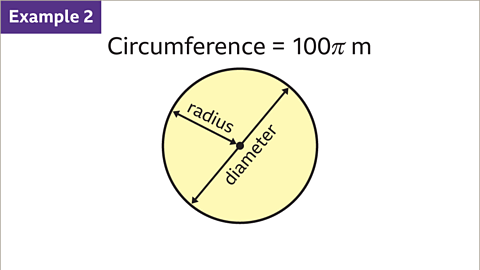
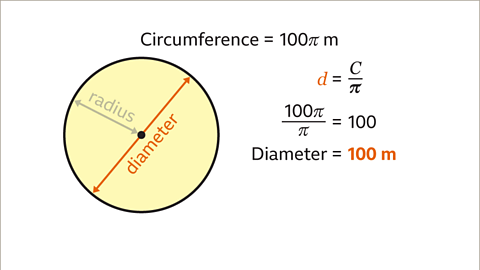
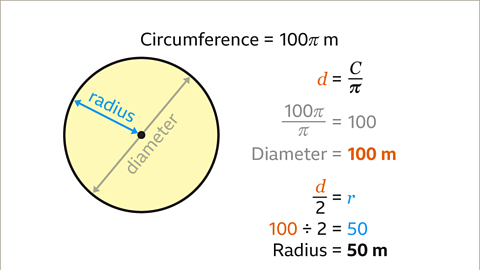
- Divide the circumference by π. This gives the diameter.
- The radius is half of the diameter.
Examples
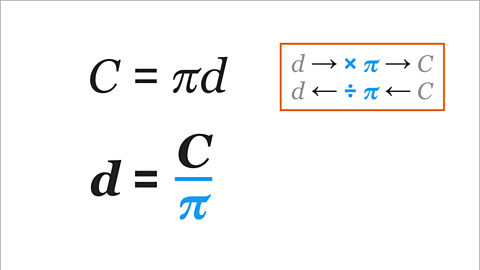
Image caption, The circumference of a circle is given by the formula 𝑪 = π𝒅. The diameter has been multiplied by π to give the circumference. The inverse of multiply by π is divide by π. The circumference divided by π gives the diameter.
1 of 7
Practise pi and working out circumference
Practise pi and working out the circumference of circles with this quiz. You may need a pen and paper to help you with your answers.
Quiz
Real-life maths
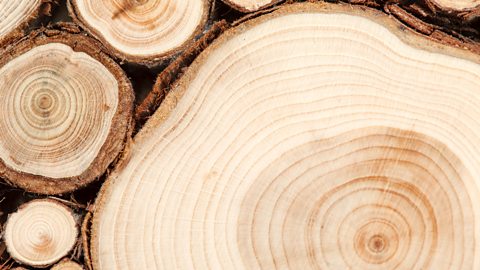
The age of a tree can be found by counting the Circles in a plane that have the same centre rings in the cross-section of the trunk. In practical terms, chopping down a tree is not environmentally sound, so another method has been developed using the circumference of a tree trunk.
Measuring the circumference at a height of 1۰4 m (about 4’ 6”) and dividing by π gives the diameter of the tree. Multiplying the diameter by the growth factor for the particular species of tree then gives an estimate for the tree’s age.
Play Sudoku with BBC Bitesize!
Every weekday we release brand new easy, medium and hard Sudoku puzzles. Perfect for testing your skill with numbers and logic.

More on Perimeter, Area, Volume
Find out more by working through a topic
- count7 of 11
- count8 of 11
- count9 of 11
- count10 of 11