Key points
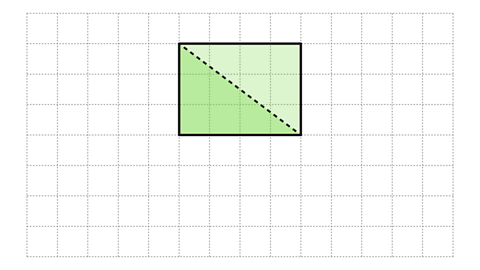
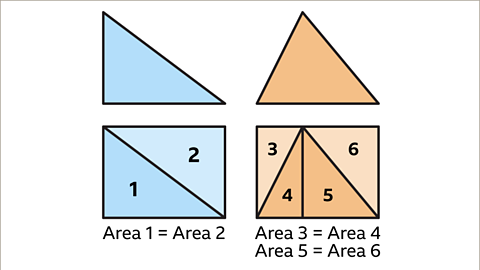
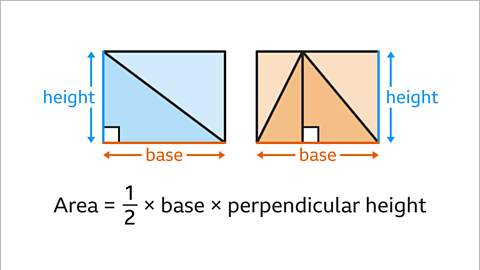
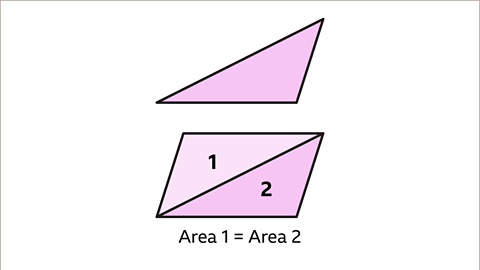
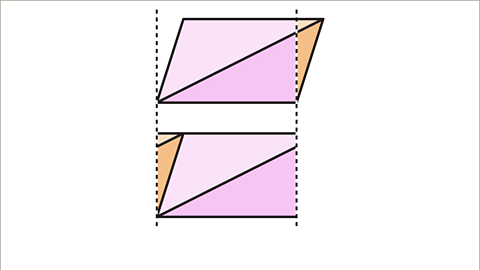
Any A three-sided polygon. can be shown to be half of a A quadrilateral with opposite pairs of sides that are both equal in length and parallel. All four angles are right angles.. This can be shown in diagrams and practically using paper and scissors.
The A measure of the size of any plane surface or 2D shape. Area is measured in square units, for example, square centimetres or square metres: cm² or m². of a triangle is calculated by finding the length of the base, halving it, and then multiplying it by the Perpendicular lines are at 90° (right angles) to each other. height. Alternatively, multiply the base length by the perpendicular height and then halve to find the area of a triangle.
The base and the perpendicular height are at right angles to each other. The measurements used must be in the same units. For example, to work in cm a 45 mm measurement would have to be converted to 4۰5 cm. Practising converting metric units will help with this process.
Understanding the formula for the area of a triangle
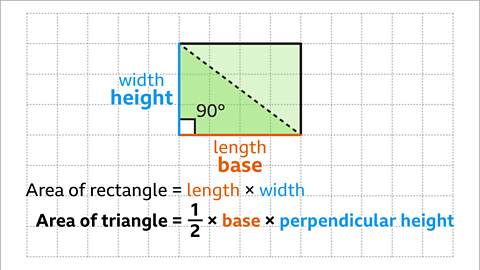
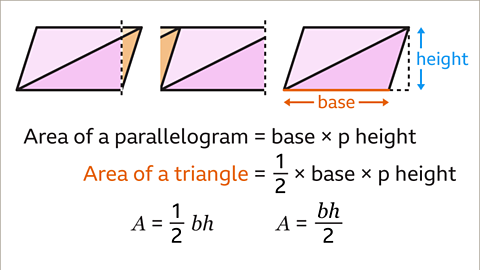
The area of a triangle is calculated by the A fact, rule, or principle that is expressed in words or in mathematical symbols. Plural: formulae.: \( \frac{1}{2} \) × base × perpendicular height.
- A rectangle can be divided into two Shapes that are the same shape and size, they are identical. triangles.
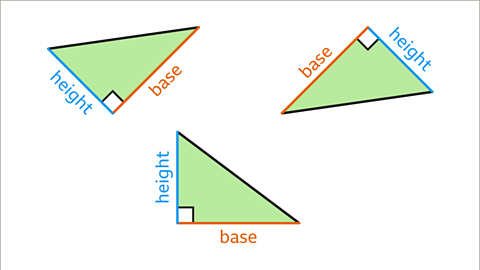
- The length and width of the rectangle are the base and height of a triangle. The base and the height are at right-angles, making the height the perpendicular height.
- For a right-angled triangle, the base and the perpendicular height are interchangeable.
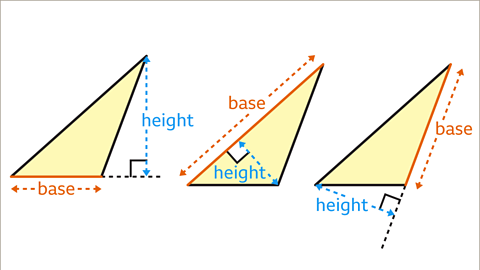
- The The position of a shape in relation to a coordinate system. Orientation is the way an object is angled. of the triangle means that the base is not necessarily horizontal.
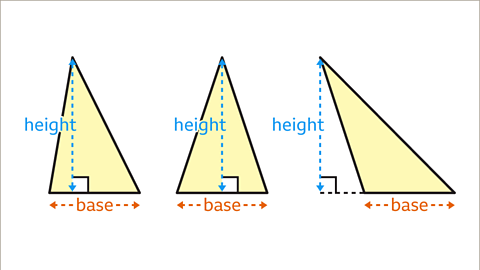
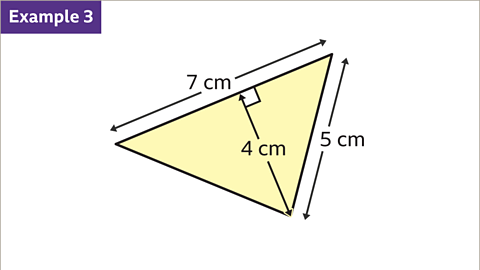
- For triangles that are not right-angled, the base is one of the sides and the perpendicular height may be shown either inside or outside the shape, it is not another side.
- The base is one side of the triangle. The perpendicular height is the perpendicular measurement that gives the other dimension of the triangle.
The formula can be presented as:
𝑨 = \( \frac{𝒃𝒉}{2} \)or 𝑨 = \( \frac{1}{2} \) 𝒃𝒉
- 𝑨 is the area of the triangle.
- 𝒃 is the length of the base of the triangle.
- 𝒉 is the length of the perpendicular height of the triangle.
Example
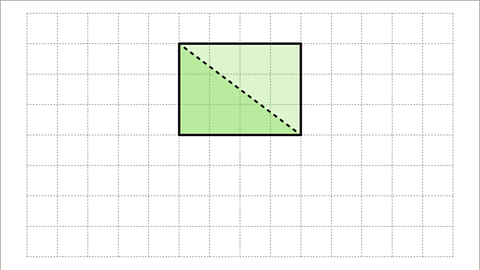
Image caption, The rectangle has been cut into two congruent triangles by drawing a diagonal.
1 of 10
Question
Which lettered lengths can be used as the base and perpendicular height for the given triangles?
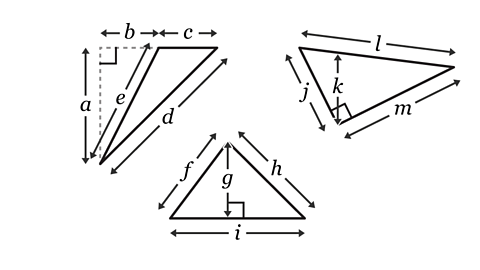
The base and the perpendicular height of the triangle must be at right-angles.
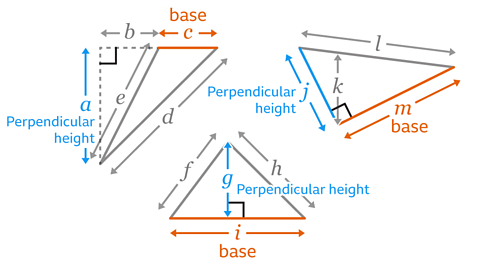
The base and heights for the triangles are:
𝒄 and 𝒂
𝒄 is one side of the triangle and 𝒂 is the height of the triangle, perpendicular to 𝒄.
𝒊 and 𝒈
𝒊 is one side of the triangle and 𝒈 is the height of the triangle, perpendicular to 𝒊.
𝒎 and 𝒋
They are two sides of the triangle and are at right-angles. Either of the sides can be used as the base and perpendicular height.
Calculating the area from the base and perpendicular height
The area of a triangle is \( \frac{1}{2} \) × base × perpendicular height. Multiplication is An operation is commutative if the order does not matter. Multiplication and addition are commutative, eg 4 × 3 = 3 × 4 and 4 + 3 = 3 + 4 so the calculation can be processed in different orders.
The formula can be presented as:
𝑨 = \( \frac{𝒃𝒉}{2} \)or 𝑨 = \( \frac{1}{2} \) 𝒃𝒉
- 𝑨 is the area of the triangle.
- 𝒃 is the length of the base of the triangle.
- 𝒉 is the length of the perpendicular height of the triangle.
To work out the area of a triangle:
- Identify the base and the perpendicular height of the triangle. They must be measured in the same units.
- Substitute the base and height into the formula.
- Perform the calculation in one of three ways, all of which will give the same answer:
- Multiply the base by the perpendicular height, then divide by two.
- Find half of the base, then multiply by the perpendicular height.
- Find half of the perpendicular height, then multiply by the base.
Examples
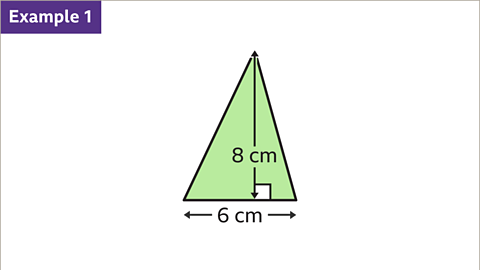
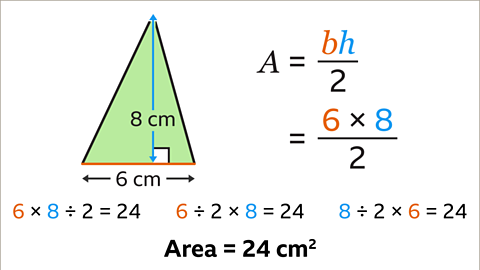
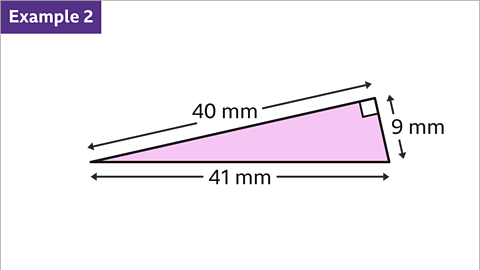
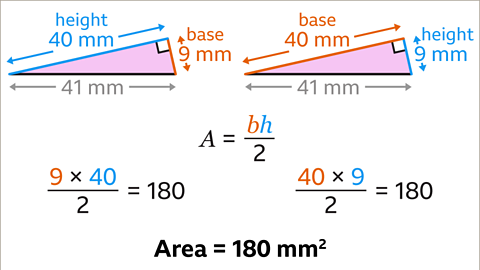
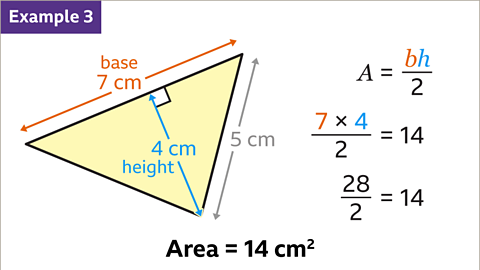
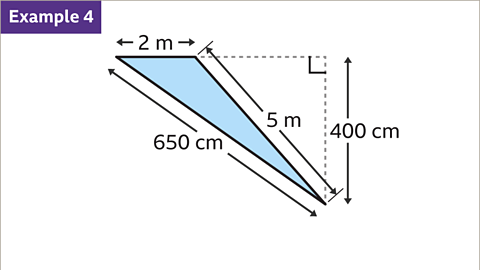
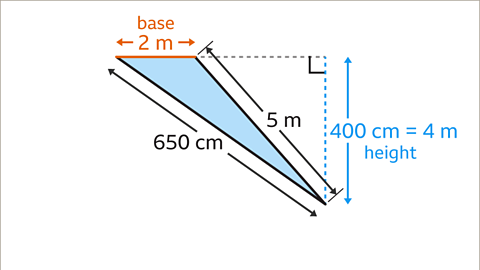
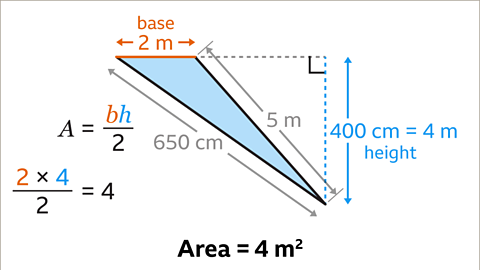
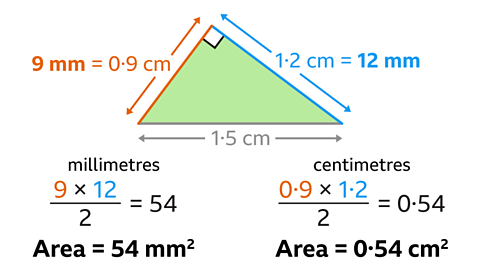
Image caption, Find the area of the triangle.
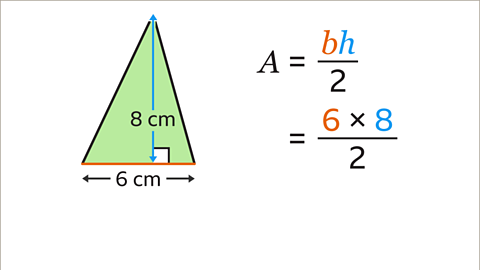
1 of 10
Question
Work out the area of the triangle.

The base is 9 mm and the perpendicular height is 1.2 cm. They are not in the same units.
Working in millimetres, the base is 9 mm and the perpendicular height is 12 mm. Substitute the base and height values into the formula. (9 × 12) ÷ 2 = 54
- The area of the triangle is 54 mm²
Working in centimetres the base is 0∙9 cm, and the height is 1.2 cm. Substitute the base and height values into the formula.
(0∙9 × 1.2) ÷ 2 = 0∙54- The area of the triangle is 0∙54 cm²
The base and the perpendicular height are interchangeable. For a base of 12 mm and a perpendicular height of 9 mm, the answer is the same.
(12 × 9) ÷ 2 = 54
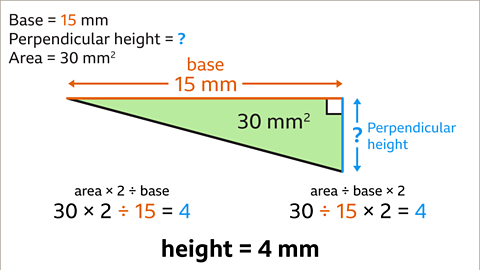
Calculating the base or perpendicular height from the area
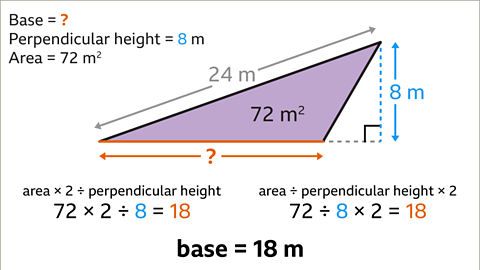
- To calculate the base of a triangle, choose one of two methods. Both calculations give the same answer.
Method 1: Multiply the area of the triangle by two, then divide by the perpendicular height.
Method 2: Divide the area of the triangle by the perpendicular height, then multiply by two.
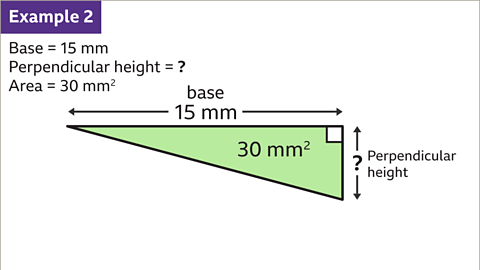
- To calculate the perpendicular height of a triangle, choose one of two methods. Both calculations give the same answer.
Method 1: Multiply the area of the triangle by two, then divide by the base.
Method 2: Divide the area of the triangle by the base, then multiply by two.
Examples
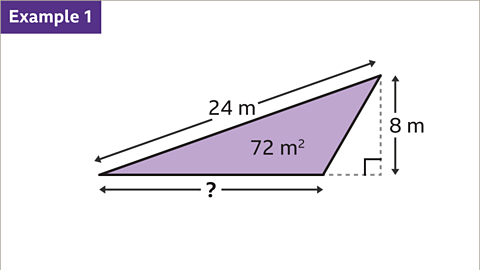
Image caption, The triangle has an area of 72 m². Find the base of the triangle.
1 of 4
Question
The triangle has an area of 24 m². Find the perpendicular height of the triangle.
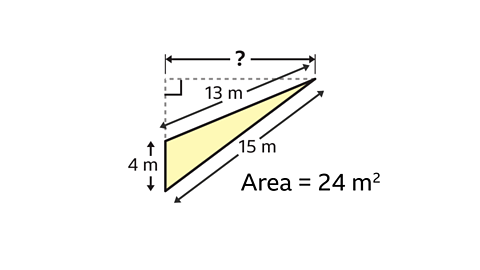
The base of the triangle is perpendicular to its height. The base is 4 m.
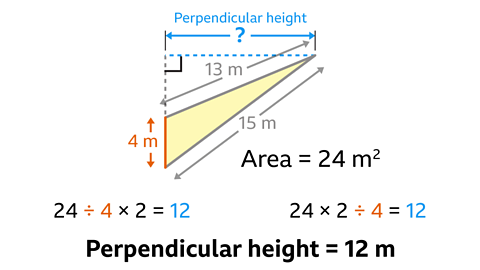
The working can be carried out in one of two ways.
height → ÷ 2 → × base → Area
Use the inverse (opposite) operation to find the perpendicular height.
height ← × 2 ← ÷ base ← Area
Divide the area by the base and then multiply by 2(24 ÷ 4) × 2 = 12
The perpendicular height of the triangle is 12 m.
height → × base → ÷ 2 → Area
Use the inverse operations to find the perpendicular height.
height ← ÷ base ← × 2 ← Area
Multiply the area by two and then divide by the base.
(24 × 2) ÷ 4 = 12
The perpendicular height of the triangle is 12 m.
Practise finding the area of triangles
Practise finding the area of triangles with this quiz. You may need a pen and paper to help you with your answers.
Quiz
Real-life maths
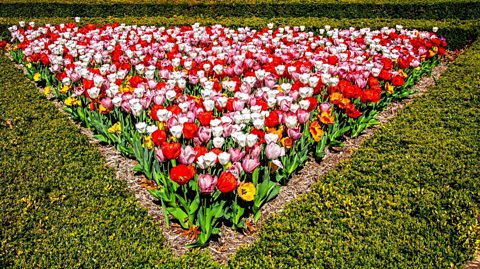
A landscape designer may choose to include a triangle-shaped flower bed when creating a new garden layout. To ensure that plants grow well, soil can sometimes require additional nutrients, such as feed or fertiliser.
Nutrients added to soil are used in specific quantities, per unit of area of surface soil.
The landscape designer will need to calculate the area of the triangular flower bed to ensure that the amount of feed or fertiliser used is correct.
Play Sudoku with BBC Bitesize!
Every weekday we release brand new easy, medium and hard Sudoku puzzles. Perfect for testing your skill with numbers and logic.

More on Perimeter, Area, Volume
Find out more by working through a topic
- count4 of 11
- count5 of 11
- count6 of 11

- count7 of 11