Key points
A A shape made up of straight lines and right angles. shape may be a A regular quadrilateral. All four sides are equal in length and all four angles are right angles. or a A quadrilateral with opposite pairs of sides that are both equal in length and parallel. All four angles are right angles. or, as a A shape formed by combining two or more shapes. , it can look like two or more rectangles joined together.
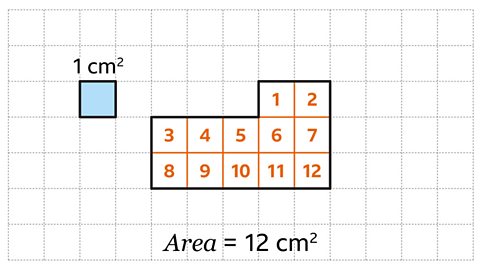
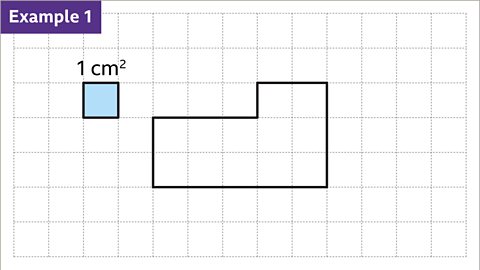
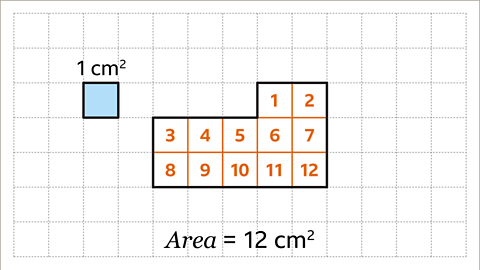
For a shape drawn on a grid the A measure of the size of any plane surface or 2D shape. Area is measured in square units, for example, square centimetres or square metres: cm² or m². may be found by counting squares. Area is measured in square units, including cm² and m².
The calculation for finding the area of a square or a rectangle is found by using a A fact, rule, or principle that is expressed in words or in mathematical symbols. Plural: formulae..
The total area of a compound shape is found by adding up the areas of the rectangles that have created the whole shape. This may be done in more than one way. The calculation may use a subtraction of areas where a rectangle has been removed from a larger rectangle.
Counting squares to find an area and working out the area of a square
To find the area of a rectilinear shape drawn on a grid:
- Count the squares inside the shape.
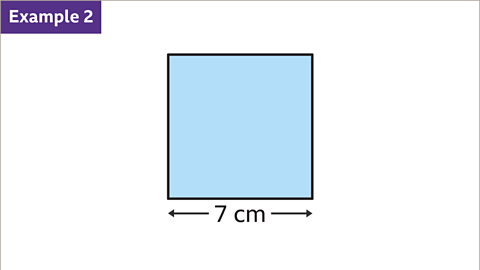
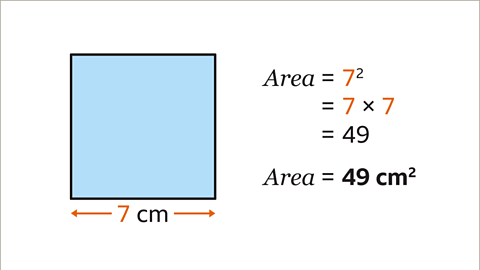
To calculate the area of a square:
- Multiply the length of one side by itself, this means the length is squared. For a whole number length, the value of the area is a The result of multiplying an integer by itself. It can be written as the product of two equal integers..
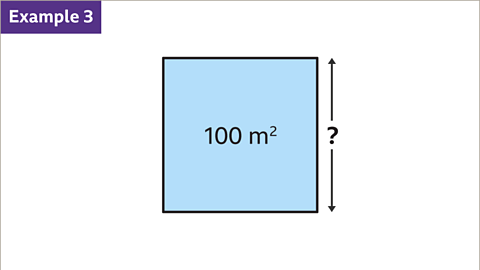
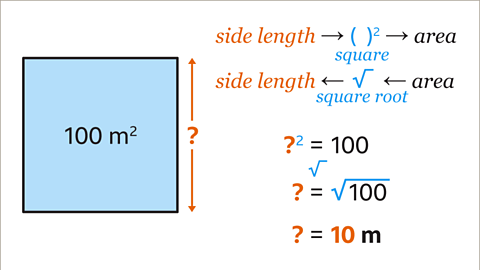
To calculate the side length of a square:
- Find the A number whose square is equal to the given number, √9 = 3, 3² = 9. The value may also be negative, eg (-3)² = 9 of the area of the square.
An Integers are numbers with no fraction or decimal part. They can be positive, negative or zero. 42, 8, and 10000 are examples of integers. value for the length of one side of a square will result in an integer value for the area of a square, which is a square number. A square number is the result of multiplying an integer by itself and can be represented by a square on a grid.
Examples
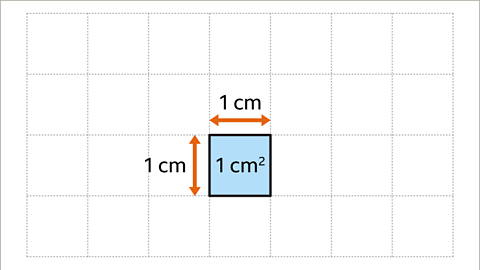
Image caption, Area is measured in square units. On a centimetre grid each square measures 1 cm by 1 cm. Each square has an area of one square centimetre, 1 cm².
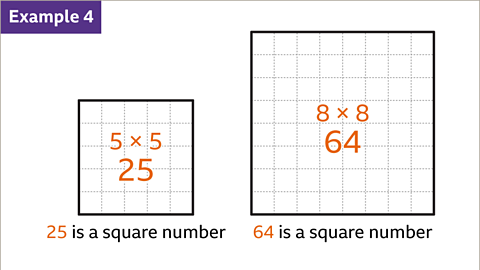
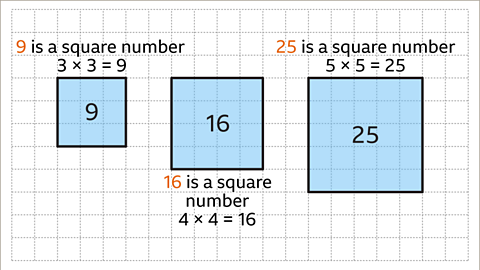
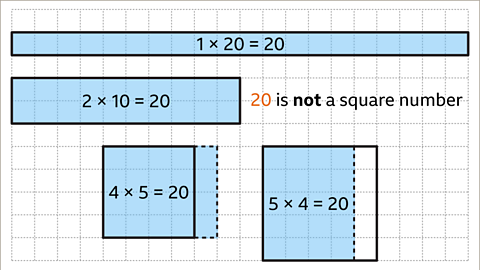
1 of 10
Question
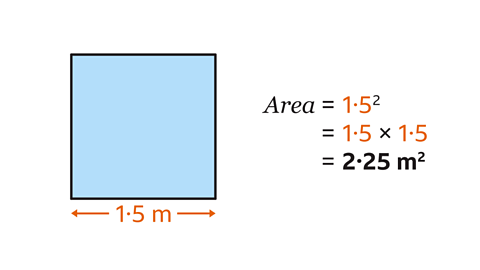
Find the area of a square with side-length 1۰5 metres.
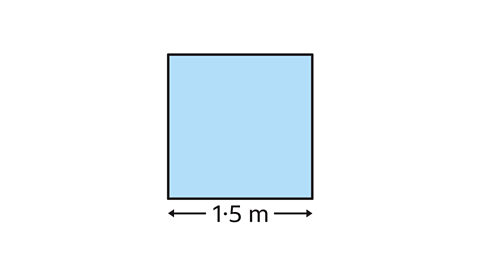
The area of a square is the side-length multiplied by itself. The side-length is squared.
1۰5² = 1۰5 × 1۰5 = 2۰25
The area of the square is 2۰25 m².
How to work out the area of a rectangle
The area of a rectangle is measured in square units including cm² and m².
To work out the area of a rectangle:
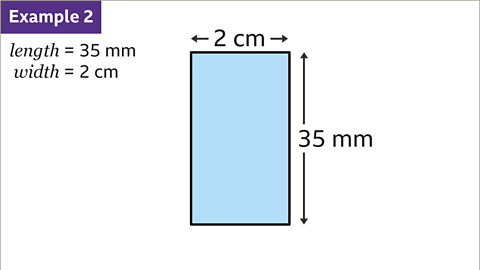
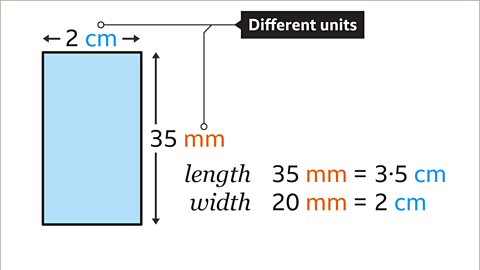
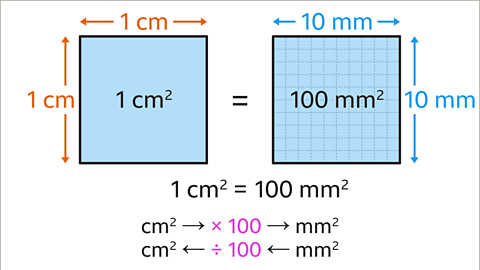
- Check that the length and width of the rectangle are measured in the same units. If necessary, convert the units so that they match.
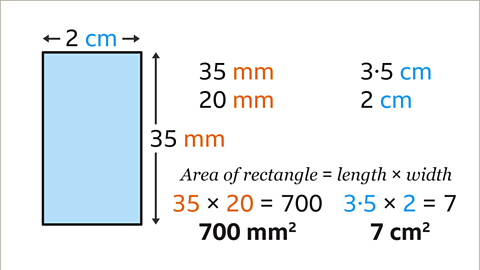
- Multiply the length by the width.
- Write the answer with the correct square units.
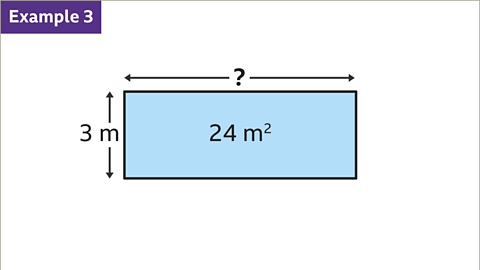
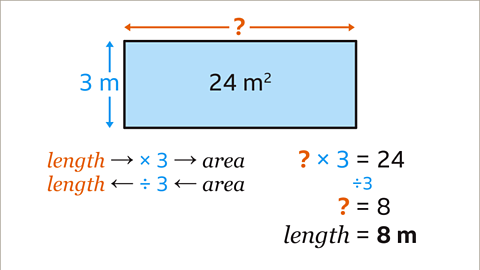
To work out the length or width of a rectangle:
- Divide the given area by the given width/length.
- Write the answer in the correct unit of length.
Examples
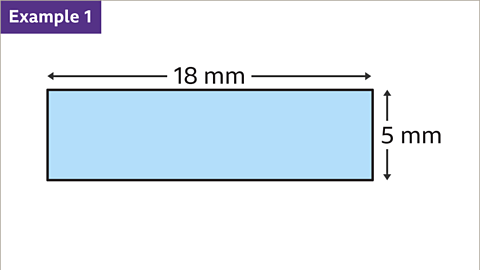
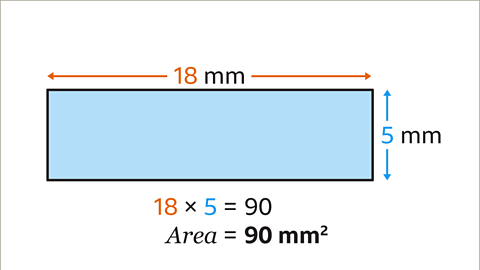
Image caption, Find the area of a rectangle with a length of 18 mm and a width of 5 mm.
1 of 8
Question
Find the area of the rectangle in square metres.
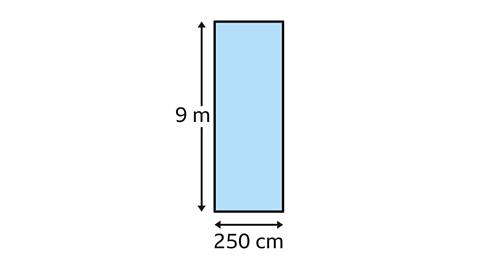
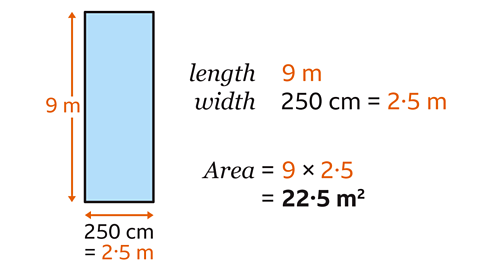
To calculate the area of the rectangle in square metres, both dimensions must be given in metres. The length of the rectangle is 9 m. The width of the rectangle is 250 cm. The width must be converted into metres.
250 cm is 2۰5 m.
The area of the rectangle is its length multiplied by its width, 9 × 2۰5 = 22۰5
The area of the rectangle is 22۰5 m².
How to find the area of a compound shape
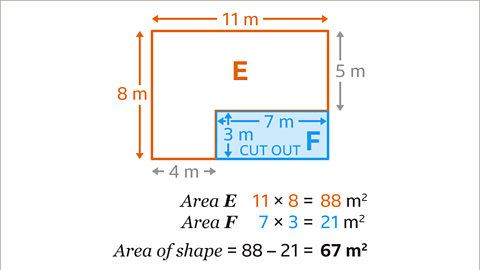
The area of a A shape formed by combining two or more shapes. may be calculated either by adding rectangles that create the shape or by subtracting a cut-out rectangle from a larger rectangle. Sometimes there is more than one way to work out the area of a compound shape.
To find the area of a compound shape using addition:
- Split the compound shape into rectangles that make the shape.
- For each separate rectangle, multiply the length and width to get its area.
- Add the separate rectangle areas to get the total area of the shape.
To find the area of a compound shape by using subtraction:
- Identify the large rectangle and the cut-out rectangle.
- For each rectangle, multiply the length and width to find its area.
- Subtract the cut-out rectangle area from the large rectangle area to find the area of the compound shape.
Example
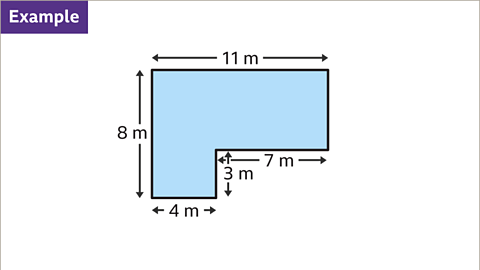
Image caption, Find the area of the compound shape.
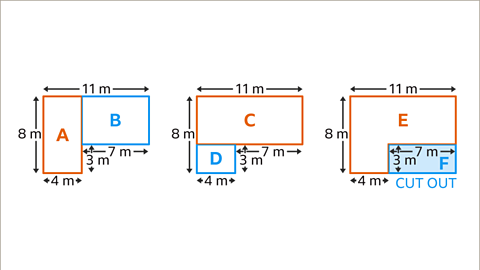
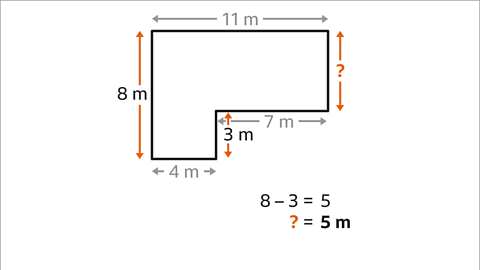
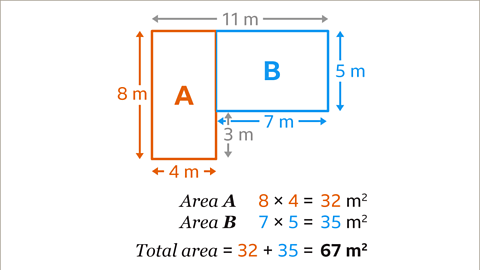
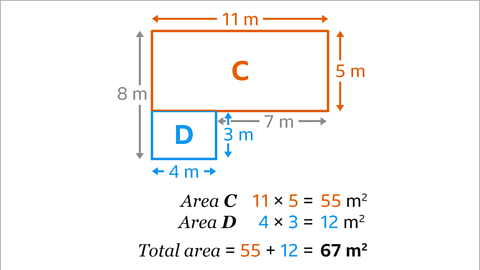
1 of 6
Practise finding the area of squares, rectangles and compound shapes
Quiz
Practise finding the area of squares, rectangles and compound shapes in this quiz. You may need a pen and paper to help you with your answers.
Real-life maths
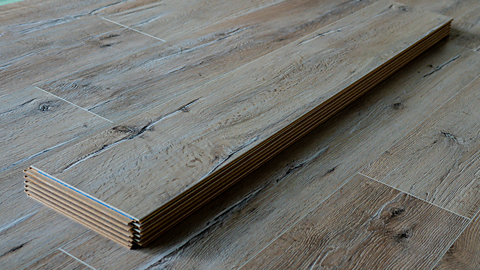
An interior designer will calculate floor area when changing the floor covering in a room. Flooring materials, including laminate slats, are sold by the square metre.
For a rectangular floor measuring 4 m by 3 m the total area would be 4 × 3 = 12 m². Laminate slats may come in packs that will cover 1۰8 m².
The number of packs needed is found by dividing the total area of the floor by the area coverage of each pack,12 ÷ 1۰8 = 6∙6
The designer will need to buy seven packs so that they have sufficient laminate slats to cover the whole floor.
Play Sudoku with BBC Bitesize!
Every weekday we release brand new easy, medium and hard Sudoku puzzles. Perfect for testing your skill with numbers and logic.

More on Perimeter, Area, Volume
Find out more by working through a topic
- count3 of 11
- count4 of 11
- count5 of 11
- count6 of 11

