CCEA GCSE Chemistry (Single Science) past papers and mark schemes
Here you can find CCEA past papers for GCSE Chemistry (Single Science). Use the links below to download question papers and mark schemes (which contain the answers).
If you’re unsure whether you need Foundation Tier or Higher Tier papers, consult your teacher.
CCEA past papers and mark schemes are the intellectual property of CCEA and are copyright © CCEA. All CCEA material is linked to with their permission.
Unit 1
Structures, Trends, Chemical Reactions, Quantitative Chemistry and Analysis
Foundation Tier
Summer 2025 - Past paper | Mark scheme
Summer 2024 - Past paper | Mark scheme
Summer 2023 - Past paper | Mark scheme
Higher Tier
Summer 2025 - Past paper | Mark scheme
Summer 2024 - Past paper | Mark scheme
Summer 2023 - Past paper | Mark scheme
Unit 2
Further Chemical Reactions, Rates and Equilibrium, Calculations and Organic Chemistry
Foundation Tier
Summer 2025 - Past paper | Mark scheme
Summer 2024 - Past paper | Mark scheme
Summer 2023 - Past paper | Mark scheme
Higher Tier
Summer 2025 - Past paper | Mark scheme
Summer 2024 - Past paper | Mark scheme
Summer 2023 - Past paper | Mark scheme
Unit 3
Practical Skills (Booklet A)
Foundation Tier
Summer 2025 - Past paper | Mark scheme
Summer 2024 - Past paper | Mark scheme
Summer 2023 - Past paper | Mark scheme
Higher Tier
Summer 2025 - Past paper | Mark scheme
Summer 2024 - Past paper | Mark scheme
Summer 2023 - Past paper | Mark scheme
Unit 3
Practical Skills (Booklet B)
Foundation Tier
Summer 2025 - Past paper | Mark scheme
Summer 2024 - Past paper | Mark scheme
Summer 2023 - Past paper | Mark scheme
Higher Tier
Summer 2025 - Past paper | Mark scheme
Summer 2024 - Past paper | Mark scheme
Summer 2023 - Past paper | Mark scheme
More CCEA mark schemes
You can find more chemistry past papers and mark schemes on the CCEA website.
Papers going back as far as 2018 are available there, in both standard and modified versions.
Five top tips for your chemistry revision

1. Definitions and key terms
There are lots of definitions and key terms in GCSE Chemistry. They are commonly asked in exams and often need to be word perfect. Make a list of all definitions and key terms and practise writing them out until you have memorised them. You can check them against CCEA's GCSE Chemistry Glossary of Terms.
2. Practical methods
There are nine prescribed practicals on the course. You may have to explain a practical method in a six-mark question, or draw a diagram of the apparatus used in an experiment. Use exam mark schemes to see examples of how you should structure your method in a six-mark question. CCEA's Chemistry Practical Manual, containing sample results and observations, is useful support here too.
3. Calculations
Mole calculations can be asked in Unit 1, 2 and 3 exams. The best way to improve at calculations is by practising questions from past papers. Don't give up if you struggle with the first few practice calculations you attempt. Use the mark schemes to see how the answer method is structured and your attempts will improve.
4. Balancing equations
Writing balanced equations can be challenging, in particular ionic and half equations. Use the Bitesize guide on symbols, formulae and equations to improve your skills. Even if you struggle with balancing an equation, you can still achieve two marks out of three on an equation question by writing the correct formulae for the reactants and products.
5. Practice makes perfect
Try to avoid spending all of your revision time learning notes. You also need to develop exam technique by completing multiple past papers. Once you have completed a past paper, make sure to mark your answers fully using the mark schemes. Make a note of any recurring errors you may be making so you can prioritise tackling those.
Five top tips for your chemistry exams

1. Consider the command
Read the command word in the question carefully. For example, being asked to give the formula of a substance (eg H2O) is not the same as being asked to name the substance (eg water).
2. Precision counts
Be precise. You can lose marks by using the incorrect scientific term in an otherwise good answer. It is also advisable to use clear, legible handwriting at all times. Remember too, to read the instructions on the front page of the exam – do not write outside the boxed area on each page, do not write on blank pages, complete questions in black ink and use a dark HB pencil for drawings and graphs.
3. Show your workings
Always show your working out in a calculation as you can still be awarded marks even if your final answer is incorrect. Remember to include units where relevant in your answers (eg g or kg for mass values).
4. Detail when drawing
When drawing a graph, plot your points accurately using an x. You should add a line of best fit (using a ruler) or a curve of best fit (drawn freehand), depending on the trend shown by your points. Your curved line should be a single line, not lots of overlapping sketched lines. When drawing a diagram, ensure all apparatus and chemicals are labelled, and that apparatus like delivery tubes and bungs do not show any blockages.
5. Hit for six
Do not be put off by six-mark questions. The information required in your answer will be clearly described in the question and you will not necessarily need to fill all of the answer lines. Write short, clear sentences and stop once you think you have covered all parts of the question. No marks will be given for writing additional information not asked for in the question.
Revise specific chemistry topics

If practising with past papers has highlighted a particular area you need to improve, then further help is at hand.
You can go straight to the most relevant Bitesize study guide for CCEA GCSE Chemistry (Single Science) and refresh your knowledge.
All topics are covered: Structures, trends, chemical reactions, quantitative chemistry, chemical analysis, rates and equilibrium, calculations and organic chemistry. There is also help and advice around prescribed practicals C1-C9.
Follow the links to the topic of your choice, where you'll find easy-to-understand revision materials, including videos, diagrams and quick quizzes.
Unit 1: Structures, trends, chemical reactions, quantitative chemistry and analysis
Atomic structure | Bonding | Structures | Nanoparticles | Symbols, formulae and equations | The periodic table | Quantitative chemistry (1) | Acids, bases and salts | Chemical analysis | Solubility
Unit 2: Further chemical reactions, rates and equilibrium, calculations and organic chemistry
Metals and the reactivity series | Redox, rusting and iron | Rates of reaction | Equilibrium | Organic chemistry | Quantitative chemistry (2) | Electrochemistry | Energy changes in chemistry | Gas chemistry
Unit 3: Prescribed practicals
C1 - Determine the mass of water in hydrated crystals | C2 - Investigate the reactions of acids | C3 - Investigate the preparation of soluble salts | C4 - Identify the ions in an ionic compound | C5 - Investigate the reactivity of metals | C6 - Investigate the rate of reaction | C7 - Investigate the reactions of carboxylic acids | C8 - Titration | C9 - Investigate the preparations and properties of gases | Practical skills
More GCSE Chemistry questions

There are plenty more chemistry questions to tackle with our Bitesize quizzes.
You can have a go at our quick-fire ten question GCSE Chemistry quiz or practise with 50 exam-style GCSE Chemistry questions.
You can also select which topic you want to focus on in this quiz based on GCSE Chemistry past papers. Choose from questions on: Atomic structure and the periodic table; Bonding, structure and the properties of matter; Quantitative chemistry and energy changes; Chemical changes; The rate and extent of chemical change; Organic chemistry and chemistry of the atmosphere; Chemical analysis and using resources.
Where can I get more help with my chemistry revision?
Explore more chemistry resources with the full range of help from Bitesize.
Chemistry - CCEA
Pinpoint areas to revise from the full list of GCSE Chemistry topics.
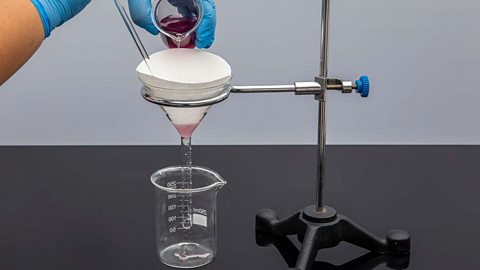
Chemistry revision resources
Get ready for your exams with quizzes, study guides, flashcards and more.
Support - exams and revision
Handy tips and advice for keeping on top of your studies and revision.

More on Exam practice
Find out more by working through a topic
- count2 of 4
- count3 of 4

- count4 of 4