What are the key learning points about organic chemistry?
Organic compounds contain carbon atoms. They can be sorted into groups called A family of organic compounds with the same general formula and in which each member differs by a CH2 unit. They show a gradation in physical properties and have similar chemical properties., such as: Saturated hydrocarbon. A compound of hydrogen and carbon only, with no C=C bonds and the general formula CnH2n+2., An unsaturated hydrocarbon containing at least one C=C and with the general formula CnH2n., An organic compound containing a hydroxyl group –OH and with the general formula CnH2n+1OH. and Organic compound containing the carboxyl group (-COOH) and with the general formula CnH2n+1COOH..
Alkanes, alkenes, alcohols and carboxylic acids all have different An atom, or group of atoms, that determines the main chemical properties of an organic compound., which affects the reactions they can undergo.
Organic A substance formed when two or more elements are chemically combined. are obtained from A mixture of comprised of hydrocarbons. It is a finite resource that has been formed over millions of years from dead plants and animals., which is separated into useful fractions by The separation of a mixture of several substances, such as crude oil, by heating; the evaporated components are collected as they condense at different temperatures..
What is bonding in organic compounds?
Organic chemistry is the study of carbon compounds.
Carbon can form four A covalent bond is formed by a shared pair of electrons., allowing it to form a wide range of carbon compounds.
It is easier to study these compounds by putting them into groups known as homologous series.
For organic compounds in a homologous series:
they have the same general formula,
their The actual number of atoms of each element present in a compound. differ by CH2,
they show a gradual variation in physical properties, such as their boiling points; and
they have similar chemical properties.
For GCSE you will study 4 different homologous series:
alkanes
alkenes
alcohols
carboxylic acids
What are alkanes?
The alkanes are saturated hydrocarbons.
Hydrocarbons are compounds which contain onlyhydrogen and carbon.
Alkanes are described as saturated because their carbon atoms are joined by C–C single bonds.
They do not contain C=C bonds.
The general formula for the alkanes is CnH2n+2.
Example
Decane is an alkane.
A molecule of decane contains 10 carbon atoms.
How to predict the molecular formula of decane
n = 10
∴ 2n + 2 = (2 × 10) + 2 = 22
Formula: C10H22
What are the first four alkanes?
The table below shows the first four alkanes.
What is crude oil?
Alkanes are obtained from crude oil, which is drilled up from under the Earth’s crust.
Crude oil is made of organisms that lived and died millions of years ago.
It is a complex mixture of A compound made of hydrogen and carbon atoms only..
Crude oil is an important source of fuels and is used as a raw material (feedstock) for the petrochemical industry, which makes plastics, rubber, solvents, lubricants and detergents.
Fractional distillation separates crude oil into simpler, more useful mixtures, because different hydrocarbons have different boiling points.
Each simpler mixture is called a fraction.
During fractional distillation:
Heated crude oil enters a tall fractioning column, which is hot at the bottom and cooler at the top.
A gas formed when a liquid evaporates or boils. from the oil rise through the column.
Each fraction condenses when it becomes cool enough, each at a different position in the column.
Pipes lead each fraction away.
Small hydrocarbon molecules have weak intermolecular forces, so they have low boiling points.
They do not condense, but leave the top of the column as gases.
Long hydrocarbon molecules have stronger intermolecular forces, so they have higher boiling points.
They leave the bottom of the column as hot, liquid A mixture of hydrocarbons obtained from crude oil distillation, used to cover road surfaces..
WATCH: How does fractional distillation work?
Fran Scott explains fractional distillation - the separation of crude oil into fractions
What is cracking?
Cracking is a reaction in which larger A saturated hydrocarbon contains no carbon-to-carbon double bonds, only single bonds. hydrocarbon molecules are broken down into smaller, more useful hydrocarbon molecules, some of which are unsaturated:
the original starting hydrocarbons are Saturated hydrocarbon. A compound of hydrogen and carbon only, with no C=C bonds and the general formula CnH2n+2.; and
the products of cracking include alkanes and An unsaturated hydrocarbon containing at least one C=C and with the general formula CnH2n., members of a different A family of organic compounds with the same general formula and in which each member differs by a CH2 unit. They show a gradation in physical properties and have similar chemical properties.,
For example, hexane can be cracked to form butane and ethene as shown by the equation below:
hexane → butane + ethene
C6H14 → C4H10 + C2H4.
The starting compound will always fit the rule for an alkane, CnH2n+2.
The first product will also follow this rule.
The second product will contain all the other C and H atoms and a C=C.
Question
Octane (C8H18) is cracked to form pentane (C5H12), and one other product.
Write a symbol equation for this cracking reaction.
Answer
C8H18 → C5H12 + C3H6
The second product of the cracking reaction is propene (C3H6), which represents the leftover C and H atoms.
What happens during the combustion of alkanes?
Combustion is the reaction of a fuel with oxygen to produce oxides and release heat.
Alkanes can undergo either complete combustion or incomplete combustion depending on the amount of oxygen available for combustion.
What is complete combustion?
Complete combustion occurs when there is a plentiful supply of oxygen.
The carbon and hydrogen atoms react with oxygen in an A physical change or chemical reaction that transfers energy to the surroundings. reaction.
Carbon dioxide and water are produced.
The maximum amount of energy is given out.
In general:
hydrocarbon + oxygen → carbon dioxide + water
For example, the equation for the complete combustion of propane is:
propane + oxygen → carbon dioxide + water
C3H8 + 5O2 → 3CO2 + 4H2O
Question
Write the balanced symbol equation for the complete combustion of ethane.
Answer
ethane + oxygen → carbon dioxide + water
2C2H6 + 7O2 → 4CO2 + 6H2O
The symbol equation could also be written as:
C2H6 + 3.5O2 → 2CO2 + 3H2O
Balancing numbers do not need to be Any number which does not need a decimal point. Also known as an integer. as they refer to the A mole of a substance is its relative atomic mass in grams.A ratio is a way to show the relationship between amounts of one substance compared to another. It is usually written in the form a:b. of the chemicals, and numbers of moles do not have to be whole numbers.
The most straightforward order to balance a combustion equation is: carbon atoms first, hydrogen atoms second and oxygen atoms third.
Key fact
The products of complete combustion can be identified by chemical tests.
Carbon dioxide can be bubbled through limewater (turns from colourless to cloudy).
Water can be condensed on a cold surface and tested with anhydrous copper(II) sulfate (turns from white to blue).
What is incomplete combustion?
Incomplete combustion occurs when there is a limited supply of oxygen.
Carbon (soot), carbon monoxide, and water are produced.
Less energy is released, compared to complete combustion.
In equations for incomplete combustion, the products are carbon monoxide and water.
Soot is not included in the equation.
For example:
butane + oxygen → carbon monoxide + water
C4H10 + 4.5O2 → 4CO + 5H2O
What are the problems with combustion?
Combustion produces four major atmospheric pollutants: carbon dioxide, carbon monoxide, soot and sulfur dioxide.
Carbon dioxide is a cause of the The trapping of the sun’s heat in the earth’s atmosphere by gases such as methane, carbon dioxide and water vapour. An increased greenhouse effect can lead to climate change. that can cause climate change, rising sea levels and increased flooding of low-lying areas.
Carbon monoxide is a toxic gas that binds to The chemical in red blood cells in which oxygen binds to be carried from the lungs to the rest of the body. in red blood cells in the body and prevents them from carrying oxygen.
Soot (carbon) can cause lung irritation if breathed in.
Sulfur dioxide is produced by combustion of fuels that contain sulfur impurities. Sulfur dioxide dissolves in rainwater causing acid rain, which can destroy vegetation, damage buildings and kill fish in lakes and rivers.
What are alkenes?
The alkenes are unsaturated hydrocarbons.
Hydrocarbons – because they contain hydrogen and carbon only.
Unsaturated – because they contain at least one C=C.
Each alkene containing one C=C has two fewer hydrogen atoms than the corresponding Saturated hydrocarbon. A compound of hydrogen and carbon only, with no C=C bonds and the general formula CnH2n+2..
Alkenes have a An atom, or group of atoms, that determines the main chemical properties of an organic compound., C=C.
A functional group is a reactive group in a molecule.
Alkanes, in contrast, do not have a functional group and are less reactive as a result.
The general formula for the alkanes is CnH2n.
What are the first four alkenes?
The table below shows the first four alkenes:
Note: But-1-ene and but-2-ene have the same The actual number of atoms of each element present in a compound..
The only difference between the two molecules is the position of the double bond.
The number within each name describes the position of the double bond in the carbon chain.
What happens during the combustion of alkenes?
Alkenes combust in a similar way to alkanes.
What is complete combustion of alkenes?
Complete combustion of alkenes produces carbon dioxide and water, provided there is a plentiful supply of oxygen.
For example:
propene + oxygen → carbon dioxide + water
C3H6 + 4.5O2 → 3CO2 + 3H2O
What is incomplete combustion of alkenes?
Incomplete combustion of alkenes occurs where oxygen is limited and produces water, carbon monoxide and carbon (soot).
For example:
propene + oxygen → carbon monoxide + water
C3H6 + 3O2 → 3CO + 3H2O
What are addition reactions involving alkenes?
Addition reactions occur when two molecules combine to form one molecule.
In alkenes, the C=C bond breaks, which gives room for two new bonds to the carbon atoms.
What happens in an addition reaction using bromine?
Bromine (Br2) can combine with alkenes in an addition reaction.
C2H4 + Br2 → C2H4Br2
How can bromine water be used to identify alkanes and alkenes?
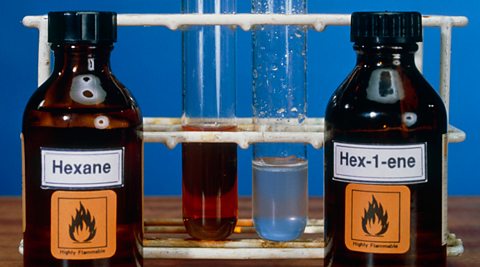
You can use bromine water to distinguish between alkanes and alkenes.
Bromine water is added to two different test tubes, one containing an alkane and the other an alkene, and they are shaken.
The bromine water remains orange in the alkane, but changes from orange to colourless in the alkene.
What happens in an addition reaction using hydrogen?
Hydrogen gas can combine with alkenes in an addition reaction to form alkanes.
This process is called hydrogenation, and it requires a A substance that speeds up a chemical reaction without being used up or chemically changed. It does this by providing an alternative reaction pathway with a lower activation energy..
For example:
propene + hydrogen → propane
C3H6 + H2 → C3H8
What happens in an addition reaction using steam?
Steam is the gas form of water.
Steam can combine with alkenes in an addition reaction to form alcohols.
This process is called hydration.
It requires a high temperature and a catalyst.
For example:
ethene + water (steam) → alcohol
C2H4 + H2O → C2H5OH
What is addition polymerisation?
A polymer is a long chain molecule made up of small, repeating units.
These small molecules, called monomers join together in a long chain to make polymers.
For example: polyethene is a polymer made from a very large number of ethene molecules bonded together.
The reaction is called an addition polymerisation reaction.
Ethene is the monomer and polyethene is the polymer.
To avoid having to write out a large structure in the polymer, a short two-carbon segment is shown in brackets.
This is called the repeating unit.
Equations use repeating units to model addition polymerisation reactions.
The letter n stands for a large number.
Polychloroethene is commonly known by the initials of its old name, PVC (polyvinyl chloride).
Polychloroethene is made by polymerising chloroethene (an ethene molecule in which one of the hydrogens has been replaced with a chlorine).
How to dispose of polymers
Polymers are unreactive, so they are suitable for storing food and chemicals safely.
Unfortunately, this also makes them difficult to dispose off.
They are often buried in landfill sites or incinerated.
Landfill
Waste polymers are disposed in landfill sites, but this uses valuable land and suitable sites often fill up quickly.
Incineration
Polymers release a lot of energy when they burn, which can be used to heat homes or generate electricity.
But burning polymers produces carbon dioxide, adding to global warming, and can release toxic gases.
What are alcohols?
The alcohols form a A family of organic compounds with the same general formula and in which each member differs by a CH2 unit. They show a gradation in physical properties and have similar chemical properties..
The general formula for the alcohols is: CnH2n+1OH
The alcohols’ An atom, or group of atoms, that determines the main chemical properties of an organic compound. is –OH. It is responsible for the alcohols’ typical reactions.
What are the first four alcohols?
The table shows the first four alcohols:
How is ethanol produced?
Ethanol, C2H5OH, is an useful alcohol which is found in alcoholic drinks, fuels and solvents.
It can be produced by the Chemical reaction in which water reacts with a substance. of steam or the An anaerobic process in which yeast converts sugar to ethanol and carbon dioxide at a warm temperature. of sugar.
What is hydration of ethene?
Ethene can react with steam in an addition reaction to produce ethanol.
ethene + steam → ethanol
C2H4 + H2O → C2H5OH
How is ethanol made by fermentation?
In fermentation, a sugar solution is mixed with yeast to produce ethanol and carbon dioxide.
It takes place under the following conditions:
anaerobic conditions (no air can get in) and
a warm (25°C – 35°C) temperature.
What happens during the combustion of alcohols?
Alcohols completely combust in the presence of oxygen to form carbon dioxide and water.
For example:
ethanol + oxygen → carbon dioxide + water
C2H5OH + 3O2 → 2CO2 + 3H2O
They combust incompletely when oxygen is in limited supply, producing water and either carbon monoxide or carbon (soot).
Question
Write a balanced symbol equation for the incomplete combustion of methanol.
Answer
methanol + oxygen → carbon monoxide + water
CH3OH + O2 → CO + 2H2O
What is the oxidisation of alcohols? (Higher tier only)
Methanol, ethanol and propan-1-ol can be oxidised to produce carboxylic acids:
Propan-2-ol can also be oxidised but for GCSE you do not need to know the product of this reaction.
A chemical reaction where a substance reacts with oxygen to form an oxide. Iron reacts with oxygen in the air to produce iron oxide, better known as rust. of an alcohol can take place in two ways:
Exposure to oxygen in the air – this is a slow process.
Reaction with acidified potassium dichromate solution. This can be mixed with an alcohol in a test tube and warmed in a warm water bath.
Acidified potassium dichromate solution is an orange solution that changes green when the alcohol is oxidised.
The reaction of acidified potassium dichromate can be used as a test for an alcohol.
What are carboxylic acids?
The carboxylic acids form a homologous series with the general formula CnH2n+1COOH.
The functional group in the carboxylic acids is the carboxyl group –COOH.
It is responsible for the carboxylic acids’ typical reactions.
They are weak acids as they are partially ionised in solution.
What are the first four carboxylic acids?
The first four carboxylic acids (higher tier only) are:
How do carboxylic acids react?
Carboxylic acids show the normal characteristic reactions of weak acids.
When carboxylic acids react with acids they form A compound formed during a neutralisation reaction when some or all of the hydrogen ions in an acid are replaced with metal ions or ammonium ions.:
Methanoic acid forms methanoate salts; the methanoate An atom or molecule that has either a positive or negative electrical charge. is HCOO-
Ethanoic acid forms ethanoate salts; the ethanoate ion is CH3COO-
Propanoic acid forms propanoate salts; the propanoate ion is C2H5COO-
Butanoic acid forms butanoate salts; the butanoate ion is C3H7COO-
Key fact
When writing the formulae of carboxylic acid salts, the symbol for the metal is normally written at the end of the formula.
For example, the formula of sodium ethanoate is CH3COONa.
How do carboxylic acids react with metals?
acid + metal → salt + hydrogen
For example:
ethanoic acid + magnesium → magnesium ethanoate + hydrogen
2CH3COOH + Mg → (CH3COO)2Mg + H2
Example observations: solid metal disappears, fizzing, heat produced, colourless solution produced.
How do carboxylic acids react with hydroxides?
acid + metal hydroxide → salt + water
For example:
methanoic acid + sodium hydroxide → sodium methanoate + water
HCOOH + NaOH → HCOONa + H2O
Example observations: heat produced, colourless solution produced.
How do carboxylic acids react with carbonates?
acid + metal carbonate → salt + water + carbon dioxide
For example:
propanoic acid + calcium carbonate → calcium propanoate + water + carbon dioxide
2C2H5COOH + CaCO3 → (C2H5COO)2Ca + H2O + CO2
Example observations: solid disappears, fizzing, heat produced, colourless solution produced (unless copper carbonate is used – a blue solution would be produced).
Prescribed practical C7: Investigate the reactions of carboxylic acids
Please use the link below to access the article on: Prescribed practical (C7) - Investigate the reactions of carboxylic acids
How to test for organic compounds
The table below shows the observations when a reaction occurs with organic compounds using certain tests.
| Organic compound | Test using bromine water | Test using acidified potassium dichromate solution | Test using magnesium ribbon |
|---|---|---|---|
| Alkanes | Remains orange | Remains orange | No fizzing |
| Alkenes | Changes from orange to colourless | Remains orange | No fizzing |
| Alcohols | Remains orange | Solution changes from orange to green | No fizzing |
| Carboxylic acid | Remains orange | Remains orange | Fizzing |
These tests can be used to distinguish between different organic compounds.
How much do you know about organic chemistry?
More on Unit 2: Further chemical reactions, rates and equilibrium, calculations and organic chemistry
Find out more by working through a topic
- count6 of 9

- count7 of 9
- count8 of 9
- count9 of 9