What are the key learning points about gas chemistry?
The Earth’s The atmosphere is the layer of gases surrounding a planet. consists of a mixture of gases: nitrogen, oxygen, carbon dioxide, argon and other The elements in Group 0 of the Periodic Table, named for their lack of chemical reactivity., and water vapour.
Nitrogen is a highly unreactive gas that is used as a coolant and in food packaging.
Ammonia is a pungent gas that is reacted to make ammonium salts that can be used as A substance added to the soil to help plants to grow..
Hydrogen is a Something which is flammable sets on fire easily. gas that can be prepared from the reaction of magnesium or zinc with hydrochloric acid. It is used in weather balloons.
Oxygen is a gas that reacts with many elements to produce When an acid is dissolved in water it makes an acidic solution. and basic A compound which contains an element bonded to oxygen. . It is used in Joining metals by melting and fusing the adjoining edges or surfaces..
Carbon dioxide is an acidic gas that can be tested for by bubbling through limewater. It is used in fizzy drinks.
What gases are in the atmosphere?
The Earth’s atmosphere consists of the following gases:
78% nitrogen
21% oxygen
0.03% - 0.04% carbon dioxide
about 1% argon
small proportions of other The elements in Group 0 of the Periodic Table, named for their lack of chemical reactivity.; and
varying proportions of water vapour.
Can you order the gases in the Earth's atmosphere?
What type of gas is nitrogen?
Nitrogen is the most abundant gas in the Earth’s atmosphere.
It is an example of a Two atoms covalently bonded. element (N2).
What are nitrogen's physical properties?
Nitrogen is:
colourless
odourless
An insoluble substance does not dissolve in water. For example, wax will not dissolve in water. in water; and
very unreactive.
How reactive is nitrogen?
Nitrogen is a highly unreactive gas:
A nitrogen molecule has a strong triple A covalent bond is formed by a shared pair of electrons. between the nitrogen atoms.
This strong triple covalent bond requires a large of amount energy to break before the nitrogen atoms can react with other atoms.
What is nitrogen used for?
We use nitrogen in two main ways:
Liquid nitrogen is very cold and is a good coolant.
Nitrogen gas provides an inert (unreactive) atmosphere in food packaging, helping to keep the contents fresh.
What type of gas is ammonia?
Ammonia gas (NH3) is a compound that can be produced from the reaction of nitrogen and hydrogen.
What are ammonia's physical properties?
Ammonia is:
- pungent
- soluble in water; and
- less dense than air.
How to test for ammonia
Method: Dip a glass rod in concentrated hydrochloric acid and put this in a sample of the gas.
Result: If ammonia is present, a white fume of ammonium chloride is observed.
Equation: NH3(g) + HCl(g) → NH4Cl(s)
What is ammonia used for?
When ammonia reacts with an acid, an ammonium salt is produced.
Ammonium salts are used as A substance added to the soil to help plants to grow..
There are three common acids, hydrochloric acid (HCl), nitric acid (HNO3) and sulfuric acid (H2SO4), each of these acids will react with ammonia to produce a different salt.
Here are the reactions to make three different ammonium salts:
ammonium chloride: NH3 + HCl → NH4Cl
ammonium nitrate: NH3 + HNO3 → NH4NO3
ammonium sulfate: 2NH3 + H2SO4 → (NH4)2SO4
The ammonium salts are very soluble in water, so they can dissolve in soil water and be absorbed by plants – this makes them useful as fertilisers.
What type of gas is hydrogen?
Hydrogen is a light, Something which is flammable sets on fire easily. gas that is another example of a diatomic element (H2).
What are the physical properties of hydrogen?
Hydrogen is:
colourless
odourless
insoluble in water; and
less dense than air.
How is hydrogen gas prepared and collected?
We prepare hydrogen by reacting zinc or magnesium with dilute hydrochloric acid:
Zn + 2HCl → ZnCl2 + H2
Mg + 2HCl → MgCl2 + H2
Hydrogen is insoluble in water, so it can be collected using a gas jar in a trough of water.
A gas jar is filled with water and placed on top of a beehive shelf.
The hydrogen gas passes through the delivery tube and displaces the water from the gas jar.
A thistle funnel is used so the hydrochloric acid can be added easily to the conical flask.
It is important that the end of the funnel is submerged in the acid or the hydrogen gas would escape the flask.
How to test for hydrogen
A lit splint applied to hydrogen gas will result in a popping sound.
What is hydrogen used for?
Making the fats in margarines solidify.
Weather balloons.
Hydrogen also has potential as a ‘clean fuel’ fuel for vehicles. The only product of the combustion of hydrogen is water which is non-polluting.
What type of gas is oxygen?
Oxygen is a Two atoms covalently bonded. element (O2) that is essential for life on Earth.
What are the physical properties of oxygen?
Oxygen is:
colourless
odourless
denser than air; and
slightly A solid is soluble if it can dissolve into a specific solvent. For example, salt and sugar are both soluble in water. in water.
How is oxygen prepared?
Oxygen can be made from hydrogen peroxide, which decomposes slowly to form water and oxygen:
hydrogen peroxide → water + oxygen
2H2O2(aq) → 2H2O(l) + O2(g)
The rate of reaction can be increased using a catalyst, manganese(IV) oxide.
(A catalyst is a substance that speeds up a reaction without being used up – it can be removed after this reaction is finished by filtration.)
Hydrogen peroxide is a colourless solution, and manganese(IV) oxide is a black solid.
To make oxygen in the laboratory the same apparatus that was used for the preparation of hydrogen is used.
How to test for oxygen
A glowing splint applied to a sample of oxygen gas will relight.
What are the uses of oxygen?
Oxygen is used in medicine to help patients with breathing difficulties.
In welding, acetylene gas is mixed with oxygen to increase the burn temperature. Oxyacetylene welding is used to cut and weld steel.
How do other elements react with oxygen?
| Element | Type | Observations | Equation | Nature of oxide |
|---|---|---|---|---|
| Carbon | Non-metal | Carbon glows orange when heated strongly, producing a colourless gas. | C + O2 → CO2 | Acidic |
| Sulfur | Non-metal | Yellow solid melts to a red liquid and burns with a blue flame to produce a colourless pungent gas. | S + O2 → SO2 | Acidic |
| Magnesium | Metal | Burns with a bright white light, white solid formed. | 2Mg + O2 → 2MgO | Basic |
| Iron | Metal | Burns with orange sparks producing a black solid. | 3Fe + 2O2 → Fe3O4 | Basic |
| Copper | Metal | Glows red, occasionally with blue-green flame, forming a black layer on the metal surface. | 2Cu + O2 → 2CuO | Basic |
A basic oxide reacts with Corrosive substance which has a pH lower than 7. Acidity is caused by a high concentration of hydrogen ions., and an acidic oxide reacts with A base which is soluble in water. A base is a substance which neutralises an acid. .
Metals react with oxygen to produce basic oxides, while non-metals react with oxygen to produce acidic oxides.
What type of gas is carbon dioxide?
Carbon dioxide (CO2) is a gas that is produced in many chemical reactions.
What are the physical properties of carbon dioxide?
Carbon dioxide is:
colourless
odourless
slightly soluble in water; and
more dense than air.
How is carbon dioxide prepared?
Carbon dioxide is prepared from the reaction of solid calcium carbonate and hydrochloric acid.
CaCO3(s) + 2HCl(aq) → CaCl2(aq) + CO2(g) + H2O(l)
It is prepared using the same apparatus that was used for hydrogen and oxygen.
What is carbon dioxide used for?
Fizzy drinks.
Fire extinguishers – carbon dioxide is more dense than air so can sink and smother a flame.
How to test for carbon dioxide
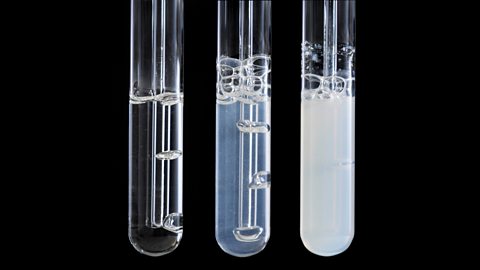
Bubble the gas through limewater.
The limewater will change from colourless to milky if carbon dioxide is present.
How does carbon dioxide react with water?
Carbon dioxide reacts with water to form the weak acid, carbonic acid, H2CO3:
CO2 + H2O → H2CO3
Carbonic acid causes the acidity in fizzy drinks.
How does carbon dioxide react with limewater?
Carbon dioxide reacts with limewater (a solution of calcium hydroxide, Ca(OH)2), to form a white precipitate (appears milky) of calcium carbonate, CaCO3.
Ca(OH)2(aq) + CO2(g) → CaCO3(s) + H2O(l)
Adding more carbon dioxide results in the precipitate dissolving to form a colourless solution of calcium hydrogencarbonate.
CaCO3(s) + CO2(g) + H2O(l) → Ca(HCO3)2(aq)
Prescribed practical C9: Investigate the reaction of gases
Please use the link below to access the article on: Prescribed practical C9 - Investigate the preparation, properties, tests and reactions of the gases hydrogen, oxygen and carbon dioxide
How much do you know about gas chemistry?
More on Unit 2: Further chemical reactions, rates and equilibrium, calculations and organic chemistry
Find out more by working through a topic
- count1 of 9
- count2 of 9
- count3 of 9
- count4 of 9