Key points
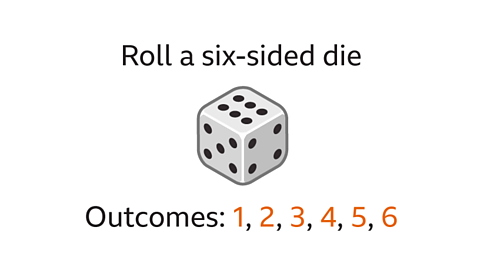
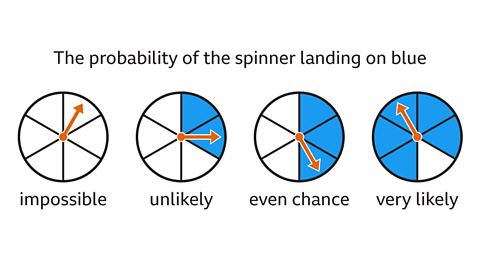
A The chance of an event happening. The probability of an event has a value from 0 to 1 and is written as a fraction, a decimal or as a percentage. The notation for the probability of an event is P(event). is how likely something is. The The answer to an addition calculation of the probabilities of all the possible When a coin is tossed there are two possible outcomes, ‘head’ or ‘tail’. When a normal die is rolled there are six possible outcomes, 1, 2, 3, 4, 5 and 6 is 1. One of the outcomes will definitely happen.
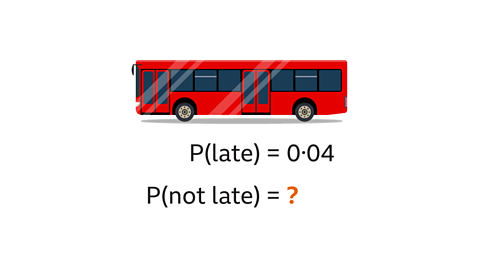
The probability of something happening and the probability of it not happening add up to one. It is certain that an A possible outcome, for example ‘heads’ when a coin is tossed. will either happen or not happen, and that is a probability of 1.
The missing value of a probability can be worked out by subtracting the known probabilities from 1 (100% when working in percentages). The calculations may involve fractions, decimals or percentages.
When adding and subtracting probabilities to calculate unknown probability values, it is helpful to be able to add and subtract fractions and decimals.
Use the fact that the sum of probabilities of an event is 1
- To find a missing probability value:
- Add up the given probabilities.
- Subtract the total of the probabilities from 1 (100% when working in percentages).
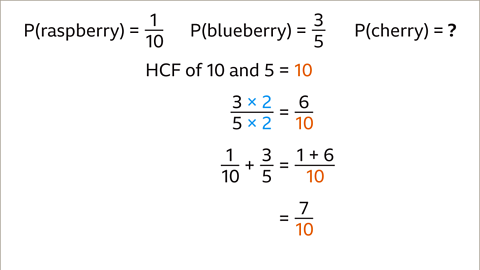
- To add and subtract fractions, use a A denominator that is the same for two or more fractions. .
Examples
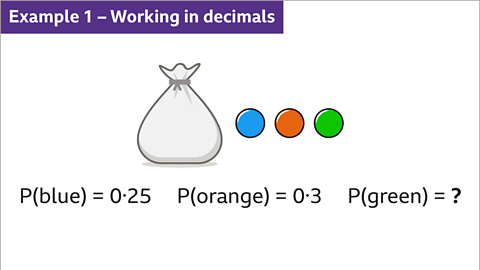
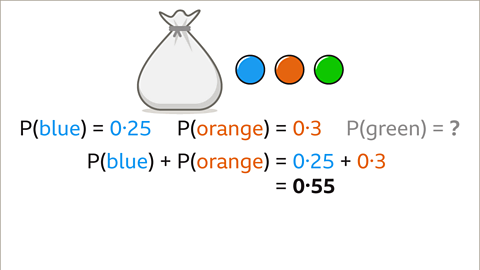
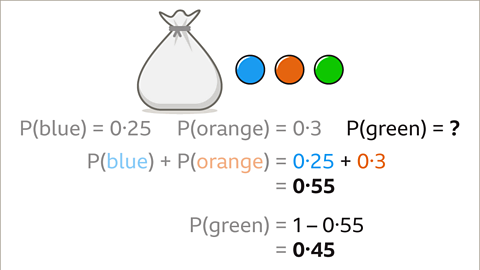
Image caption, A bag only contains blue, orange and green counters. A counter is taken at random from the bag. P(blue) = 0۰25, P(orange) = 0۰3. Work out P(green).
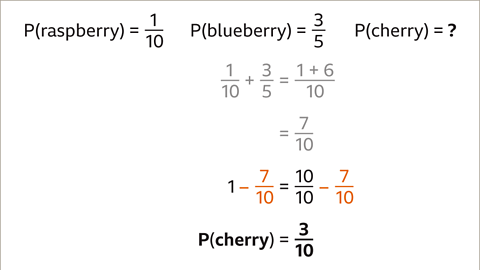
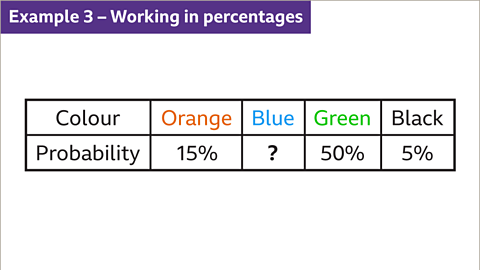
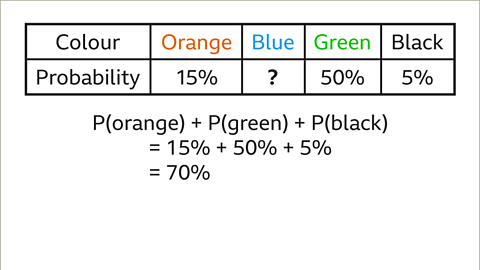
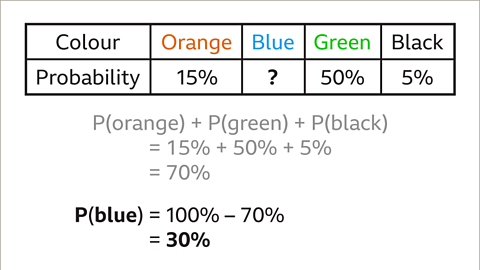
1 of 9
Question
A raffle ticket may be purple, blue or green.
The probability of a purple ticket is \( \frac{2}{5}\).
The probability of a blue raffle ticket is \( \frac{1}{4}\).
Find the probability of a green raffle ticket.
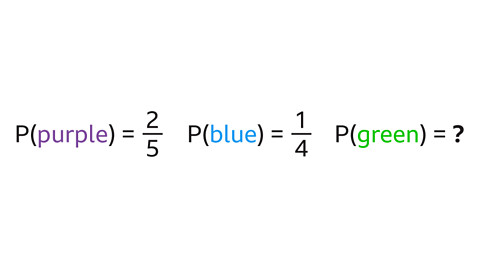
P(green) is the sum of the known probabilities subtracted from 1
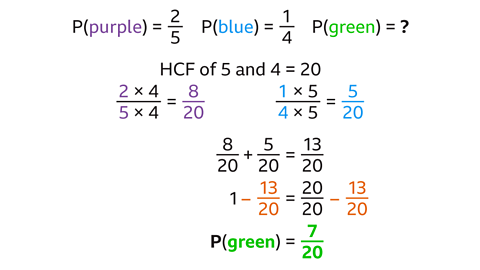
Sum the given probabilities, P(purple) + P(blue). The HCF of 5 and 4 is 20
This is the common denominator used to add the fractions.
The equivalent fraction for \( \frac{2}{5} \) is \( \frac{8}{20} \).
The equivalent fraction for \( \frac{1}{4} \) is \( \frac{5}{20} \).
The sum of \( \frac{8}{20} \) and \( \frac{5}{20} \) is \( \frac{13}{20} \).
Subtract \( \frac{13}{20}\), the sum of the known probabilities, from 1
P(green) = \( \frac{7}{20} \).
Calculate the probability that an event does not happen
The The chance of an event happening. The probability of an event has a value from 0 to 1 and is written as a fraction, a decimal or as a percentage. The notation for the probability of an event is P(event). of an A possible outcome, for example ‘heads’ when a coin is tossed. happening and the probability of the same event not happening sum to 1. It is certain that the event will either happen or not happen.
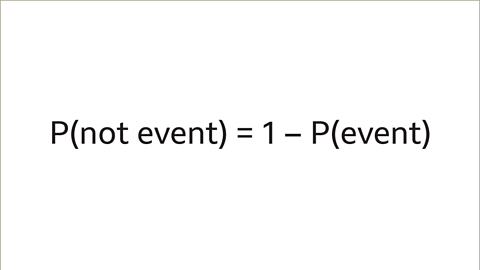
To find probability that an event does not happen.
- Subtract the P(event) from 1
The calculation may involve a fraction, decimal or percentage.
Examples
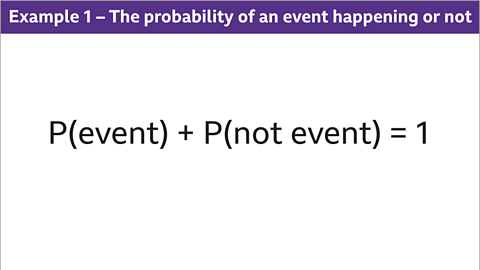
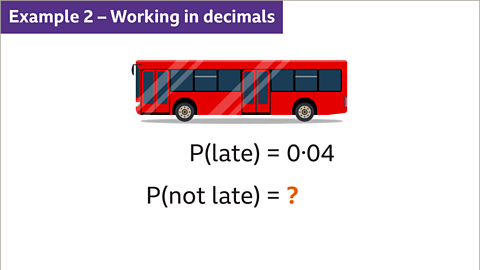
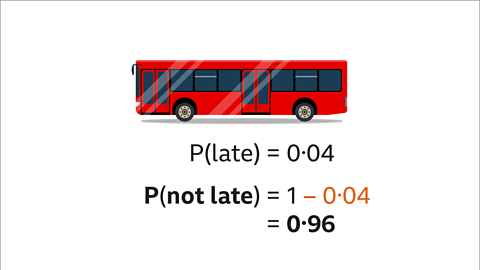
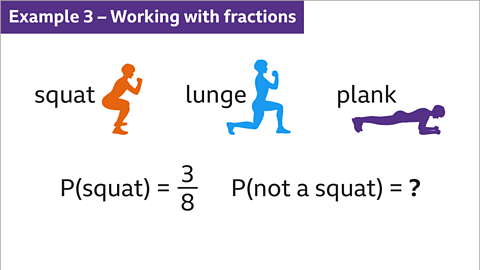
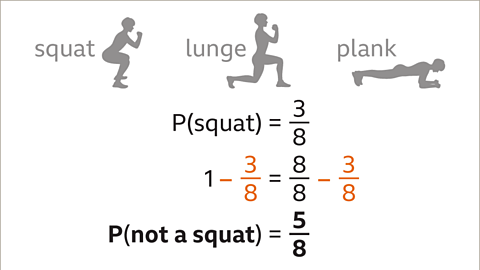
Image caption, The probability of an event happening and the probability of the same event not happening sum to 1. It is certain that the event will either happen or not happen.
1 of 6
Question
The probability that it will rain is \( \frac{1}{5}\).
What is the probability that it will not rain?
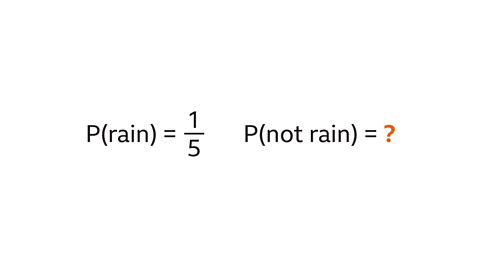
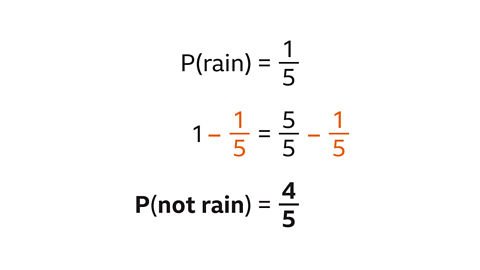
The probability that it will not rain is found by subtracting the probability that it will rain from 1
1 – \( \frac{1}{5} \) = \( \frac{4}{5} \).
P(not rain) = \( \frac{4}{5} \).
Practise finding the sum of probabilities
Practise working out the sum of probabilities with this quiz. You may need a pen and paper to help you with your answers.
Quiz
Real-life maths
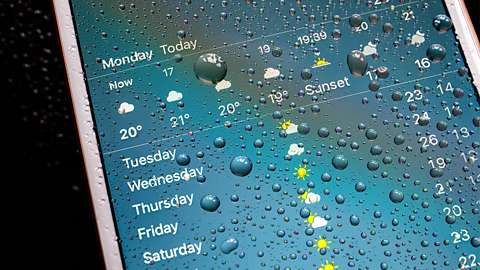
A meteorologist studies the weather, working with data to assess how likely it is that there will be rain, snow, wind or sun on a given day in a particular area. People use the information given by meteorologists, such as on a weather app, to make decisions when planning activities.
For example, if the probability of rain is 10%, then the probability of no rain is 90%, meaning doing something outdoors could be more appealing. If the probability of rain is 70%, this could put people off, making them decide to stay indoors instead.
Play Sudoku with BBC Bitesize!
Every weekday we release brand new easy, medium and hard Sudoku puzzles. Perfect for testing your skill with numbers and logic.

More on Calculating probabilities
Find out more by working through a topic
- count4 of 5
- count2 of 5