Key points
Listing all possible outcomes of an event can be used to work out probabilities. The The chance of an event happening. The probability of an event has a value from 0 to 1 and is written as a fraction, a decimal or as a percentage. The notation for the probability of an event is P(event). of an event can be written as a fraction where the Number written at the top of a fraction. The numerator is the number of parts used. Eg, for 1⁄3, the numerator is 1 is the number of outcomes where the event happens, and the Number written on the bottom of a fraction. The denominator is the number of equal parts. Eg, for 1⁄3, the denominator is 3 is the total number of outcomes.
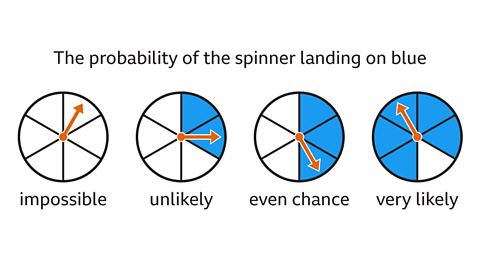
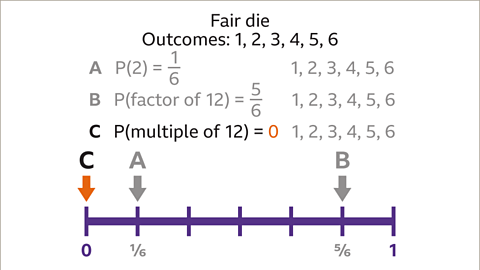
Probabilities can also be presented on a This is a scale between 0 (zero) and 1. 0 means the event is impossible. 1 means the event is certain. .
A probability of zero means an outcome is impossible. A probability of 1 means an outcome is certain. All other probabilities have a value between 0 and 1.
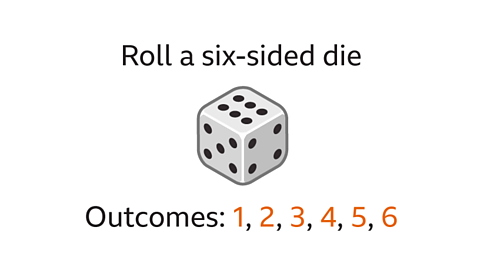
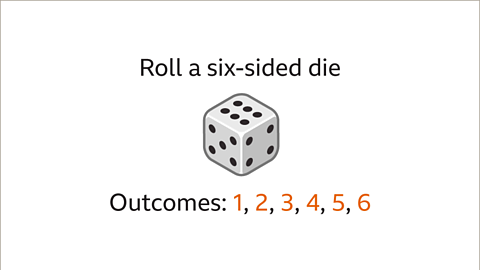
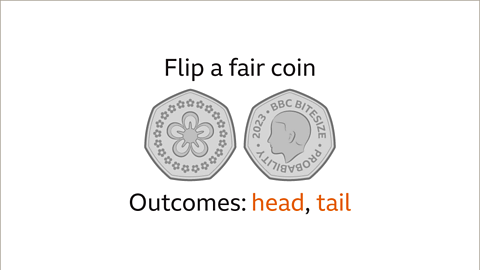
A potential result. When a coin is tossed there are two possible outcomes, ‘head’ or ‘tail’. When a normal die is rolled there are six possible outcomes, 1, 2, 3, 4, 5 and 6. are equally likely when they have the same probability.
- A Unbiased. The probability of each outcome is equal. The probability of rolling each number on a fair die is the same, each number has the same chance of occurring. The die is unbiased. coin is equally likely to land on heads or on tails.
- A fair six-sided Singular of 'dice'. Dice is plural. One die, two (or more) dice. is equally likely to land on 1, 2, 3, 4, 5 or 6.
- A spinner that has half its sectors coloured blue and the other half white, is equally likely to stop on blue or on white.
Knowing about number facts, including recognising factors, multiples, prime numbers and square numbers, is useful when working through probability questions.
Listing outcomes
Listing outcomes means writing down all the possible outcomes of an event.
An A possible outcome, for example ‘heads’ when a coin is tossed. could be the result of:
- rolling a standard six-sided die
- flipping a fair coin
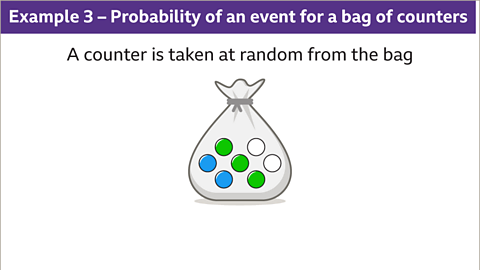
- taking a counter at random out of a bag
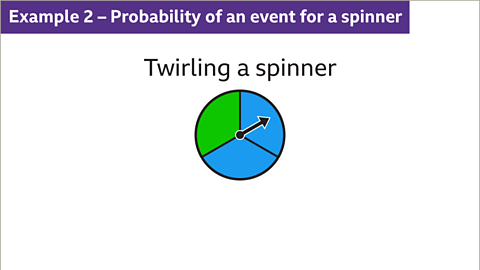
- twirling a coloured spinner
When there is one of each outcome, usually the outcomes are equally likely. If there are more of one outcome than another, the outcomes are not equally likely.
Examples
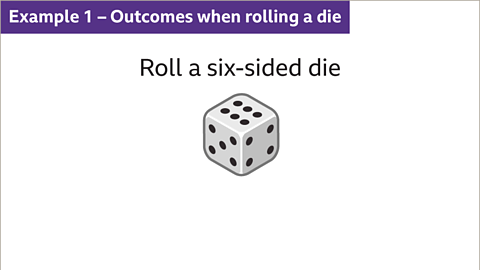
Image caption, List all the possible outcomes for rolling a fair standard six-sided die.
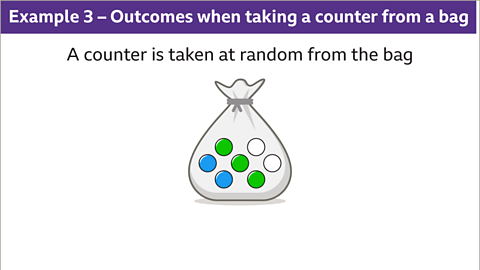
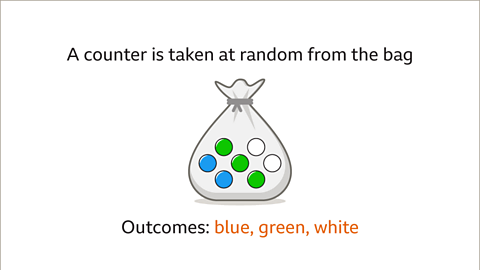
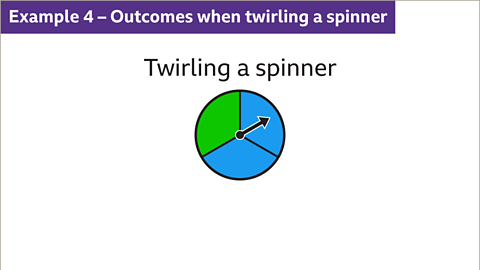
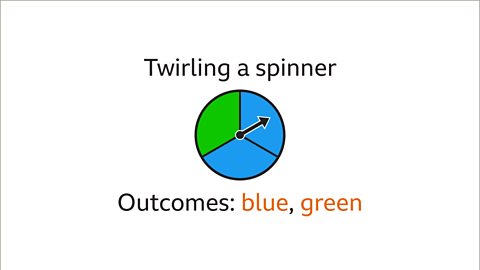
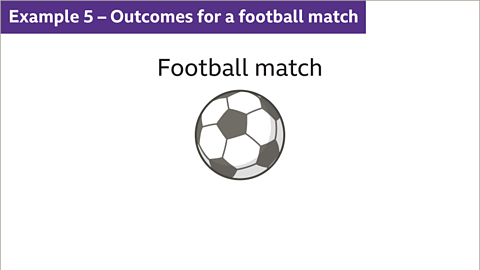
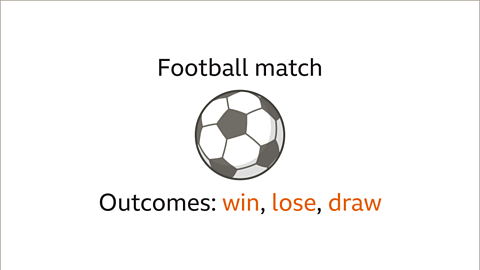
1 of 10
Question
Five lettered tiles that spell the word ALPHA are put into a bag. One tile is taken at random from the bag.
List all the possible outcomes.
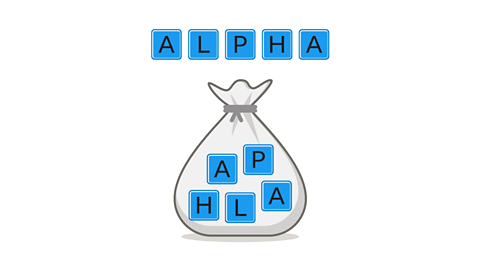
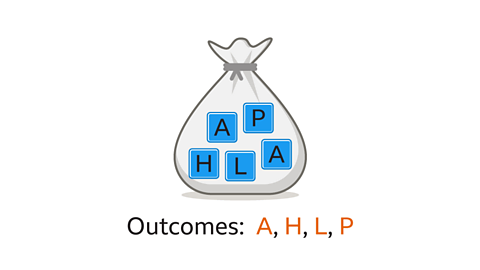
The outcomes are the different tiles that can be taken from the bag.
There are four possible outcomes: A, H, L and P.
They are not all equally likely because there are two letter As and only one of each of the other letters.
Finding the probability of an event
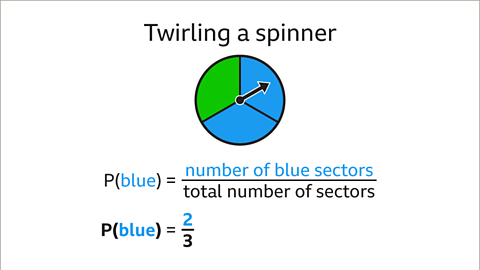
The The chance of an event happening. The probability of an event has a value from 0 to 1 and is written as a fraction, a decimal or as a percentage. The notation for the probability of an event is P(event). of an A possible outcome, for example ‘heads’ when a coin is tossed. can be written as a fraction:
- the numerator is the number of outcomes where the event happens
- the denominator is the total number of outcomes
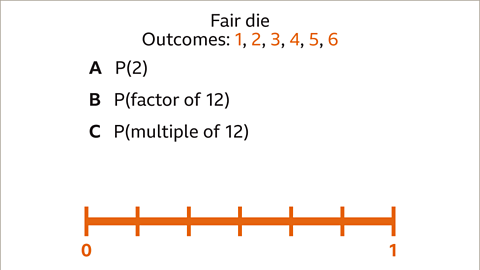
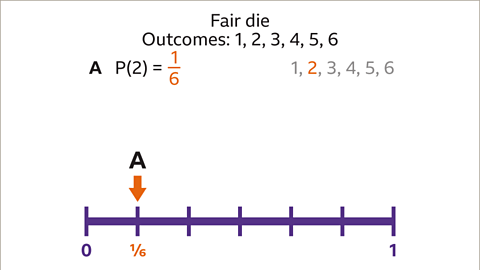
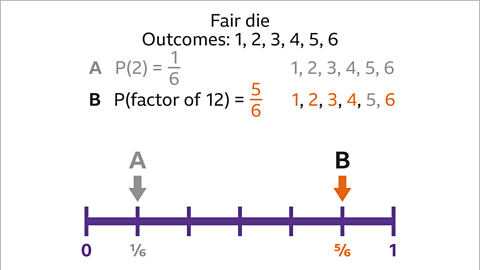
The probability may also be represented on a This is a scale between 0 (zero) and 1. 0 means the event is impossible. 1 means the event is certain. .
Number facts, including recognising factors, multiples, prime numbers and square numbers, often appear in probability questions.
Examples
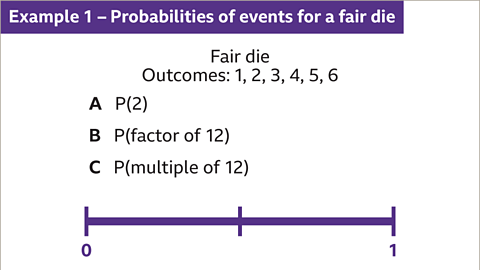
Image caption, Rolling a fair die has six equally likely outcomes: 1, 2, 3, 4, 5 and 6. Find the probability of the listed events as a fraction and show them on the probability scale.
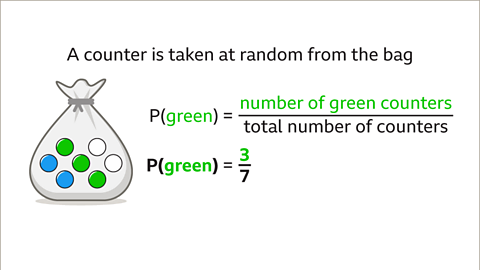
1 of 9
Question
Five lettered tiles that spell the word TOAST are put into a bag. One tile is taken at random from the bag.
What is the probability that a letter T is taken out of the bag?
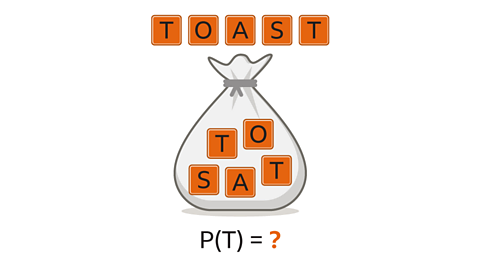
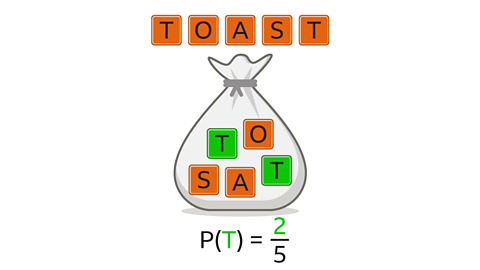
Two of the five tiles are lettered T.
The probability of taking a tile with the letter T is ⅖.
Practise finding probabilities
Practise finding probabilities with this quiz. You may need a pen and paper to help you with your answers.
Quiz
Real-life maths
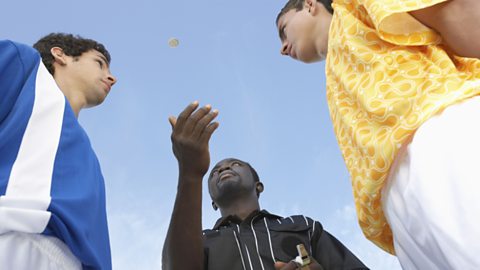
An unbiased coin is usually flipped at the start of a sports match. This decides which team or player starts and the direction they want to play in first, or whether to be the first to serve or bat.
It is a fair method of choosing as the coin has two equally likely outcomes: heads or tails.
Play Sudoku with BBC Bitesize!
Every weekday we release brand new easy, medium and hard Sudoku puzzles. Perfect for testing your skill with numbers and logic.

More on Calculating probabilities
Find out more by working through a topic
- count3 of 5
- count4 of 5