Key points
Algebra is a part of maths that uses letters and symbols in the place of numbers. Each letter or symbol is a A quantity that can take on a range of values. and can represent a range of values.
A series or system of written symbols used to represent numbers, amounts or elements in mathematics. is used to present information concisely.
An algebraic statement may be an A mathematical sentence expressed either numerically or symbolically made up of one or more terms., an A mathematical statement showing that two expressions are equal. The expressions are linked with the symbol =, a A fact, rule, or principle that is expressed in words or in mathematical symbols. Plural: formulae., or an An equation that is true no matter what values are chosen. The identity symbol ≡ links expressions that are identities..
Algebra uses arithmetic operations (+, –, ×, ÷) to simplify expressions, solve equations and rearrange formulae.
When writing or interpreting algebraic expressions, it is important to understand that addition and multiplication are An operation is commutative if the order does not matter. Multiplication and addition are commutative, eg 4 × 3 = 3 × 4 and 4 + 3 = 3 + 4 and that subtraction and division are not.
To help your understanding of algebra, it may be useful to review negative number arithmetic.
Understanding algebraic notation
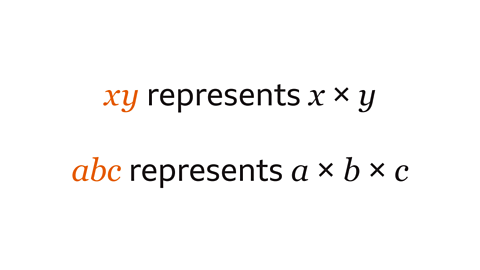
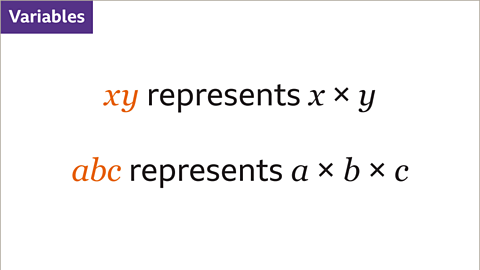
Algebraic notation presents information in a concise way. For example, when variables are multiplied they are written next to each other in alphabetical order. Eg, 𝒙𝒚 represents 𝒙 × 𝒚
An algebraic sentence is known as an expression. Within an expression, each part is known as a An element within an algebraic sentence. Elements (terms) are separated by + or - signs. .
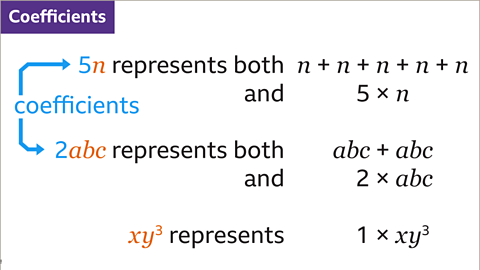
A term is one element in an algebraic sentence. It may be a A number or quantity that does not vary. A constant speed is a steady speed. Eg, the speed of light is constant. The speed of a car is not constant, it varies., a An unknown value, usually represented by a letter like 𝒙 or 𝒚, or a combination of a A number or symbol multiplied with a variable or an unknown quantity in an algebraic term. Eg, 5 is the coefficient of 5𝒏 and one or more variables.
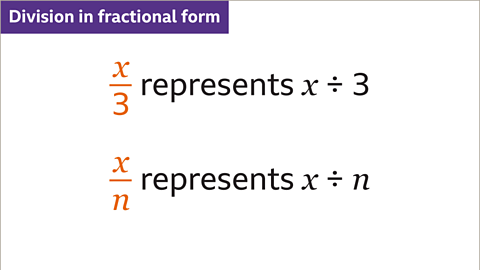
In algebra, division is written in fractional form. The dividend is the Number written at the top of a fraction. The numerator is the number of parts used. Eg, for 1⁄3, the numerator is 1 and the divisor is the Number written on the bottom of a fraction. The denominator is the number of equal parts. Eg, for 1⁄3, the denominator is 3.
Examples
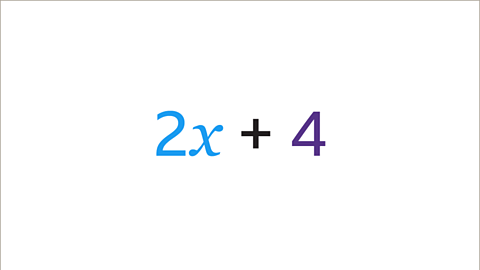
Image caption, 2𝒙 + 4 is an algebraic statement known as an expression. Each element in an expression is called a term. This expression has two terms (2𝒙 and 4).
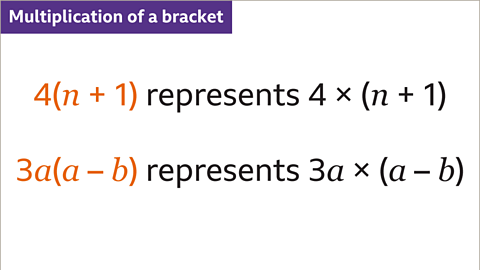
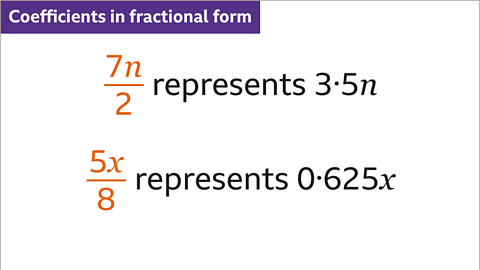
1 of 7
Question
Write this expression using the correct algebraic notation:
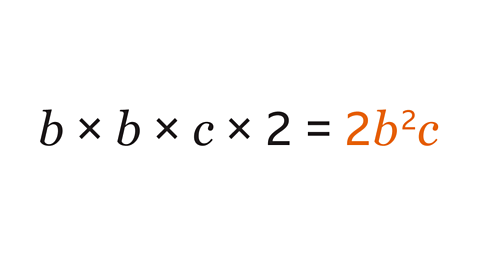
𝒃 x 𝒃 x 𝒄 x 2
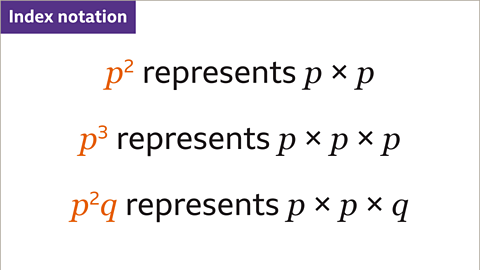
Repeated multiplication by the same variable is written using index notation. 𝒃 × 𝒃 is 𝒃²
When variables are multiplied, they are written next to each other. The 𝒃² and 𝒄 are written next to each other, 𝒃²𝒄
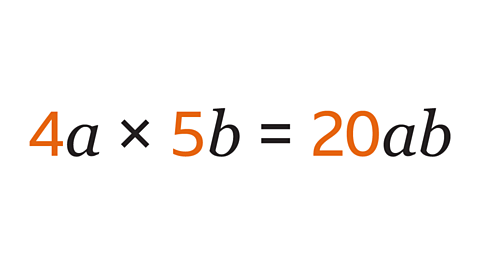
The coefficient (2) is written at the front of the term and gives the number of this combination of variables. The 2 is written first, 2𝒃²𝒄
Video
Watch the video to hear Kim, a textiles designer, talk about how algebra plays a part in her work.
Bobby:The word algebra might make you think of equations and formulas that you only hear about in a maths lesson.
Bobby: So Kim, tell me about your work in fashion.
Kim: I’m a textiles designer for my own company and we make silk scarves that feature endangered animals.
Bobby: That sounds really cool. So, how would you work out how much you can sell your products for?
Kim: There’s a lot of things I need to consider. There’s the materials, the size of the scarf, the manufacture and also the finishing of the scarf.
Bobby: So, you listed some variables to me. Your sales price, that’s an unknown variable. Your cost of production is a known variable. And the other factors, they are known variables. So, we can set up an algebraic equation for that.
Kim: Exactly, and when I work seasonally, I know how much I need to make and when I need to make, but I don’t know the cost. That’s because the price of materials could change from season to season or year to year.
Bobby: Ah, even again, there’s more algebra there because your cost of production, that’s an unknown variable and then your known variables are your time frame and how much to produce - Algebra!
Kim: Exactly.
Writing and interpreting algebraic expressions
To interpret an A mathematical sentence expressed either numerically or symbolically made up of one or more terms., each A quantity that can take on a range of values. is defined as representing a number of items.
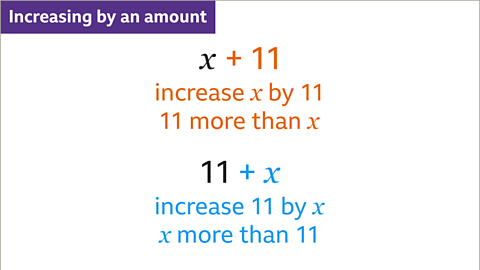
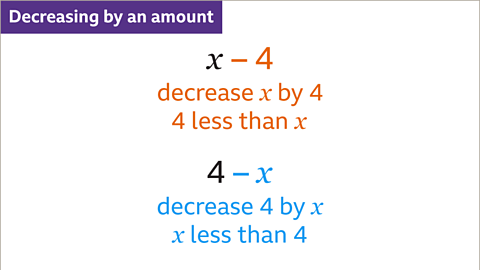
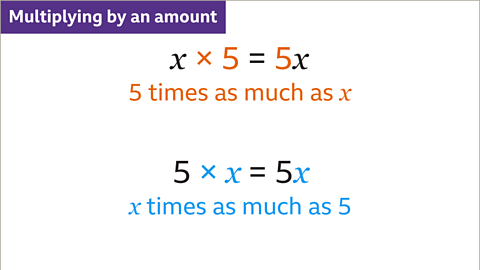
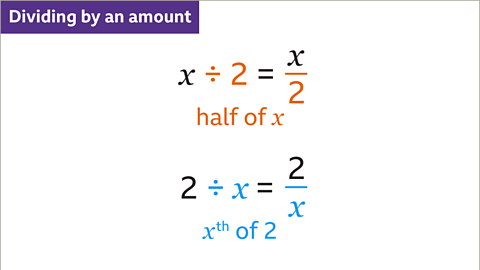
The correct operation must be used in an expression.
- An amount is added on to show that the result is more. Addition is used to total values.
- An amount is subtracted to show that the result is less. Subtraction is also used to find a difference.
- An amount is multiplied to show that the result is that amount times larger. Multiplication is also used for repeated addition.
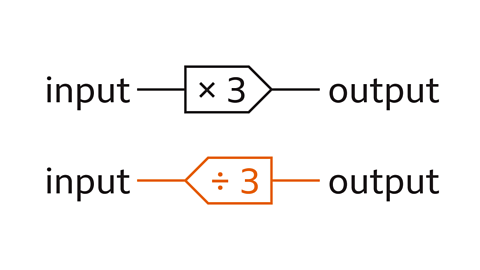
- An amount in a divisor is used to show that the result is that amount times smaller. This can include finding a fractional amount. Eg, to find a half, divide by 2
Examples
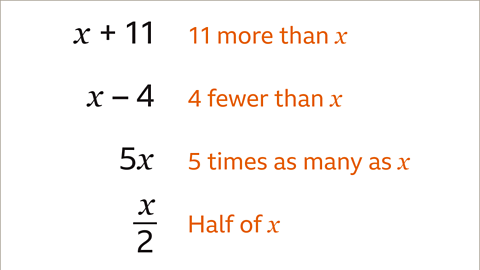
Image caption, Algebraic expressions can show different amounts.
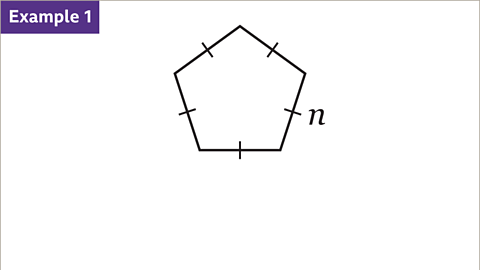
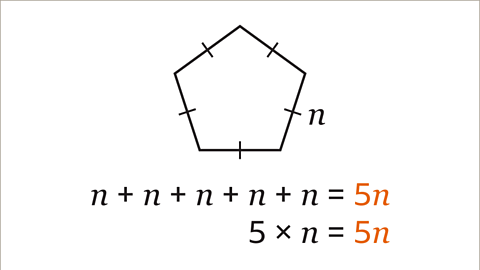
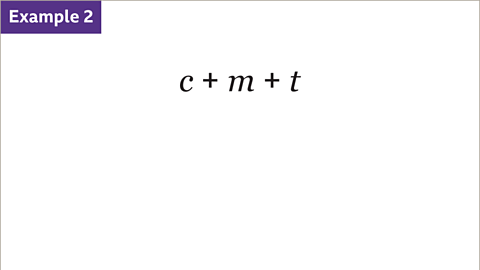
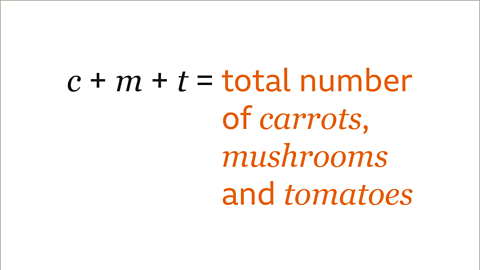
1 of 9
Match the statement to the correct expression
Practise using algebraic expressions by matching the correct statement to each algebraic expression.
Recognising different algebraic statements
There are four types of algebraic statements:
- An expression is a mathematical statement with no equals symbol.
- An equation links two expressions with an equals symbol.
- A formula is a statement linking two or more variables.
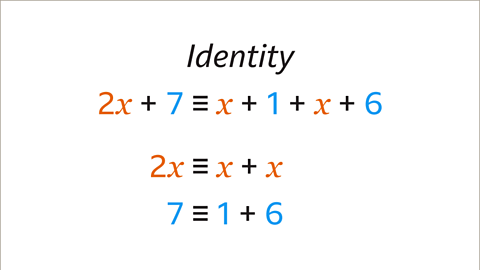
- An identity means that the left-hand side of the equation is identically equal to the right-hand side, for all values of the variables. The identity symbol links expressions that are identities.
Examples
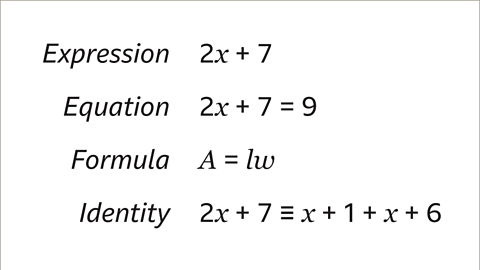
Image caption, An algebraic statement can be an expression, an equation, a formula or an identity.
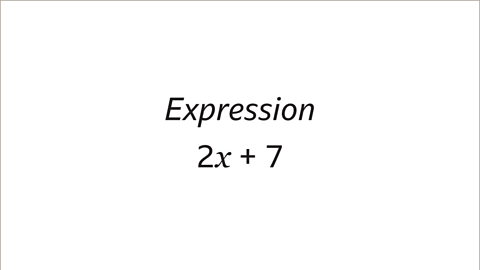
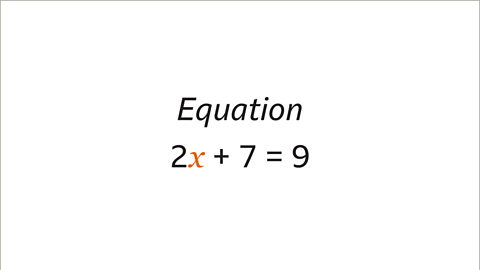
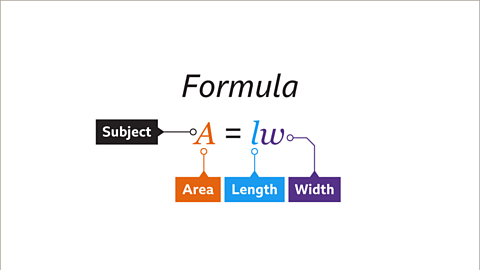
1 of 5
Practise algebraic notation
Quiz
Practise recognising, writing and interpreting algebraic notation with this quiz. You may need a pen and paper to help you.
Real-life maths

Knowing algebraic notation is necessary when working with certain types of computer software.
Software engineers rely on a solid understanding of algebraic notation and processing. They create codes that make computer interfaces more user-friendly, which other software developers then make use of to enhance games or Computer-Aided Design (CAD) packages.
Revise for your exams with BBC Bitesize
Get ready for the GCSEs with quizzes, past papers, flashcards, podcasts and more resources!

More on Expressions and formulae
Find out more by working through a topic
- count2 of 8
- count3 of 8
- count5 of 8