Key points
- Multiplication is An operation is commutative if the order does not matter. Multiplication and addition are commutative, eg 4 × 3 = 3 × 4 and 4 + 3 = 3 + 4 . This means that the order in which you multiply a pair of numbers does not make a difference, eg 3 x 5 = 5 x 3
- The The result of multiplying one number by another, eg the product of 4 and 5 is 20 since 4 × 5 = 20 is the answer when two or more numbers are multiplied together.
- Calculations can be written with brackets around negative numbers because this can make a calculation easier to read, eg -3 × -1 is the same calculation as (-3) × (-1)
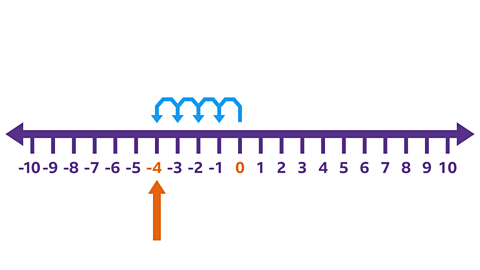
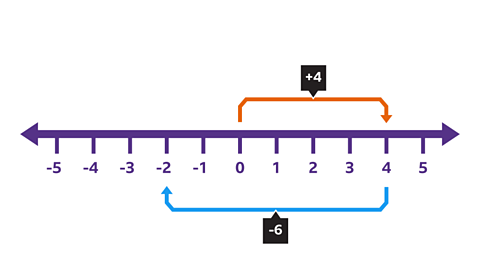
- Learning about positive and negative numbers will help when multiplying and dividing negative numbers.
Multiplying positive and negative numbers
When multiplying negative numbers it is often useful to complete the calculation using positive numbers initially.Then remember that:
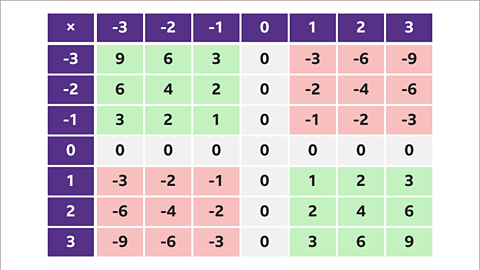
- multiplying two numbers together with the same sign gives a positive answer
- multiplying two numbers together with different signs gives a negative answer
Examples: multiplying positive and negative numbers
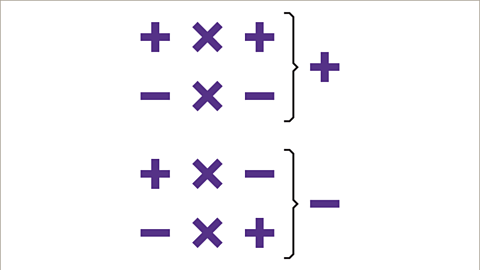
Image caption, Start by completing the calculation using positive numbers first, then use the sign rules to find the sign of the answer.
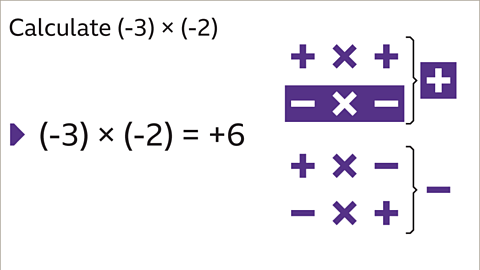
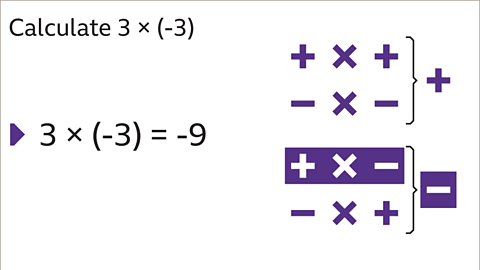
1 of 4
Dividing positive and negative numbers
When dividing negative numbers it is often useful to complete the calculation using positive numbers initially.Remember that:
- dividing two numbers with the same sign gives a positive answer
- dividing two numbers with different signs gives a negative answer
Examples: dividing positive and negative numbers
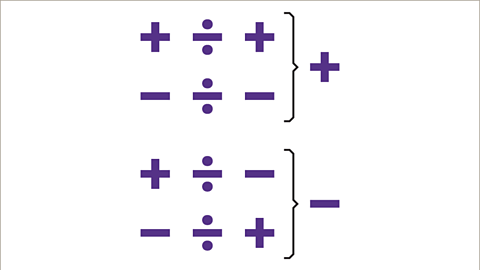
Image caption, Start by completing the calculation using positive numbers first, then use the sign rules to find the sign of the answer.
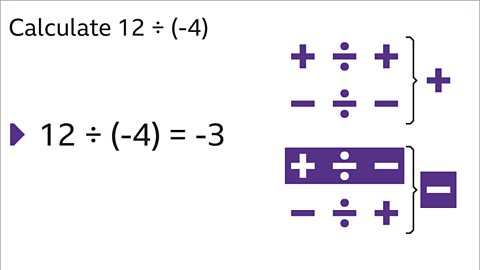
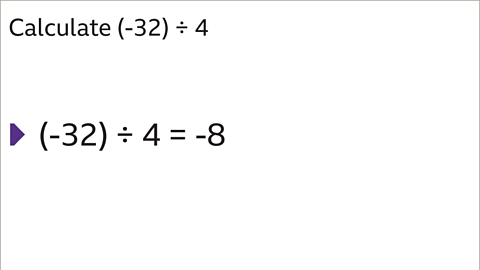
1 of 3
Question
Calculate the following. You might need a pen and paper to note down the answers.
(-6) × 3
(-4) × (-2)
(-6) ÷ 2
(-6) ÷ (-2)
Multiplying or dividing two numbers together with the same sign gives a positive answer. If the two numbers have different signs, the answer is negative.
(-6) × 3 = -18
(-4) × (-2) = 8
(-6) ÷ 2 = -3
(-6) ÷ (-2) = 3
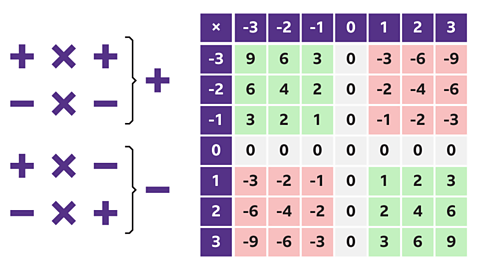
Practise multiplying and dividing negative numbers
Remember that negative numbers are sometimes written in brackets. This can make the calculation easier to read.
Activity
Try this ordering activity to practise calculating with positive and negative numbers. You might need a pen and paper to help with your working out.
Quiz
Practise multiplying and dividing positive and negative numbers in this quiz.
Real-world maths

Negative numbers are used in everyday life, especially in business when making financial decisions and forecasting future profits.
Accountants and businesses use negative numbers to represent when money has already been or is going to be spent. Eg a regular outgoing of £300 per month on expenses is calculated as 12 x (-£300) over the next year.
Revise for your exams with BBC Bitesize
Get ready for the GCSEs with quizzes, past papers, flashcards, podcasts and more resources!

More on Positive and negative numbers
Find out more by working through a topic
- count1 of 3