Key points
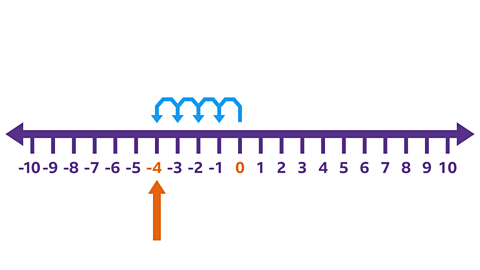
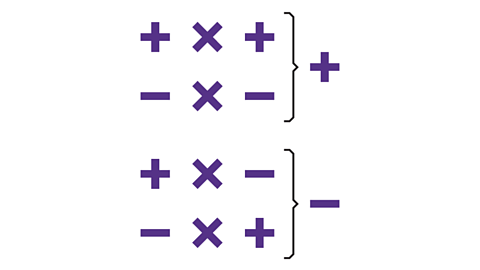
- There are rules for adding and subtracting A number greater than zero. and A number less than zero. numbers.
- If a number has no sign it usually means that it is a positive number. For example, 7 is really +7
- Learning how to use a number line may help you with calculations.
Adding and subtracting
When adding or subtracting negative numbers it can be useful to use a A straight line on which numbers are marked at equal intervals..
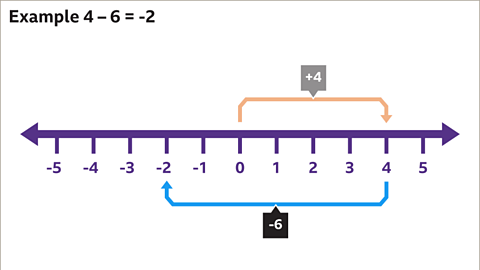
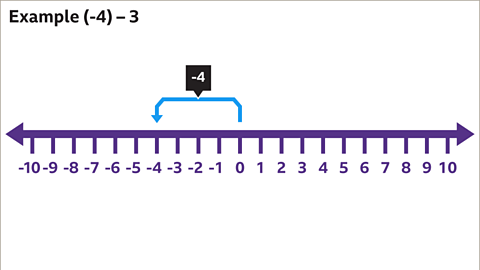
- To add and subtract numbers always begin counting from zero.
- When adding positive numbers, count to the right.
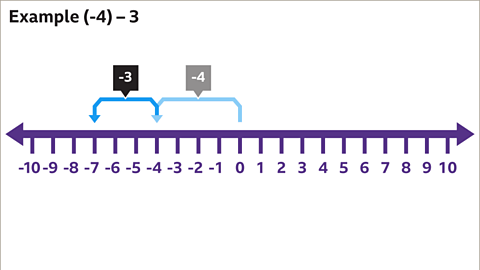
- When subtracting positive numbers, count to the left.
Example: calculate 4 - 6
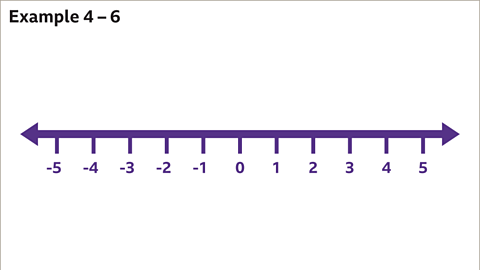
Image caption, To add and subtract numbers always begin counting from zero. When adding positive numbers, count to the right. When subtracting positive numbers, count to the left.
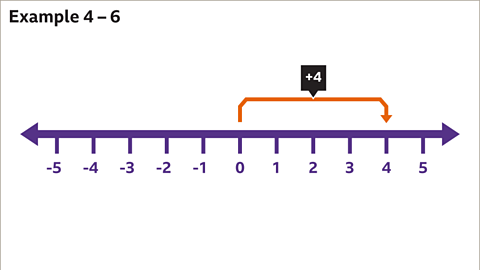
1 of 3
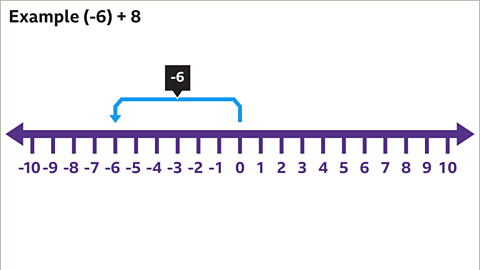
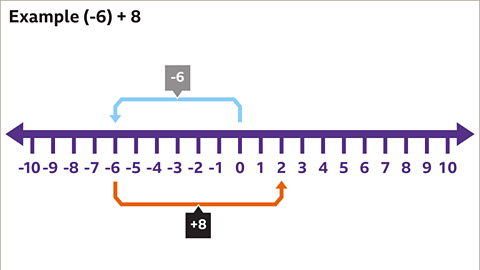
Example: calculate (-6) + 8
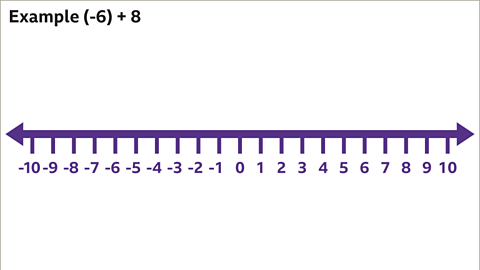
Image caption, Work out (-6) + 8
1 of 3
Example: calculate (-4) - 3
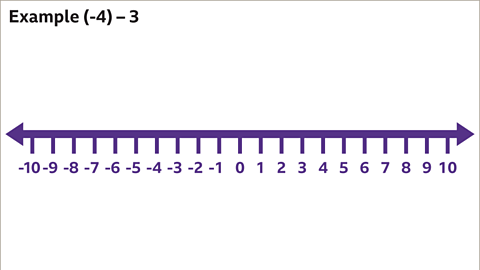
Image caption, Work out (-4) – 3
1 of 3
Real-world example
A thermometer is a number line that depicts temperature and often uses a vertical number line rather than horizontal.
When reading a thermometer:
- zero represents 0°C
- plus temperatures are above zero, eg 8°C counting upwards as the temperature gets warmer (positive numbers)
- minus temperatures are below zero, eg -4°C counting downwards as the temperature gets colder (negative numbers)
Question
In the example below, what is the difference between the daytime and night-time temperatures?
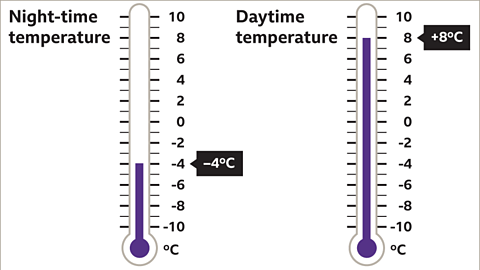
To find the difference between the two temperatures, count the steps between the two readings. Starting at -4°C move up 4 to reach zero. Then move up another 8 to reach 8°C. The difference in temperatures is 12°C.

Alternatively, we can use our knowledge of negative numbers to calculate the difference 8°C – (-4°C) = 8°C + 4°C = 12°C.
Practise positive and negative numbers
Ordering activity
Work out the differences in temperature for each city. You might need a pencil and paper for your working out.
Adding and subtracting quiz
Practise adding and subtracting positive and negative numbers with this quiz.
Real-world maths

Positive and negative numbers are used in everyday life to compare values against zero.
Many people use negative numbers in their jobs, for example accountants, staff working in banks or building societies and weather presenters.
Play Sudoku with BBC Bitesize!
Every weekday we release brand new easy, medium and hard Sudoku puzzles. Perfect for testing your skill with numbers and logic.

More on Positive and negative numbers
Find out more by working through a topic
- count1 of 3