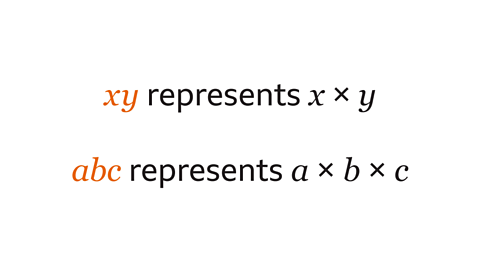
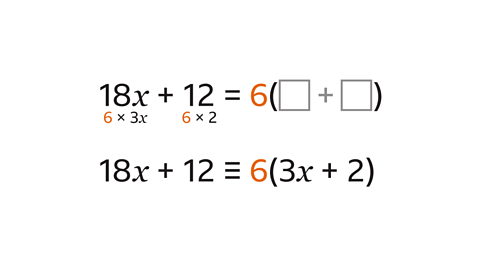
Key points
When expanding brackets it’s important to have a good understanding of multiplying terms, multiplying by positive and negative numbers and index notation.
To expand a single bracket, each An element within an algebraic sentence. Elements (terms) are separated by + or - signs. inside the bracket is multiplied by the A mathematical sentence expressed either numerically or symbolically made up of one or more terms. outside the bracket.
It may be possible to Rewrite an expression so that it has fewer terms. An expression may be simplified using addition, subtraction, multiplication or division. the expression after expanding the bracket. This is done by collecting the Terms whose variables (such as 𝒙 or 𝒚) with any exponents (a symbol written above and to the right of a mathematical expression) are the same. For example, 7𝒙 and 2𝒙 are like terms because they are both amounts of ‘𝒙’..
One bracket may be multiplied by another bracket. This is sometimes called expanding double brackets.
To expand double brackets, every term in the first bracket must be multiplied by every term in the second bracket. It may be possible to simplify the resulting expression.
The expression that results from expanding a single or a double bracket and the original expression are An equation that is true no matter what values are chosen. The identity symbol ≡ links expressions that are identities.. They are A numerical or algebraic expression which is the same as the original expression but is in a different form. Equivalent expressions are identically equal. The identity symbol, ≡, can link equivalent expressions. expressions.
Expanding a single bracket
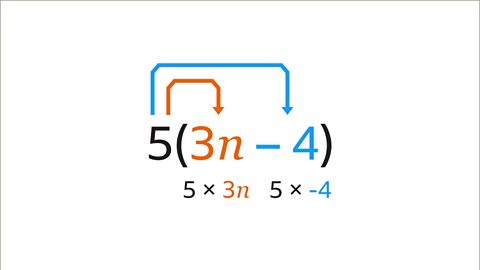
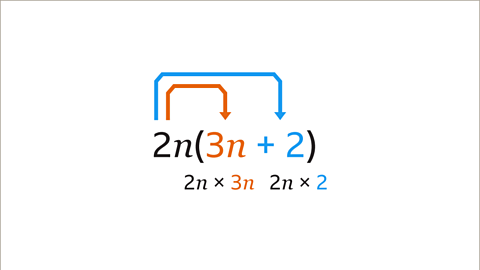
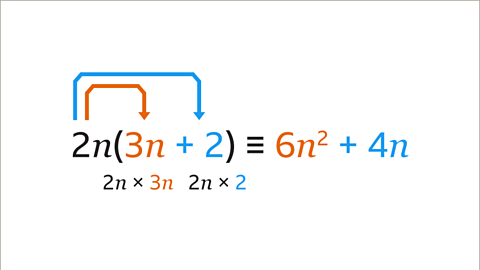
To expand a single bracket multiply each term inside the bracket by the term outside the bracket.
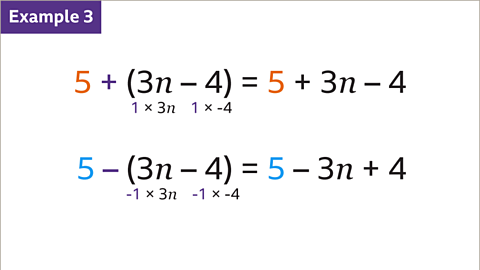
If the term and the bracket are joined by an addition or subtraction symbol, the term is not multiplied by the expression in the bracket.
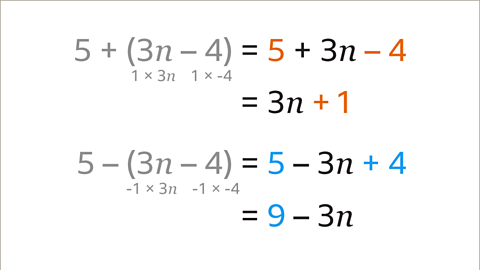
An addition sign before the bracket means each term is multiplied by 1. A subtraction sign in front of the bracket means each term is multiplied by –1.
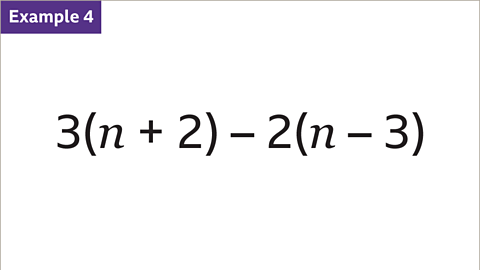
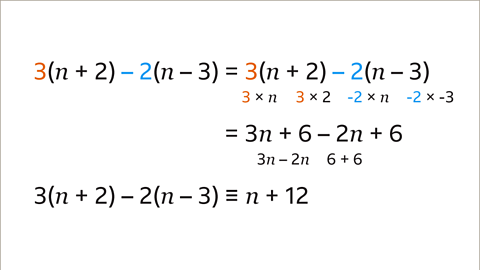
When an expression includes multiple single brackets:
Expand each bracket in the expression by multiplying each term in the bracket by the term in front of the bracket.
Simplify the expression by collecting the like terms.
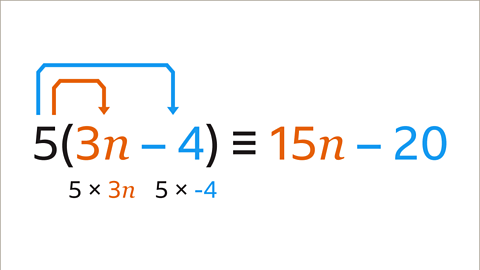
The starting expression, with a bracket (or brackets), is equivalent to the resulting expression. They are identities.
Examples
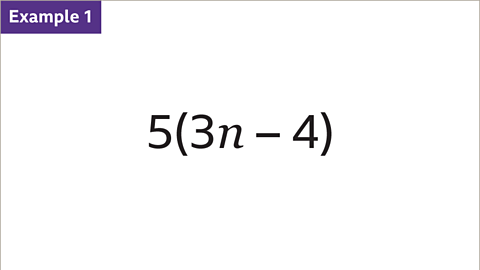
Image caption, Expand the expression 5(3𝒏 – 4).
1 of 10
Questions
Question 1: Expand the bracket.
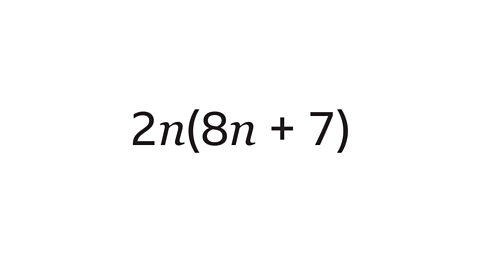
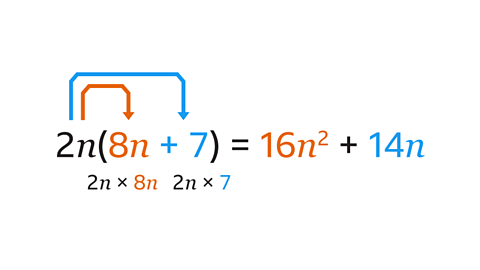
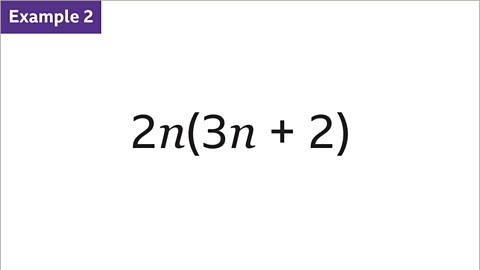
The term in front of the bracket (2\(n\)) is multiplied by each term inside the bracket.
The calculations are 2\(n\) × 8\(n\) = 16\(n\)² and 2\(n\) × 7 = 14\(n\)
2\(n\)(8\(n\) + 7) is equivalent to 16\(n\)² + 14\(n\), they are identities.
Question 2: Expand and simplify the expression.
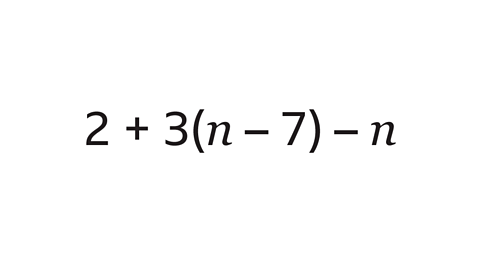
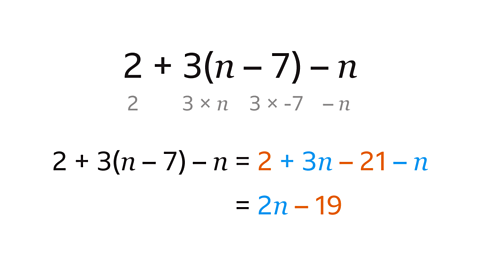
The expression has one bracket that must be expanded and two other terms: 2 and -\(n\)
The bracket 3(\(n\) - 7) expands to give 3\(n\) – 21
The expression becomes 2 + 3\(n\) – 21 – \(n\). This can be simplified by collecting the like terms.
The like terms are the constants 2 and –21 and the variables 3\(n\) and – \(n\)
The expression simplifies to 2\(n\) – 19
Expanding double brackets
- To expand double brackets using a grid:
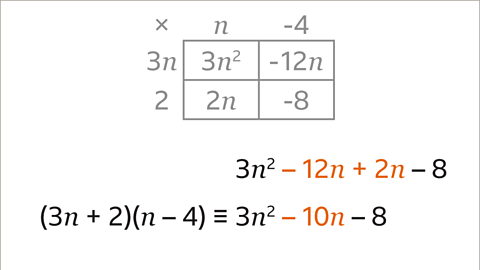
Multiply each term in the first bracket by each term in the second bracket. When there are two terms in each bracket, use a 2 x 2 grid. The dimensions of the grid match the number of terms in each bracket.
Write the terms for the first bracket on the left side of the grid and the terms in the second bracket across the top of the grid.
Fill in the grid by multiplying each term in the first bracket by each term in the second bracket.
Write the expression with all four terms.
Simplify the expression by collecting the like terms.
- To expand double brackets without using a grid:
Multiply each term in the first bracket by each term in the second bracket.
Rewrite the expression so that the first bracket is split to show each term is multiplied by the second bracket. The expression now has two single brackets to expand.
Expand each single bracket.
Simplify the expression by collecting the like terms. The starting expression (with brackets) is equivalent to the resulting expression. They are identities.
Examples
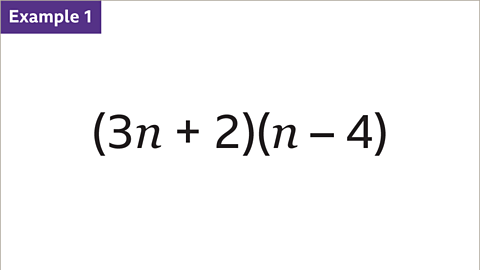
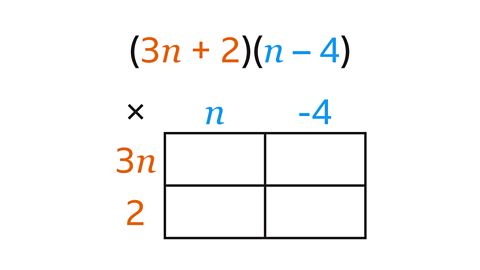
Image caption, Expand (3𝒏 + 2)(𝒏 – 4).
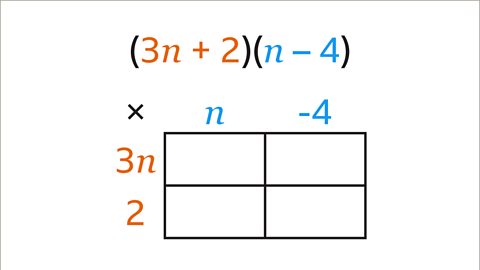
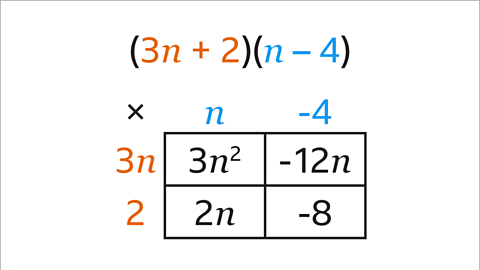
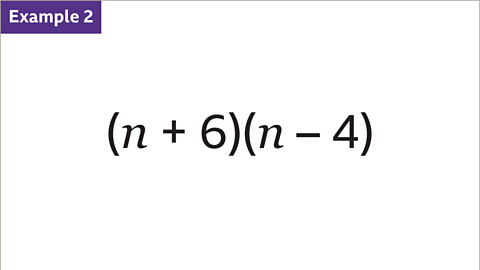
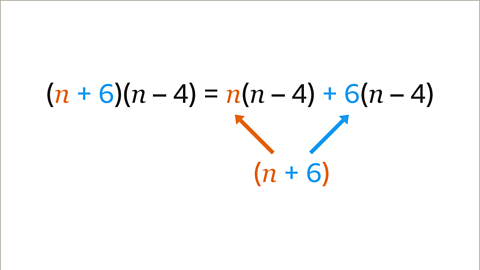
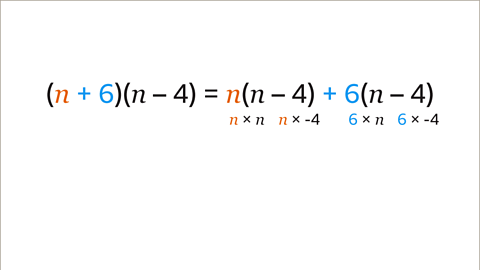
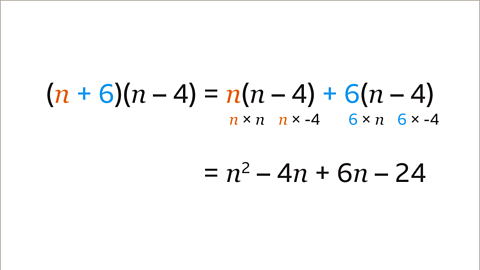
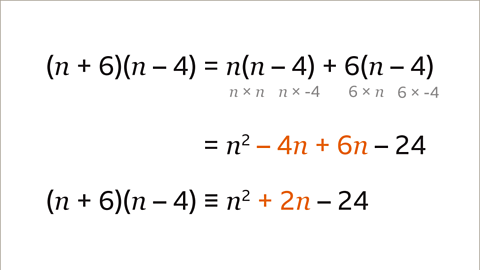
1 of 9
Questions
Question 1: Expand and simplify the expression.
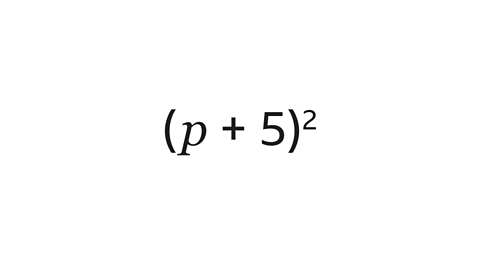
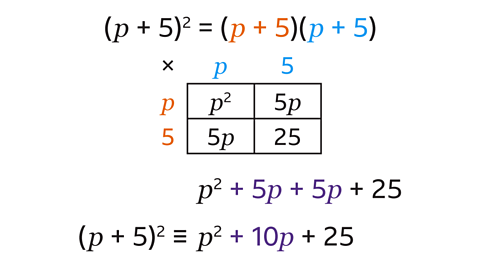
(\(p\) + 5)² means (\(p\) + 5)(\(p\) + 5). Each term in the first bracket is multiplied by each term in the second bracket.
There are two terms in each bracket so a 2 x 2 grid is used. To expand and simplify the expression:
Write the terms for the first bracket to the left of the grid, and the terms in the second bracket across the top.
Fill in the grid by multiplying each term in the first bracket by each term in the second bracket:
\(p\) × \(p\) = \(p\)². \(p\) × 5 = 5\(p\). 5 × \(p\) = 5\(p\). 5 × 5 = 25Write the expression with all four terms.
Simplify the expression by collecting the like terms.
(\(p\) + 5)² is equivalent to \(p\)² + 10\(p\) + 25. They are identities.
Question 2: Expand and simplify the expression.
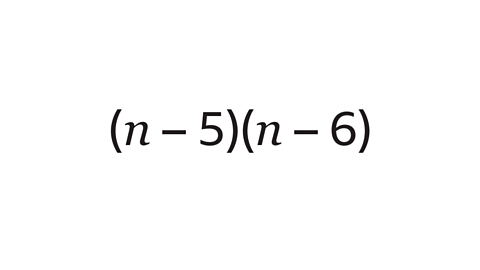
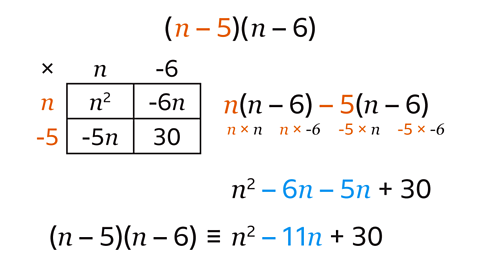
Each term in the first bracket is multiplied by each term in the second bracket. To expand and simplify the expression:
Use a 2 x 2 grid or work without a grid.
Rewrite the expression so that the first bracket is split to show each term is multiplied by the second bracket. The expression now has two single brackets to expand.
\(n\) is multiplied by (\(n\) – 6) and –5 is multiplied by (\(n\) – 6).Expand each single bracket:
\(n\) (\(n\) – 6) = \(n\)² – 6\(n\). –5(\(n\) – 6) = – 5\(n\) + 30Simplify the expression by collecting the like terms:
\(n\)² – 6\(n\) – 5\(n\) + 30 ≡ \(n\)² – 11\(n\) + 30
Practise multiplying brackets
Quiz
Practise multiplying brackets with this quiz. You may need a pen and paper to help you work out your answers.
Revise for your exams with BBC Bitesize
Get ready for the GCSEs with quizzes, past papers, flashcards, podcasts and more resources!

More on Expressions and formulae
Find out more by working through a topic
- count7 of 8
- count8 of 8
- count1 of 8