Key points
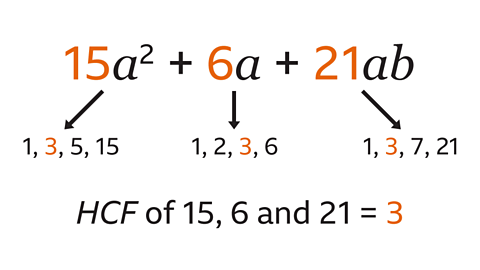
Essential knowledge for factorising includes understanding factors and The largest factor that will divide into the selected numbers. Eg, 10 is the highest common factor of 30 and 20. Highest common factor is written as HCF. (HCF), as well as having a good knowledge of Recognising when a number can be divided exactly by a selected integer. Eg, any even number is divisible by 2 .
An A mathematical sentence expressed either numerically or symbolically made up of one or more terms. that has been rewritten by taking out common factors has been To express a number or an expression as the product of its factors. For example, the number 6 can be factorised as 2 × 3. 6𝒏 – 12 can be factorised as 6(𝒏 – 2)..
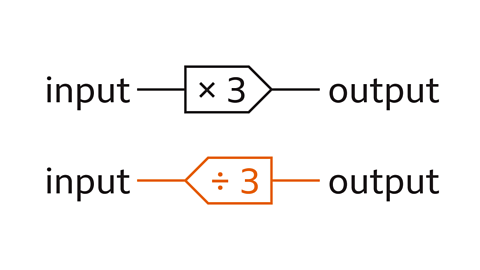
Factorising is the reverse process of expanding brackets.
A factorised expression is The same as but in a different form. to the original expression. They are An equation that is true no matter what values are chosen. The identity symbol ≡ links expressions that are identities.. The identity symbol (≡) is used to link the original expression and its equivalent factorised expression.
Understanding and using algebraic notation correctly is necessary to complete the factorising process properly.
Finding the highest common factors (HCF) in an expression
When the A mathematical sentence expressed either numerically or symbolically made up of one or more terms. includes a A number or quantity that does not vary. A constant speed is a steady speed. Eg, the speed of light is constant. The speed of a car is not constant, it varies. the only highest common factor (HCF) will be a number:
- Find the HCF of the A number or symbol multiplied with a variable or an unknown quantity in an algebraic term. Eg, 5 is the coefficient of 5𝒏 and constant, the greatest factor that is common to all the numbers in the expression.
- The HCF for the expression is a number.
When the expression has no constants:
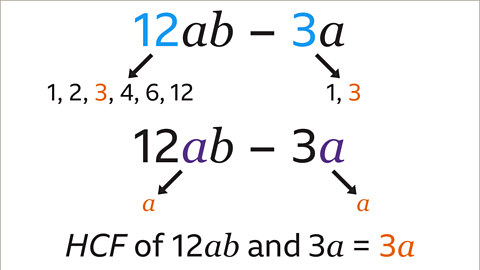
- Find the HCF of the coefficients, the greatest factor that is common to all the coefficients in the expression.
- Find common A quantity that can take on a range of values. factors in each term, which may be a single variable or a combination of variables.
- The HCF of the expression is the The result of multiplying one number by another, eg the product of 4 and 5 is 20 since 4 × 5 = 20 of the number and variable HCFs.
Examples
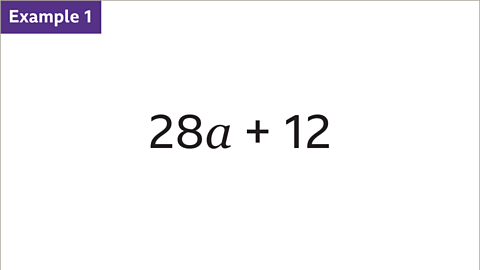
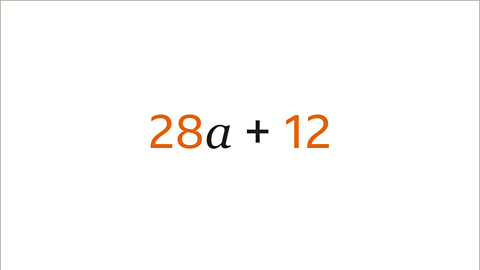
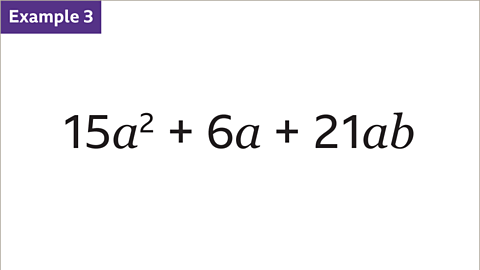
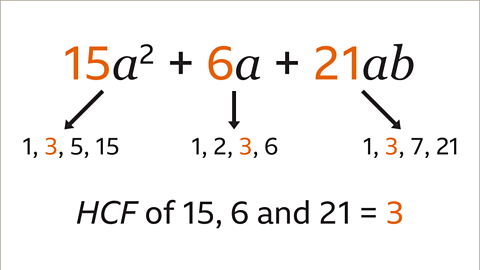
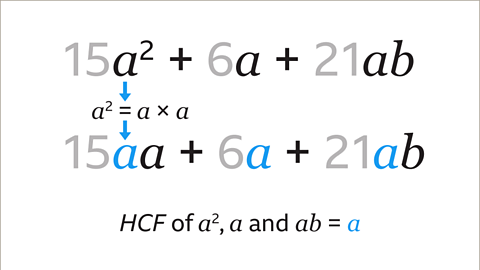
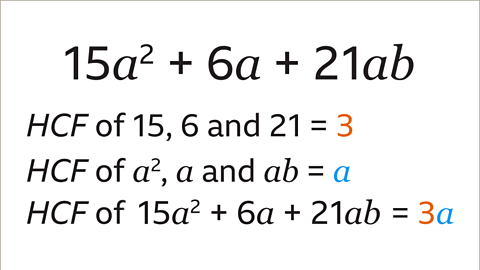
Image caption, Find the highest common factor (HCF) of this expression.
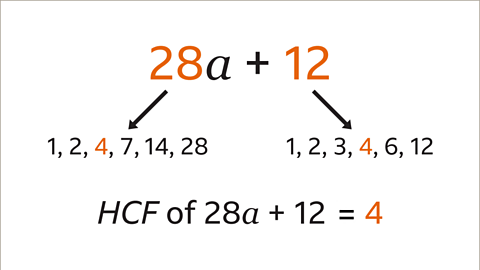
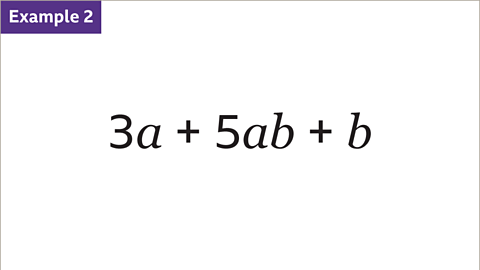
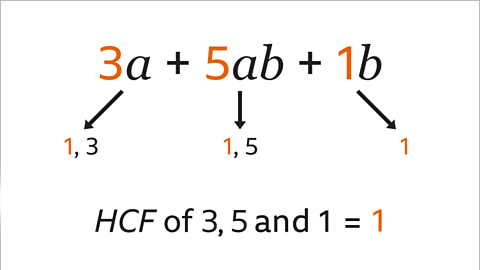
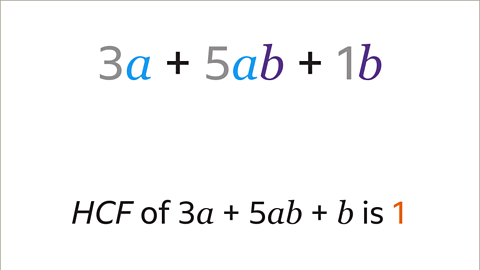
1 of 10
Question
Find the highest common factor of this expression.
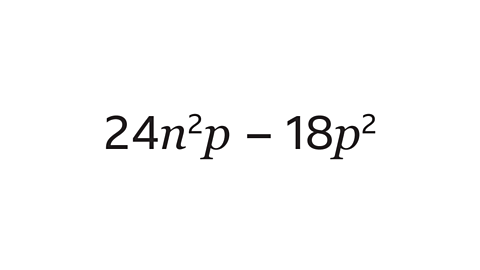
The expression has no constants.
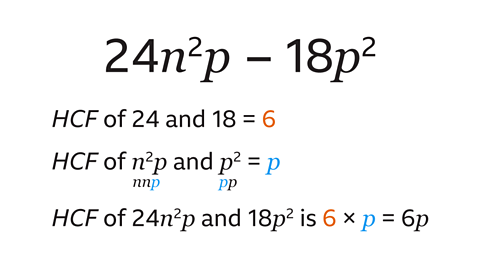
The HCF of the coefficients is the greatest factor that is common to all the numbers in the expression.
- The coefficients are 24 and 18
- The HCF of 24 and 18 is 6
The common variable in 24\(n\)²\(p\) – 18\(p\)² is \(p\)
- The variable HCF is \(p\)
The HCF of the expression is the product of the number HCF (6) and the variable HCF (\(p\)).
- 6 × \(p\) = 6\(p\)
The HCF of the expression is 6\(p\)
Factorise simple expressions
- When the expression includes a constant the highest common factor (HCF) is a number.
- When the expression does not include a constant the HCF is a number, a variable or a combination of a number and variables.
To factorise an expression:
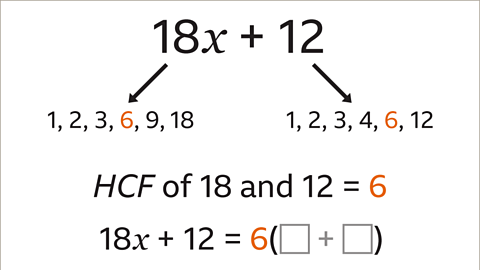
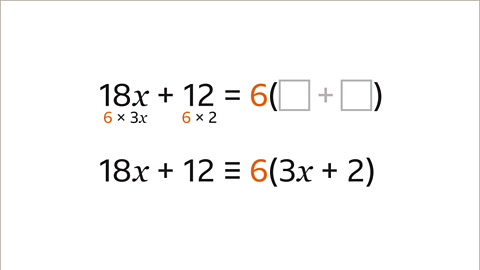
Find the HCF of the numbers in the expression.
Find the HCF of the variables in the expression.
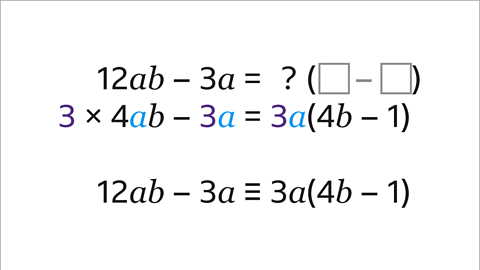
Find the product of the number and variable HCFs and write this term in front of the bracket.
Work out the terms in the bracket by completing the factor pair for each of the original terms in the expression.
The identity symbol (≡) is used to link the original expression and its equivalent factorised expression.
Examples
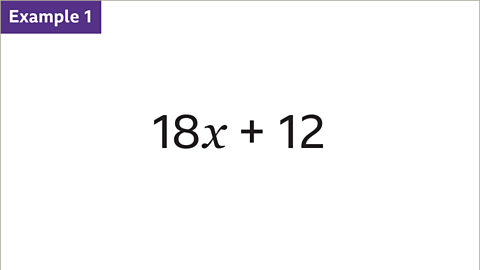
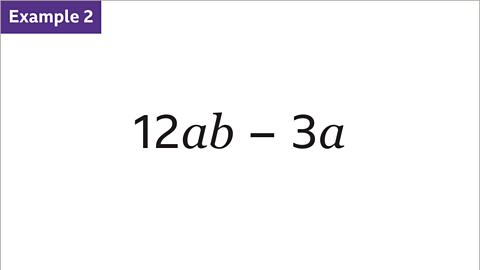
Image caption, Factorise 18𝒙 + 12
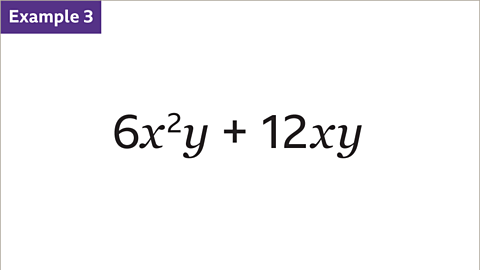
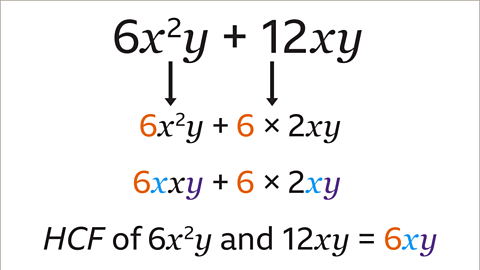
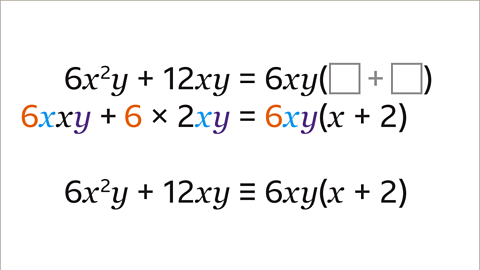
1 of 9
Question
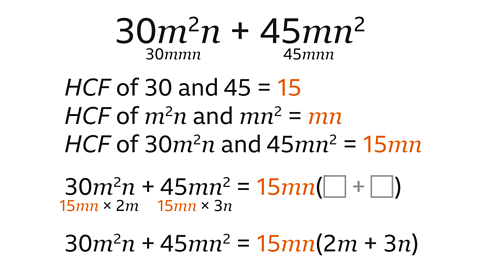
Factorise the expression.
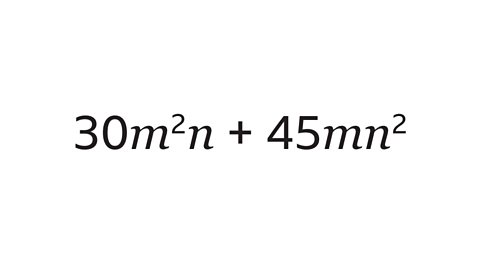
- The highest common factor of 30 and 45 is 15
- The HCF of the variable terms \(m\)²\(n\) and \(mn\)² is \(mn\)
- The HCF of 30\(m\)²\(n\) and 45\(mn\)² is 15\(mn\)
- 15\(mn\) is the term in front of the bracket.
- The first term in the bracket is 2\(m\) because the factor pair for 30\(m\)²\(n\) is 15\(mn\) × 2\(m\)
- The second term in the bracket is 3\(n\) because the factor pair for 45\(mn\)² is 15\(mn\) × 3\(n\)
- 30\(m\)²\(n\) + 45\(mn\)² factorises to the equivalent expression 15\(mn\)(2\(m\) + 3\(n\)).
Practise rewriting expressions
Quiz
Practise rewriting expressions by taking out common factors with this quiz. You may need a pen and paper to help you with your answers.
Play Sudoku with BBC Bitesize!
Every weekday we release brand new easy, medium and hard Sudoku puzzles. Perfect for testing your skill with numbers and logic.

More on Expressions and formulae
Find out more by working through a topic
- count7 of 8
- count8 of 8
- count1 of 8
- count2 of 8