The Earth
A year on Earth
The Earth and the other planets rotate around the Sun in an anticlockwise direction. A year is the time it takes a planet to make one complete orbit around the Sun. The Earth goes once around the Sun in one Earth year, which takes 365.25 days.
Seasons
The Earth's axis is the imaginary line through the centre of the Earth between the south and north poles about which the Earth spins. This axis is tilted compared with the way the Earth orbits the Sun – at an angle of 23.5 degrees.
There are seasons (winter, spring, summer and autumn) because the Earth’s axis is tilted. Some parts of the Earth receive more sunlight each day than others. This changes during the year because the Earth orbits the Sun, which gives rise to the seasons. Due to their position, different parts of the Earth experience more dramatic differences in each season than other parts of the Earth.
The UK is in the top half (northern hemisphere) of the Earth. When the northern hemisphere is tilted towards the Sun it is summer in the UK. Six months later the northern hemisphere is tilted away from the Sun and it is winter. The reverse is true in the southern hemisphere. When it is winter in the southern hemisphere, it is summer in the northern hemisphere.
Summary
it is summer in the UK when the northern hemisphere is tilted towards the Sun.
it is winter in the UK when the northern hemisphere is tilted away from the Sun.
when the northern hemisphere is neither tilted towards or away from the Sun it is spring or autumn.
if the earth wasn’t tilted, there would not be seasons, it would always be like spring or autumn.
Question
Why are there no seasons on the equator?
The equator is always tilted at the same angle to the Sun and so does not have a colder winter and warmer summer.
Days and nights
Planets spin or revolve on their axes as they orbit the Sun. A day is the time it takes for a planet to spin once on its axis. The Earth takes 24 hours to spin once on its axis and so one Earth day is 24 hours.
The Sun lights up one half of the Earth and the other half is in shadow. As the Earth spins, each place moves from shadow to light, day to night. It is daytime on the part of the planet which is lit by the Sun. And it is night on the part of the planet which is facing away from the Sun.
Length of daylight
The difference in the length of daylight from summer to winter is also due to the tilt of the Earth.
In winter, the northern hemisphere is tilted away from the Sun. As the Earth spins on its axis, there is more time in the shadow than in the light and nights are longer than days.
In summer, the northern hemisphere is tilted towards the Sun. As the Earth spins on its axis, there is more time in the light than in the shadow and days are longer than nights.
The An imaginary line drawn around the Earth half way from each pole. It divides Earth into the northern and southern hemispheres (halves). is neither pointed towards or away from the Sun at any time of the year. There are 12 hours of daylight and 12 hours of darkness every day all year round.
Video: Length of day and night
As the Earth cycles around the Sun, the length of day and night change
The Earth spins on its axis every day,and it takes a year to travel around the Sun.
The UK is in the top half of the Earth,in the northern hemisphere.
In winter, the northern hemisphere is tilted away from the Sun.The Earth spins on its axis once every 24 hours.There are only a few hours of daylight,and the dark nights are long.
Seasons change as the Earth continues its journey around the Sun.
In summer, the northern hemisphere is tilted towards the Sun.In the UK, it’s light from early in the morning until late in the evening.The nights are short.
Summer is here!
Path of the sun
During the day, the Sun appears to move through the sky. This happens because the Earth is spinning on its axis. In the UK, if a person was to look south and follow the path of the Sun in the sky during the day, it would look like this:
The Sun appears to move from east to west. This is because the Earth turns anticlockwise from west to east. The Sun appears to:
rise in the east
set in the west
be due south at midday in the northern hemisphere or due north at midday in the southern hemisphere.
One way to remember which way the Earth turns is to remember ‘WE spin’, which means that we (the Earth) spin from west to east.
Path of the sun at different times of the year
The length of the day (the time when the Sun shines on a particular part of the world) changes during the year, unless you are on the equator. Everywhere else, daytime is longest in the summer and shortest in the winter. In winter, the Sun still appears to rise in the east and set in the west, but it does not climb so high in the sky as it does in the summer.
Summary
Day: A day is the time it takes for a planet to spin once on its axis. An Earth day is 24 hours.
Year: A year is the time it takes a planet to make one complete orbit around the Sun. An Earth year is 365.25 days.
Seasons: occur because the Earth is tilted on its axis and it is orbiting the Sun.
Length of daylight: long in summer, short in winter.
Question
True or false: a year is the time it takes for a planet to spin on its axis?
False: A year is the time it takes for a planet to orbit its star. A day is the time it takes for a planet to spin on its axis.
The Moon
Phases of the moon
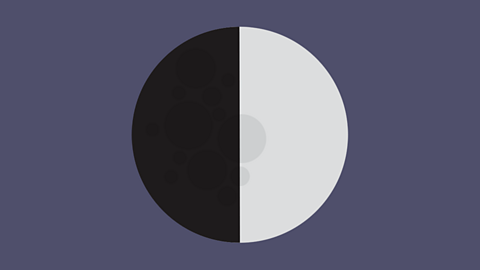
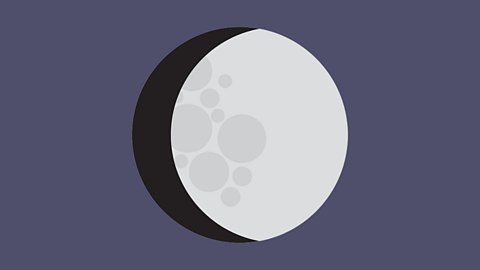
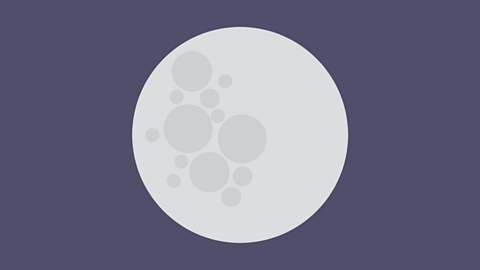
The Moon’s appearance changes over time when viewed from Earth. Sometimes, the Moon is not easily seen in the sky and at other times it can appear as a thin Less than half of the illuminated part of the moon is visible., a full circle – or somewhere in between.
A Moon phase is the shape of the visible part of the Moon, and this changes gradually over the course of a The time between a new moon and the next new moon – approximately 29½ days..
A lunar month

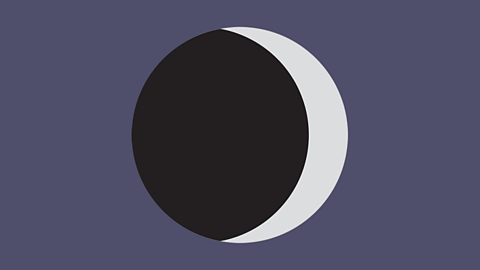
Image caption, New Moon
The illuminated part is not visible at all.
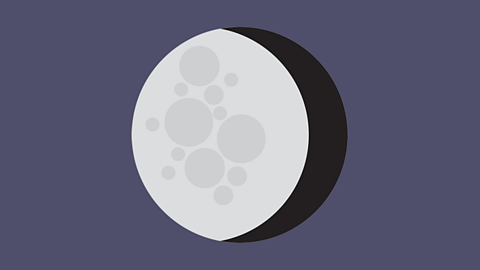
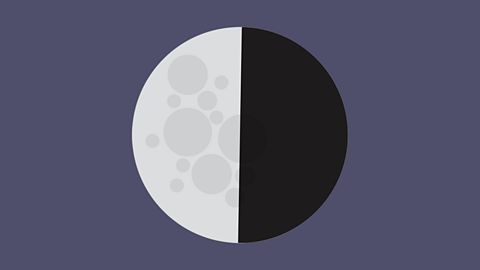
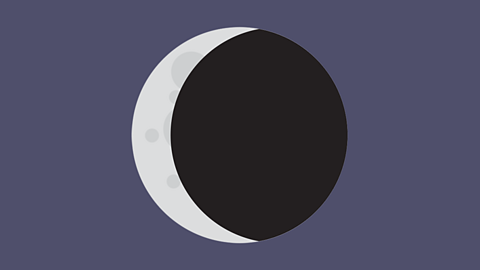
1 of 8
A lunar month lasts around 29.5 days and starts with a The illuminated part of the Moon is not visible at all. – when the Moon is not easily seen in the sky because the light from the Sun lands on the side of the Moon which is facing away from Earth.
As the Moon moves around Earth, the illuminated section of the Moon’s surface starts to face towards the Earth. A thin crescent Moon appears.
Over the course of a lunar month, the Moon goes through the following phases:
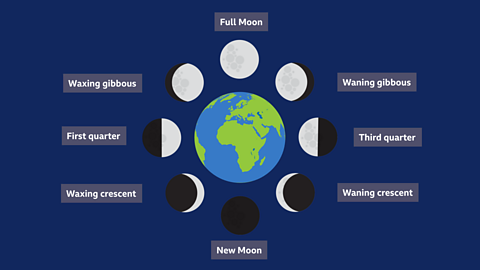
What causes lunar phases?
The Moon is An object that does not produce light. The Moon is non-luminous. It does not produce its own light, but does reflect like from the Sun (which is luminous)., meaning that it does not produce light. We see the Moon because it reflects light from the Sun, and half of the Moon’s surface is always illuminated. The amount of this illuminated portion that we can see from Earth varies depending on the angle that we are viewing from. This changes as the Moon orbits Earth, and Earth orbits around the Sun.
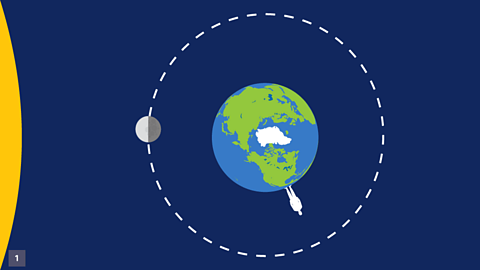
Image caption, When the moon is between Earth and the Sun, the illuminated part of the Moon is facing away from Earth so we cannot see it at all – this is a new Moon. (Not to scale)
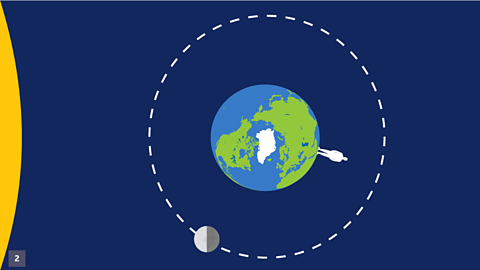
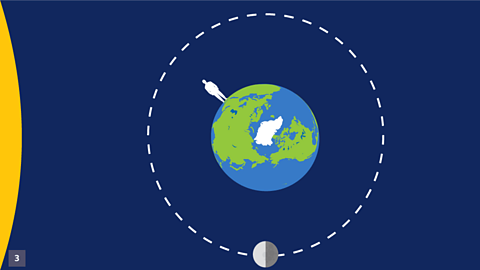
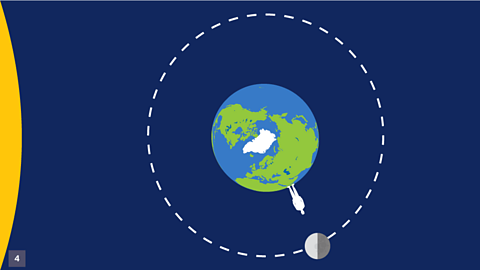
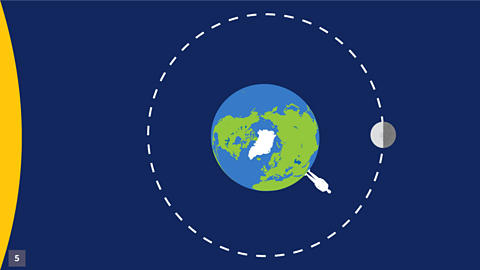
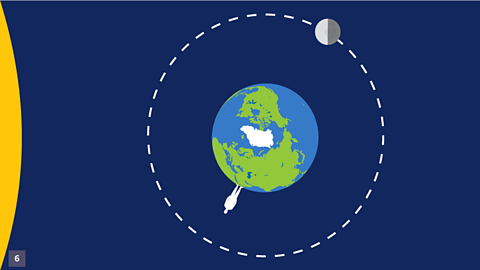
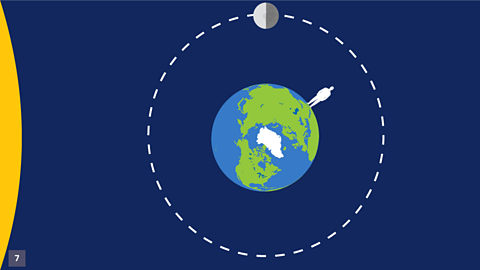
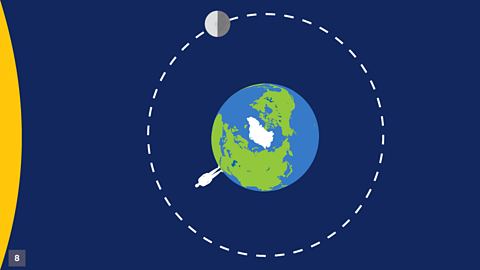
1 of 8
Extended syllabus content: Calculating the average orbital speed
If you are studying the Extended syllabus, you will also need to be able to recall and use the equation for average orbital speed. Click 'show more' for this content:
Calculating average orbital speed
The average orbital speed of any object can be calculated by:
\(\text{average orbital speed} = \frac{2 \times \pi \times \text{average radius of orbit}}{\text{orbital period}}\)
v = \(\frac{2 π \times r}{T}\)
If the units for average radius or orbit were metres (m) and the orbital period were seconds (s), then the units for average orbital speed would be metre per second (m/s).
Example
The average distance between the Earth and the Sun is 1.5 × 10¹¹m. The orbital period of the Earth is 365 days. Calculate the average orbital speed.
Step 1 – convert days into seconds to calculate the orbital period
T = 365 days x 24 hours × 60 minutes × 60 seconds
T = 31 536 000 s
Step 2 – complete the calculation
\(\text{average orbital speed} = \frac{2 \times \pi \times \text{average radius of orbit}}{\text{orbital period}}\)
average orbital speed = 2 × π × 1.5 × 10¹¹ ÷ 31 536 000
average orbital speed = 30 000 m/s
Question
The average distance between Mercury and the Sun is 5.79 × 10¹⁰m. The orbital period of the Mercury is 88 days. Calculate the average orbital speed.
Step 1 – convert days into seconds to calculate the orbital period
T = 88 days × 24 hours × 60 minutes × 60 seconds
T = 7 603 200 s
Step 2 – convert days into seconds to calculate the orbital period
T = 88 days × 24 hours × 60 minutes × 60 seconds
T = 7 603 200 s
Step 3 – complete the calculation
\(\text{average orbital speed} = \frac{2 \times \pi \times \text{average radius of orbit}}{\text{orbital period}}\)
average orbital speed = 2 × π × 5.79 × 10¹⁰ ÷ 7 603 200
average orbital speed = 47900 m/s
Video: Brian Cox on the orbit of the Earth
Professor Brian Cox demonstrates how the orbit of the Earth results in days, nights and seasons, using an orange and a lamp
Why do we have day and night?
Why are the days longer in the summer and shorter in the winter here in the northern hemisphere?
And why do we have seasons?
Well, the answer has to have something to do with the sun, which is here, and the Earth, represented by this orange.
The answer lies in the way that the Earth spins on its axis - it goes round on its axis once a day.
And the way that it orbits around the sun - it goes round the sun once a year.
But the Earth is tilted - so, its spin axis is tilted, actually at an angle of around 23 degrees to the horizontal.
That means that - let's say this is northern hemisphere summer, so there's the North Pole - we're going to spin on our axis, but you see that the North Pole always gets sunlight, 24 hours a day. And if this is us, you see that this would be night, in the shadows, and the sun would rise about there, and the sun would be up, and sun would be up, and the sun would be up, and it'd be up, and it'd be up… and it would set around there. So in the summer, when the North Pole is pointing towards the sun, we get very short nights and very long days.
Then, let's go around six months, so the Earth goes halfway around the sun in its orbit. Now, the North Pole, which is here, is always pointing away from the sun. So, as the Earth spins, the sun never rises. It never shines on the North Pole.
Now we are there. And so, you see that we spend a very short amount of time in the daylight, lots of time in the shadows in the night, and not very long in the day.
So, in the winter, which is what this represents, the North Pole gets no sun at all. We get short days, a little bit of sunlight, and very long nights.
This, quarter way around again, would be the spring, back to the summer, the autumn and the winter.
So, the seasons occur because the Earth's axis is tilted and it goes around the sun - winter in the north, summer in the north.
And the days, because the Earth spins on its axis. It goes around once every, roughly 24 hours.
The structure of the Solar System
The Milky Way is a A cluster of billions of stars, held together by gravity. containing billions of stars. The Sun is one of these stars. The distances between the Sun and other stars are much greater than between the Sun and the planets of the Solar System.
The Sun
The Sun is the largest object in the A group of planets and other objects in space that revolve around a star. Earth is the third planet in orbit around the Sun in the Solar System.. It contains most of the mass of the Solar System, which explains how the Sun’s huge The area of space around a body which experiences the force of gravity. keeps many other objects - planets, dwarf planets, asteroids and comets - in orbit around it.
The Sun is a medium sized star. It is made mainly of hydrogen and helium. It Spreads out from a source. Energy is transferred as a wave. most of its energy in the infrared, visible and ultraviolet regions of the electromagnetic spectrum.
The Sun and all other stars are powered by Changes that occur in the nucleus of an atom. Eg due to radioactive decay, nuclear fission or nuclear fusion. which release energy. In stable stars, like the Sun, hydrogen is fused into helium.
For a planet to form, its own The force of attraction between all objects. The more mass an object has, the larger the force of gravity it exerts. must be strong enough to make it round or spherical in shape. Its gravitational field must also be strong enough to ‘clear the neighbourhood’, pulling smaller nearby objects into its orbit.
Moons
Moons are natural Body that orbits a planet. For example, the Moon is a natural satellite of the Earth but communication satellites are artificial satellites of the Earth. which orbit a planet. Many planets have moons, and some planets have many moons - Saturn has more than 50. The Earth has just one moon - the Moon.
Dwarf planets
Pluto is a An object orbiting a star that is massive enough to be rounded by its own gravity but has not 'cleared the neighbourhood' of other objects and is not a satellite.. The gravitational field of a dwarf planet is not strong enough to clear the neighbourhood, so there may be other objects in its orbit around the Sun. The Solar System contains hundreds of dwarf planets, including Ceres (the only dwarf planet in the asteroid belt).
Asteroids
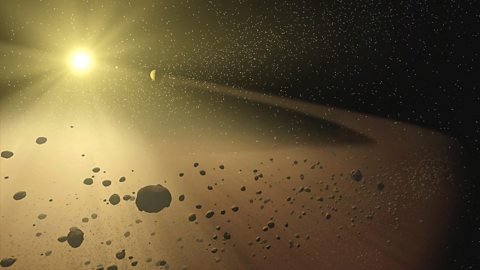
The Solar System contains smaller objects called A rock in space. Asteroids orbit the Sun but some may cross the Earth's orbit, producing a small risk of collision.. These are made of metals and rocky material. There are large numbers of asteroids orbiting the Sun in the asteroid belt between Mars and Jupiter and in a region beyond Neptune called the Kuiper Belt.
Comets
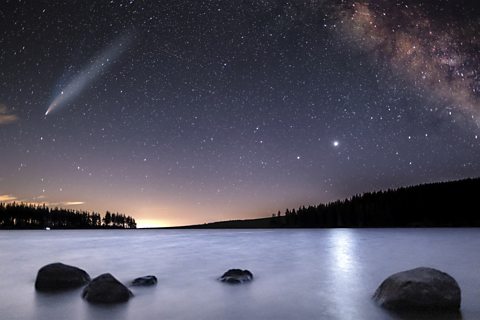
The Solar System also contains small objects called A ball of icy rock that follows an elliptical orbit around the Sun.. Comets are similar to asteroids, but are made of rocky material, dust and ice. As a comet approaches the Sun, it begins to To turn from a liquid to a gas or a vapour., which means that it turns into a gas. It then produces a distinctive tail.
Formation of the Solar System
An explanation for the formation of our Solar System is called the A theory for how gravity caused the formation of the Sun and Solar System around it.. It explains that it could have started with a large rotating cloud of Between stars. gas and dust. This was pulled together by gravity.
A The early stage in the formation of a star, before nuclear fusion occurs. began to form at the centre of this spinning dust cloud. The joining together of two smaller atomic nuclei to produce a larger nucleus. Radiation is released when this happens. Nuclear fusion happens in stars like our Sun, and in hydrogen bombs.started, and a star was born. The remaining gas and dust formed an A rotational disk of matter formed within a gravitational field. around it. The planets began to form from these swirling dust clouds around the star.
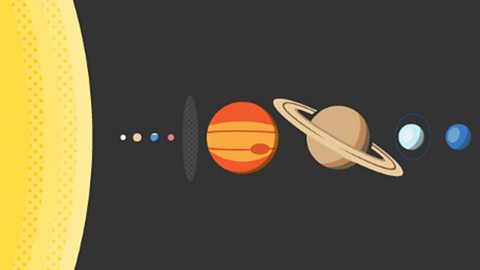
Gravity is greater closer to the star. Most of the dense material in the dust cloud was attracted strongly and ended up there. The inner four planets (Mercury, Venus, Earth, and Mars) are rocky and have solid surfaces that can be walked on. When the Solar System formed, rocks (and other dense, heavy materials in the dust cloud such as iron and uranium) tended to gather closer to the Sun, and these materials combined together to form the inner planets.
The outer four planets (Jupiter, Saturn, Uranus, and Neptune) are called gas giants. When the Solar System formed, many different gaseous substances gathered together further away from the Sun and formed the gas giants. These are much larger than the closest four planets.
Activity: The Solar System
This activity explores some key facts and figures about the Solar System.
Gravitational field strengths
All objects with mass produce a gravitational field. The more The amount of matter an object contains. Mass is measured in kilograms (kg) or grams (g). an object has, the greater its gravitational field will be. The further from the mass, the weaker its gravitational field will be.
A force that acts on mass due to gravity. Because weight is a force, it is measured in newtons (N). is the force acting on an object due to gravity - it has the unit Newtons (N) and acts towards the centre of a gravitational field. Weight is a Force exerted between two objects, even when they are not touching, such as the force of gravity. because gravity exerts its force through a field. An object does not need to be touching the Earth to have a weight.
Gravitational field strength (
Where there is a weaker gravitational field, the weight of an object is smaller. For example, the gravitational field strength of the Moon is 1.6 N/kg. This means that for each kg of mass, an object will experience 1.6 N of force. Therefore, an astronaut will weigh less on the Moon than they do on the Earth.
Question
A person has a mass of 50 kilograms. Is their weight just under eight stone?
No. Weight is a force and all forces are measured in Newtons. Mass multiplied by 10 equals weight, so they would weigh 500 Newtons.
Podcast: Gravity
In this episode, James Stewart and Ellie Hurer explore gravity, gravitational field strength, weight and how to use an equation to calculate them.
Listen to this podcast on gravity.
ELLIE: Hello and welcome to the BBC Bitesize Physics podcast.
JAMES: The series designed to help you tackle your GCSE in physics and combined science. I'm James Stewart, I'm a climate science expert and TV presenter.
ELLIE: And I'm Ellie Hurer, a bioscience PhD researcher.
ELLIE: We're covering lots of different aspects of forces in this series, so make sure to listen to the rest of the episodes too.
JAMES: Yeah, and they're really good. Okay, let's get started because today, I thought so, because today we're talking all about the force that keeps our feet on the ground, gravity.
ELLIE: While we often think about space and astronauts when we talk about gravity, gravity actually acts all around us every single day. Because the definition of gravity is a force of attraction between two objects.
JAMES: The gravitational field is the area around an object where another object will feel a force of gravitational attraction from it.
Gravitational field strength is measured in newtons per kilogram, written out as ‘n’ forward slash ‘kg’.
ELLIE: And the size of the gravitational field strength affects the force of gravity acting on an object in that gravitational field. The other thing that affects the size of gravity is the object's mass. The bigger the mass, the greater the force of gravity.
JAMES: So one key thing to know that a lot of people misunderstand is that weight and mass are actually two different things.
ELLIE: Yeah, so when we say, oh, this loaf of bread weighs 400 grams, we're actually saying that the mass of the loaf of bread is 400 grams.
JAMES: Because mass is about the amount of matter, whereas weight is a force and is the heaviness due to gravity.
ELLIE: Exactly. So let me tell you about the equation you need to calculate the force of weight of an object.
JAMES: Yeah, I'm gonna get my pen and paper out for this one, so if you're listening, please feel free to do the same thing and write along as we go through this.
ELLIE: So, weight equals mass multiplied by the gravitational field strength.
JAMES: Weight is measured in newtons. Mass is measured in kilograms and gravitational field strength is measured in newtons per kilogram.
ELLIE: So to calculate the weight of an object in newtons, you multiply its mass in kilograms by the strength of the gravitational field in newtons per kilogram.
JAMES: That was a lot. Don't panic. Let's just hear that again.
ELLIE: So weight equals mass multiplied by the gravitational field strength.
JAMES: Weight is measured in newtons, mass is measured in kilograms, and gravitational field strength is measured in newtons per kilogram.
ELLIE: So, to calculate the weight of an object in Newtons, you multiply its mass in kilograms by the strength of the gravitational field in Newtons per kilogram.
JAMES: Right, let's try out some examples then. And if you don't have your pen and paper just yet, now would be the perfect time to grab them and you can write down these calculations with us as we go along.
ELLIE: Let's say we want to find out the force of gravity, their weight, acting on your physics teacher as they stand at the front of the classroom.
JAMES: Good image. Now first, you would need to find out their mass. Now let's say it's 80 kilograms, then you need to know the gravitational field strength of the planet they're standing on, which for the planet of Earth is 9.8 newtons per kilogram.
ELLIE: So to measure the force of weight acting on them, you would write down their mass of 80 kilograms and then multiply it by the Earth's gravitational field strength of 9.8 newtons per kilogram to get the answer 784.
JAMES: And because weight is measured in newtons, their weight would be 784 newtons downward. We always have to include those units. And because weight is a force, which is a vector quantity (more about that in episode one), we also have to say the direction it is in, which in this case is downwards.
ELLIE: In those instances, the weight of an object and its mass are directly proportional. So let's say if something had a bigger mass, its weight would be higher. And if something had a smaller mass, its weight would be lower.
JAMES: Exactly. And when we're measuring weight in terms of gravity, we don't use regular kitchen scales. We use something called a newton meter, also known as a calibrated spring balance.
ELLIE: And when we do that, we say that the weight of an object, or in this case, person, acts at a single point. The object or person's centre of mass. The force of gravity, weight, always acts from the middle of an object, straight down.
JAMES: Okay, that was a lot, but I hope that helped you understand gravity a little bit more.
ELLIE: So, let's recap the three main points.
Firstly, gravity is a force of attraction between two objects. The next point is, mass is the amount of matter in an object. However, weight is the force of gravity acting from the middle of the object straight down.
And finally, the equation to find out an object's weight is mass multiplied by gravitational field strength equals weight.
ELLIE: There's your key points about gravity. In the next episode of Bitesize Physics, we're going to dig into work done and energy transfer, and I cannot wait.
JAMES: I believe you. Thank you for listening to BBC Physics. If you found this helpful, and hopefully you did, please do go back and listen, make some notes, so you can come back here and always have this as your point to revise from.
JAMES: Thank you, bye! Bye!
The speed of light
The speed of light in air is very close to 300 000 000 m/s which is approximately the same as 670 000 000 miles per hour (or 670 million miles per hour).
That means in one second light travels a distance of 300 000 000 m – which is about seven and a half times around the world. Nothing can travel faster than the speed of light.
Measuring distances in space
The distances to stars and galaxies are so large that miles and kilometres are meaningless. The Sun is 150 million kilometres or 93 million miles from the Earth, but that’s a tiny distance compared with the distance to other stars, or other galaxies.
Larger units of length are used for these measurements, for example the The distance light travels in a year. . A light year is the distance light travels in a year. This is 9.5 × 10¹⁵ m.
It takes light over four years to reach us from the next nearest star, Proxima Centauri. We say that the distance to Proxima Centauri is 4.2 light years.
It takes over 100,000 years to cross our galaxy, the Milky Way. We say that the diameter of the Milky Way is 100,000 light years. The most distant galaxies observed are millions of light years away.
Calculations involving light years and distance
As light travels at constant speed, the distance light travels in a year can be calculated by:
distance = speed × time
Where:
distance (d) is measured in metres (m)
speed (s) is measured in metres per second (m/s)
time (t) is measured in seconds (s)
Speed of light = 300,000,000 m/s = 3 × 10⁸ m/s
time = 1 year = 365 × 24 × 60 × 60 = 31,536,000 s
1 light year = 3 × 10⁸ m/s × 31,536,000 s = 9.46 × 10¹⁵ metres
1 light year = 9.46 × 10¹⁵ m
Question
A galaxy is found to be 20 million light years away. How far is that in metres?
20 million light years can be written as 20,000,000 light years or 20 × 106 light years.
1 light year = 9.46 × 10¹⁵ metres
20 × 106 light years = 20 × 106 × 9.46 × 1015 metres = 1.89 × 10²³ m
Orbits
Extended syllabus content: Elliptical orbits and orbital speeds
If you are studying the Extended syllabus, you will also need to know about orbits with constant and changing speeds. Click 'show more' for this content:
Explaining orbits
Gravity provides the force needed to maintain stable orbits of both planets around a star and also of moons and artificial satellites around a planet. For an object to remain in a steady, circular orbit it must be travelling at the right speed. The diagram shows a satellite orbiting the Earth.
There are three possible outcomes:
If the satellite is moving too quickly then the gravitational attraction between the Earth and the satellite is too weak to keep it in orbit. If this is the case, the satellite will move off into space.
If the satellite is moving too slowly then the gravitational attraction will be too strong, and the satellite will fall towards the Earth.
A stable orbit is one in which the satellite’s speed is just right - it will not move off into space or spiral into the Earth, but will travel around a fixed path.
Orbits and constant speed
When an object moves in a circle at a constant speed, its direction constantly changes. A change in direction causes a change in velocity. This is because velocity is a vector quantity - it has an associated direction as well as a magnitude. A change in velocity results in acceleration, so an object moving in a circle is accelerating even though its speed may be constant.
An object will only accelerate if a resultant force acts on it. For an object moving in a circle, this resultant force is the centripetal force that acts towards the middle of the circle. Gravitational attraction provides the centripetal force needed to keep planets and all types of satellite in orbit.
Orbits and changing speed
The gravitational attraction between two objects decreases with distance. This means that the closer the two objects are to each other, the stronger the force of gravity between them. If the force between them is greater, a greater acceleration will occur.
The greater the acceleration, the greater the change in velocity - this causes the object to move faster. This means that objects in small orbits travel faster than objects in large orbits.
The graph shows how the orbital speed of a planet changes with its distance from the Sun.
The planets, minor planets, asteroids and comets in the Solar System have Shaped like an ellipse. Oval or egg-shaped. orbits, which are oval or egg-shaped. The Sun is not at the centre of an elliptical orbit unless is it is approximately circular.
The strength of the Sun’s The area of space around a body which experiences the force of gravity. decreases as the distance from it increases. Objects in elliptical orbits decrease in speed the further they travel from the Sun. As their orbits return them towards the Sun, their speed increases.
As an object returns towards the Sun its gravitational potential energy store decreases. This energy must be Energy can be transferred usefully, stored or dissipated (spread out in small amounts), but it cannot be created or destroyed. and so is transferred to the object’s Energy which an object possesses by being in motion. store. This means it gets faster. The reverse energy transfer happens when objects in elliptical orbits begin to move away from the Sun.
Extended syllabus content: Planetary data
You will also need to know how to work with planetary data. Click 'show more' for this content:
Planetary data
It is important to be able to analyse and interpret this planetary data.
| Orbital distance (Miles) | Orbital duration (Days) | |
|---|---|---|
| Mercury | 223700000 | 88 |
| Venus | 422500000 | 225 |
| Earth | 584000000 | 365 |
| Mars | 888000000 | 687 |
| Jupiter | 3037000000 | 4331 |
| Saturn | 5565900000 | 10747 |
| Uranus | 11201300000 | 30589 |
| Neptune | 17562300000 | 59800 |
| Density (kg/m3) | Surface temperature (degree Celsius) | Gravity (m/s2) | |
|---|---|---|---|
| Mercury | 5429 | 167 | 3.7 |
| Venus | 5243 | 464 | 8.9 |
| Earth | 5514 | 15 | 9.8 |
| Mars | 3934 | -65 | 3.7 |
| Jupiter | 1326 | -110 | 23.1 |
| Saturn | 687 | -140 | 9 |
| Uranus | 1270 | -195 | 8.7 |
| Neptune | 1638 | -200 | 11 |
Question
What trend is observed between orbital distance and duration?
For all eight planets, as the orbital distance increases so does the orbital duration.
Question
What trend is observed between distance to the Sun and density?
The four planets closest to Sun have significantly greater densities.
Question
Which set of data does not seem to be linked to closeness to the Sun?
The gravity on each planet does not seem to be linked to closeness to the Sun. Jupiter is the fifth plant from the Sun and has the highest density. Mercury is the closest and has the lowest, joint with Mars.
Quiz
Test your knowledge on the Solar System with this quiz.
Listen
Studing the Core syllabus? Listen to the Core content from this page. You might like to read along at the same time.
Listen to Earth and the Solar System
Teaching resources
Are you a physics teacher looking for more resources? Share this selection of short videos with your students:
More on Space physics
Find out more by working through a topic
- count2 of 3
- count3 of 3

