Why do we have day and night?
Why are the days longer in the summer and shorter in the winter here in the northern hemisphere?
And why do we have seasons?
Well, the answer has to have something to do with the sun, which is here, and the Earth, represented by this orange.
The answer lies in the way that the Earth spins on its axis - it goes round on its axis once a day.
And the way that it orbits around the sun - it goes round the sun once a year.
But the Earth is tilted - so, its spin axis is tilted, actually at an angle of around 23 degrees to the horizontal.
That means that - let's say this is northern hemisphere summer, so there's the North Pole - we're going to spin on our axis, but you see that the North Pole always gets sunlight, 24 hours a day. And if this is us, you see that this would be night, in the shadows, and the sun would rise about there, and the sun would be up, and sun would be up, and the sun would be up, and it'd be up, and it'd be up… and it would set around there.
So in the summer, when the North Pole is pointing towards the sun, we get very short nights and very long days.
Then, let's go around six months, so the Earth goes halfway around the sun in its orbit. Now, the North Pole, which is here, is always pointing away from the sun. So, as the Earth spins, the sun never rises. It never shines on the North Pole.
Now we are there. And so, you see that we spend a very short amount of time in the daylight, lots of time in the shadows in the night, and not very long in the day.
So, in the winter, which is what this represents, the North Pole gets no sun at all. We get short days, a little bit of sunlight, and very long nights.
This, quarter way around again, would be the spring, back to the summer, the autumn and the winter.
So, the seasons occur because the Earth's axis is tilted and it goes around the sun - winter in the north, summer in the north.
And the days, because the Earth spins on its axis. It goes around once every, roughly 24 hours.
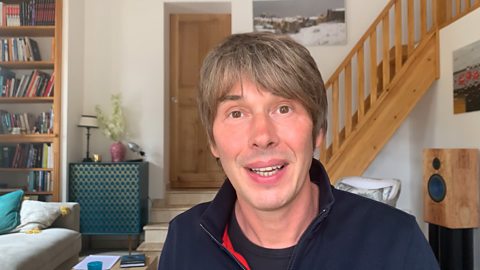
In this video, Professor Brian Cox uses a simple demonstration to explain why we have day and night, and why in the northern hemisphere, days are longer in the summer and shorter in the winter.
Using only an orange and a lamp, representing the Earth and sun respectively, this video demonstrates clearly the impact of the Earth's tilt on the amount of sun that falls on the northern hemisphere during different stages of the year, giving us seasons.
The demonstration also shows the impact of the Earth’s spin on day and night, which affects the length of the day.
Teacher Notes
Points for discussion
Students often find it difficult to visualise the movement of the Earth relative to the sun. This simple model is similar to one used in many classrooms, and uses video to ensure all students see and hear the same details.
*Students often confuse the significance of the Earth’s tilt (seasons) with the significance of the Earth’s rotation (day and night). In this film, the two are highlighted separately and clearly. *
Suggested activities
This demonstration could replace one that you would normally do in the classroom, or it could be used to reinforce it, particularly at KS3 but also for revision at KS4 in an introduction to a space topic.
The learning could then be assessed and reinforced by asking students to apply it to a different part of the Earth, such as at the Equator or in the southern hemisphere.
Curriculum notes
Suitable for KS3 England, Wales and NI and CfE Scotland, S1-3, Combined Science and Physics GCSE in England, Wales and Northern Ireland and at National 4 and 5 in Scotland, and Cambridge IGCSE Physics

Why do astronomers use 'light years' to measure distance in space? video
A short explanation of ‘light years’ and why scientists use them in place of standard units of measurement when talking about space.
What is the Milky Way? video
A description of the Milky Way and its components, including stars, dust, gas and the mysterious ‘dark matter’.

Moons in our solar system. video
A short description of moons in the solar system including what differentiates a moon from a planet.

The solar system. video
A description of the solar system including the eight planets, the asteroid belt, dwarf planets, the Kuiper Belt and the Oort Cloud.