Production in quantity
Manufacturing processes for different scales of production
There are four terms used to describe the scale of production in relation to manufacturing a product:
- The first working model of a design used for testing, development and evaluation. and one-off production
- Where one group of identical products is made at the same time, before moving onto producing the next group.
- When the same product is manufactured many times.
- A production method that leads to many of the same product being made, continuously.
Prototypes and one-off production
There are many ways to produce a prototype - some are rough and look like models and others are well finished and function as intended. It is now possible to A method of building layers to produce a 3D form. metal, and many engineering companies have welcomed this technology as 3D printing is classed as A method of shaping a form by building on top of material., rather than subtractive. Additive manufacture builds up the metal form in layers, whereas A method of shaping a form by the removal of material. takes material away from a larger piece. There is very little waste when using additive techniques, making it more environmentally friendly.
A custom-made or Made as a one-off product that matches the client requirements exactly. product that is made from metal could be made based on a customer Document containing details of a product's required characteristics, and all the processes, materials and other information needed to design the product.. Products such as rings and jewellery are often made personally for a customer and only one will ever exist.
Batch production
Batch production is where many items of the same product are produced, such as a bike frame or parts for a metal fence. Many metal products are joined by A method of joining metal by the addition of molten material., often done by hand rather than by machines, and the metal is held in place with a A tool used to aid the repetition of a process and/or to hold a work in place. during the manufacturing process. The jig ensures that each part stays in place whilst the welding is completed.
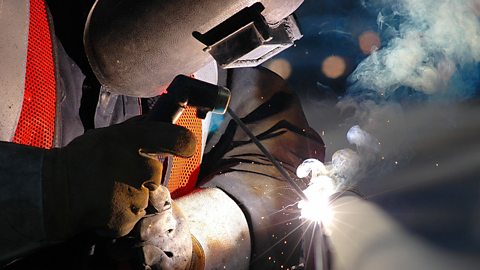
When a product is made in a batch, it is often far cheaper per product than when making just one.
Mass production
Mass-produced products are manufactured in large volumes, and often A series of workers and machines in a factory by which a succession of similar items is progressively assembled. workers can be used to fit standard components, such as screws and An interlocking mechanism that allows rotary motion., to parts. Mass-produced metal products include door handles, barbecues and cooking utensils.
Continuous production
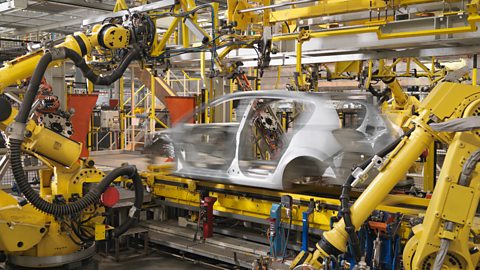
Continuous production takes place 24 hours a day, 7 days a week and, in some cases, 365 days a year. Many cars are made using a continuous production process, and the huge amount of sheet steel that is bought for this brings down the prices.
When cars are made using continuous production methods, most of the work in the factory is automated using robots, with A way to describe that a material is normally much thinner than it is long or wide. steel being cut and pressed, transported, welded and painted by them. However, people are needed to work alongside the robots to fit parts to the cars, as robots currently lack manual The ability to move with care and precision..
Accuracy
Unlike metal, materials such as timber, paper and board change shape easily depending on temperature or the amount of moisture they are holding. Metal can change shape and expand in the heat, but it is not prone to the same amount of movement as timber is. It is often the case that engineers can work to a fine The amount by which a measurement can vary without affecting the ability of the product to be manufactured accurately. when using metal.
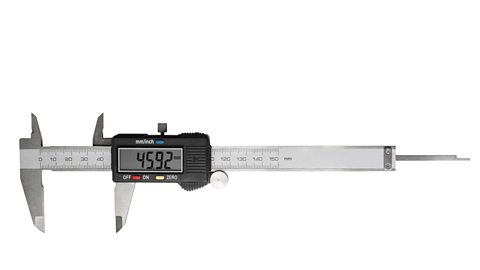
A precision tool used to measure thickness. can be used to measure the width of a material and A digital device for measuring with accuracy. can be used to measure the outside width, inside dimensions and depth of holes. Both tools measure to 1/100th of 1 millimetre (mm) and can be read quickly because of the digital screen.
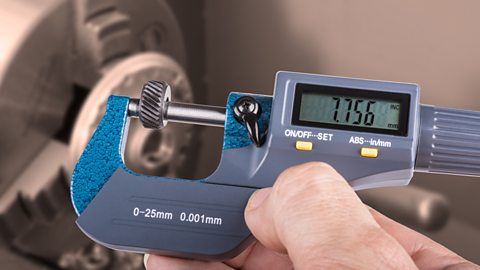
Image caption, Digital micrometer
1 of 2
Quality control
A set of checks intended to ensure that a product will meet the specified customer requirements once it has been manufactured. These procedures are followed before work is complete, as opposed to afterwards. takes place during the manufacture of any product, but, since metal parts are engineered to a fine tolerance, there are specific quality control tools to ensure that metal parts have been made correctly - one such tool is called a A quality control tool used to check tolerance.. The ‘go-no-go gauge’ has a ‘go’ side and a ‘no-go’ side - when testing the product one side must pass and one side must fail.
Example
It is common to hear engineers say they can work to a tolerance of ‘one thou’, meaning 1/1,000th of an inch.
1 inch = 2.54 mm
2.54 ÷ 1,000 = 0.0254 mm, so:
‘one thou’ = 0.03 mm (to 2 decimal places)
If an engineer was asked to mill a 50-mm slot in a block of A chemical element often used for making drinks cans. to the tolerance above, it would be possible to check whether the slot was correct by using a ‘go-no-go gauge’:
50 mm - 0.03 mm = 49.97 mm
This side of the gauge must be able to slide into the milled slot.
50 mm + 0.03 mm = 50.03 mm
This side of the gauge must not be able to slide into the milled slot.
Question
If 1 m lengths of steel bar were cut +/- 5%, what would the range of tolerance be?
1 m = 1,000 mm
5% = 1,000 × 0.5 = 50 mm
Range of tolerance = 50 mm either side of the 1 m mark:
50 mm + 1,000 mm = 1,050 mm maximum
1,000 mm - 50 mm = 950 mm minimum
= 100 mm range
