Irregular stems and endings
Irregular verbs work in a very similar way to regular verbs.
However, if the verb is irregular, you need to use the irregular verb stem then add slightly different endings.
The irregular imperfect verb stems can be found in a dictionary or on an irregular verb list.
For example, if you check the verb trinken (to drink), you will find that it is an irregular verb and that the irregular imperfect stem is trank. Then you need to add the imperfect endings to the imperfect stem.
If you look at the following table, you can see that the first and third person singular forms - 'I' and 'he/she/it' - don’t need an ending added to the stem at all.
| Pronoun | Stem | Ending | Full forms | |
| ich | trank- | - | ich trank – I drank | |
| du | trank- | -st | du trankst – you drank | |
| er/sie/es | trank- | - | er/sie/es trank – he/she/it drank | |
| wir | trank- | -en | wir tranken – we drank | |
| ihr | trank- | -t | ihr trankt – you drank | |
| Sie | trank- | -en | Sie tranken – you drank | |
| sie | trank- | -en | sie tranken – they drank |
| Pronoun | ich |
|---|---|
| Stem | trank- |
| Ending | - |
| Full forms | ich trank – I drank |
| Pronoun | du |
|---|---|
| Stem | trank- |
| Ending | -st |
| Full forms | du trankst – you drank |
| Pronoun | er/sie/es |
|---|---|
| Stem | trank- |
| Ending | - |
| Full forms | er/sie/es trank – he/she/it drank |
| Pronoun | wir |
|---|---|
| Stem | trank- |
| Ending | -en |
| Full forms | wir tranken – we drank |
| Pronoun | ihr |
|---|---|
| Stem | trank- |
| Ending | -t |
| Full forms | ihr trankt – you drank |
| Pronoun | Sie |
|---|---|
| Stem | trank- |
| Ending | -en |
| Full forms | Sie tranken – you drank |
| Pronoun | sie |
|---|---|
| Stem | trank- |
| Ending | -en |
| Full forms | sie tranken – they drank |
Here are some examples of irregular verbs in the first person singular:
| Infinitive | Imperfect | English | |
| fahren | ich fuhr | I went/travelled | |
| gehen | ich ging | I went | |
| lesen | ich las | I read | |
| sehen | ich sah | I saw/watched | |
| trinken | ich trank | I drank | |
| essen | ich aß | I ate | |
| schwimmen | ich schwamm | I swam |
| Infinitive | fahren |
|---|---|
| Imperfect | ich fuhr |
| English | I went/travelled |
| Infinitive | gehen |
|---|---|
| Imperfect | ich ging |
| English | I went |
| Infinitive | lesen |
|---|---|
| Imperfect | ich las |
| English | I read |
| Infinitive | sehen |
|---|---|
| Imperfect | ich sah |
| English | I saw/watched |
| Infinitive | trinken |
|---|---|
| Imperfect | ich trank |
| English | I drank |
| Infinitive | essen |
|---|---|
| Imperfect | ich aß |
| English | I ate |
| Infinitive | schwimmen |
|---|---|
| Imperfect | ich schwamm |
| English | I swam |
Some common irregular German verbs in the imperfect tense are:
| Infinitive | Stem | Example | Meaning | |
| gehen (to go) | ging- | Ich ging ins Konzert. | I went to the concert. | |
| fahren (to travel) | fuhr- | Wir fuhren nach Österreich. | We travelled to Austria. | |
| essen (to eat) | aß- | Er aß zu viele Pommes. | He ate too many chips. | |
| trinken (to drink) | trank- | Sie trank viel Sprudelwasser. | She drank a lot of sparkling water. | |
| fliegen (to fly) | flog- | Wir flogen zusammen nach Berlin. | We flew (together) to Berlin. | |
| lesen (to read) | las- | Ich las in meinem Schlafzimmer. | I read in my bedroom. | |
| schreiben (to write) | schrieb- | Wir schrieben eine E-Mail. | We wrote an email. | |
| finden (to find) | fand- | Ich fand das unfair. | I found that unfair. | |
| denken (to think) | dachte- | Ich dachte, dass das gut war. | I thought that it was good. |
| Infinitive | gehen (to go) |
|---|---|
| Stem | ging- |
| Example | Ich ging ins Konzert. |
| Meaning | I went to the concert. |
| Infinitive | fahren (to travel) |
|---|---|
| Stem | fuhr- |
| Example | Wir fuhren nach Österreich. |
| Meaning | We travelled to Austria. |
| Infinitive | essen (to eat) |
|---|---|
| Stem | aß- |
| Example | Er aß zu viele Pommes. |
| Meaning | He ate too many chips. |
| Infinitive | trinken (to drink) |
|---|---|
| Stem | trank- |
| Example | Sie trank viel Sprudelwasser. |
| Meaning | She drank a lot of sparkling water. |
| Infinitive | fliegen (to fly) |
|---|---|
| Stem | flog- |
| Example | Wir flogen zusammen nach Berlin. |
| Meaning | We flew (together) to Berlin. |
| Infinitive | lesen (to read) |
|---|---|
| Stem | las- |
| Example | Ich las in meinem Schlafzimmer. |
| Meaning | I read in my bedroom. |
| Infinitive | schreiben (to write) |
|---|---|
| Stem | schrieb- |
| Example | Wir schrieben eine E-Mail. |
| Meaning | We wrote an email. |
| Infinitive | finden (to find) |
|---|---|
| Stem | fand- |
| Example | Ich fand das unfair. |
| Meaning | I found that unfair. |
| Infinitive | denken (to think) |
|---|---|
| Stem | dachte- |
| Example | Ich dachte, dass das gut war. |
| Meaning | I thought that it was good. |
Question
Translate these sentences. Find the irregular stem and then check the irregular endings table for the correct form.
- We went to a concert.
- I read a book.
- She drank Apfelsaftschorle.
- We watched television.
- We ate pancakes with chocolate cream.
- I met my friends.
- Wir gingen ins Konzert.
- Ich las ein Buch.
- Sie trank Apfelsaftschorle.
- Wir sahen fern.
- Wir aßen Pfannkuchen mit Shokosahne.
- Ich traf mich mit meinen Freunden.
Did you know?
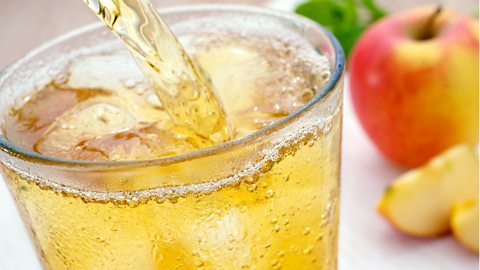
If you order water at a restaurant in the German-speaking countries, you will often automatically get carbonated water – Sprudelwasser – unless you specifically order stilles Wasser.
In Germany, many people stock up on bottles of sparkling water by the crate at the Getränkemarkt – the drinks section of a supermarket. However, some people choose the cheaper option of carbonating their own tap water at home.
Apfelsaftschorle is a very popular drink in Germany, made by mixing half a glass of apple juice with half a glass of Sprudelwasser.
Schorle means a 'spritzer', and many people also drink a Weißweinschorle. Waiters may ask if it should be süß oder sauer (sweet or sour). A Weißweinschorle sauer is white wine mixed with sparkling water, but a Weißweinschorle süß is white wine mixed with lemonade.
