Adjectives that follow nouns
Adjectives are words used to describe A naming word. In German, all nouns must start with a capital letter..
Here are some words you might use to describe people's emotions:
But adjectives can be used to describe much more than just emotions.
Here are some of the most common adjectives in German:
Hilfsvokabeln– Helpful vocabulary
- billig – cheap
- dick – fat
- einfach – easy
- ekelhaft – disgusting
- faul – lazy
- fleißig – hard-working
- freundlich – friendly
- groß – big/tall
- interessant – interesting
- klein – small/short
- kompliziert – complicated
- langweilig – boring
- mittelgroß – medium sized
- ruhig – peaceful
- schlank – slim
- schön – beautiful
- schrecklich – terrible
- schwierig – difficult
- sportlich – sporty
- teuer – expensive
- toll – great
Did you know?
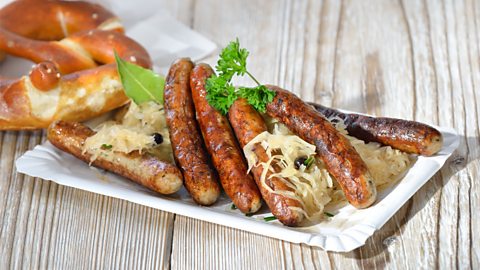
Bratwurst is a grilled sausage and is very popular – beliebt – in Germany.
The verb braten means to fry, roast or barbecue. The word for sausage is Wurst, and there are lots of different types of sausages, eg Bockwurst (a smoked sausage), Weißwurst (a boiled white sausage) and Jagdwurst (a semi-dried sausage). They are often served with a Brötchen (a bread roll) or Bretzel (a salted bread in the shape of a knot – a pretzel) with Sauerkraut (pickled white cabbage) and Senf (mustard).
Extrawurst is a cold cut of sausage which is popular in Austria. But when used idiomatically, Extrawurst refers to a demanding person or to someone who expects special treatment, eg wir kriegen nie Extrawurst in der Schule – we never get special treatment in school.