Using adjectives
If the adjective is separated from the noun it's describing by the words 'is', 'are', 'was' or 'were', it is placed after the noun.
Look at how to use the following adjectives in this context:
- sein Kaninchen ist sehr niedlich – his rabbit is very cute
- meine Schuhen sind zu klein – my shoes are too small
- die Bratwurst war total lecker – the sausage was really delicious
- der Hund ist schwarz – the dog is black
Question
How would you say the following in German?
- The snake is very long.
- The mustard was delicious.
- The boys were so young.
- The strawberries are sweet.
- Die Schlange ist sehr lang.
- Der Senf war lecker.
- Die Jungen waren so jung.
- Die Erdbeeren sind süß.
Adjective endings
If the adjective comes before the noun it's describing, you will need to add different endings to the adjective.
However, where the adjective comes after the noun and is separated by a form of sein, there is no change needed to the end of the adjective. For example:
- der Mann ist alt – the man is old
- der alte Mann – the old man
You need to know two things before you add a different ending to an adjective:
- The Refers to whether a noun is masculine (der/ein), feminine (die/eine) or neuter (das/ein). of the A naming word. In German, all nouns must start with a capital letter. (is it masculine, feminine or neuter?)
- The There are four cases in German – nominative, accusative, dative and genitive. They are used to show the function of a word within a sentence. A case determines which noun is the subject, the object and the indirect object in a sentence. of the word you are describing (eg The nominative case is used for when you are talking about the "subject" of a sentence (the thing or person doing the verb)., The accusative case is used for the direct object of the sentence (the person or thing being "done" by the verb). It is also used after certain prepositions: bis, entlang, durch, ohne, gegen, wider, um, für., Denotes the indirect object of a sentence (eg the girl gave a present TO THE man). The dative case is also used after the following prepositions: aus, außer, bei, gegenüber, mit, nach, seit, von, zu. or The genitive case is used to show possession/belonging. It is also used after certain prepositions: innerhalb, außerhalb, statt, trotz, während, wegen.).
Gender of nouns
All nouns in German have a gender – this is really just a label. They are either masculine (Maskulinum), feminine (Femininum) or neuter (Neutrum). The gender of a noun changes the word for 'the' (The definite article goes before a noun and indicates that the person, place or thing can be identified, ie is specific. In English it would be 'the' or 'this', eg I took the suitcase on holiday.) and 'a' (The indefinite article goes before a noun and indicates that the person, place or thing cannot be identified, ie it could be one of many. In English it would be 'a' or 'an', eg I took a suitcase on holiday.).
- der Hund (masculine) - the dog
- die Katze (feminine) - the cat
- das Kaninchen (neuter) - the rabbit
- ein Hund (masculine) - a dog
- eine Katze (feminine) - a cat
- ein Kaninchen (neuter) - a rabbit
Cases
There are four cases in German. They show the role of the noun in the sentence.
Nominative (used for the subject of a sentence)
- Die Katze hat das Katzenfutter gegessen - The cat ate the food
The cat is the subject as it’s doing the eating
Accusative (used for the direct object of a sentence)
- Die Katze hat den Hund gebissen - The cat bit the dog
The dog is the direct object in the sentence as it’s being bitten
Dative (used for the indirect object of a sentence)
- Ich gebe dem Mann ein Geschenk - I give the man a present (or – I give a present to the man)
The man is the indirect object of the sentence
Genitive (used to show possession)
- Das ist das Zimmer meines Bruders - This is my brother’s room
The room of my brother
Did you know?
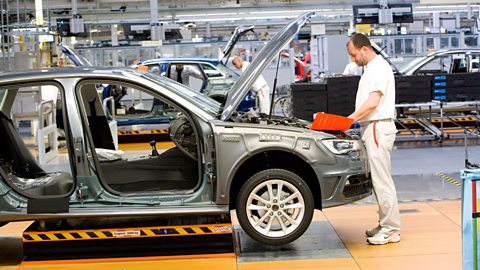
Germany produces and sells by far the largest number of cars in Europe.
Among the most popular makes of German cars driven in the UK, are Volkswagen, BMW, Mercedes, Audi and Porsche.
Volkswagen literally means car of the people and the famous VW Beetle, or Käfer as it is referred to in German, has been in production since 1938.