Regular stems and endings
With regular verbs in the imperfect tense:
- Take off the -en or -n at the end of the infinitive to find the stem, eg spielen > spiel-
- Add the regular endings for the imperfect tense
This table shows the regular endings for the imperfect tense:
| Pronoun | Stem | Ending | Full forms |
| ich | spiel- | -te | ich spielte – I played |
| du | spiel- | -test | du spieltest – you played |
| er/sie/es | spiel- | -te | er/sie/es spielte – he/she/it played |
| wir | spiel- | -ten | wir spielten – we played |
| ihr | spiel- | -tet | ihr spieltet – you played |
| Sie | spiel- | -ten | Sie spielten – you played |
| sie | spiel- | -ten | sie spielten – they played |
| Pronoun | ich |
|---|---|
| Stem | spiel- |
| Ending | -te |
| Full forms | ich spielte – I played |
| Pronoun | du |
|---|---|
| Stem | spiel- |
| Ending | -test |
| Full forms | du spieltest – you played |
| Pronoun | er/sie/es |
|---|---|
| Stem | spiel- |
| Ending | -te |
| Full forms | er/sie/es spielte – he/she/it played |
| Pronoun | wir |
|---|---|
| Stem | spiel- |
| Ending | -ten |
| Full forms | wir spielten – we played |
| Pronoun | ihr |
|---|---|
| Stem | spiel- |
| Ending | -tet |
| Full forms | ihr spieltet – you played |
| Pronoun | Sie |
|---|---|
| Stem | spiel- |
| Ending | -ten |
| Full forms | Sie spielten – you played |
| Pronoun | sie |
|---|---|
| Stem | spiel- |
| Ending | -ten |
| Full forms | sie spielten – they played |
Here are some examples of regular verbs in the first person singular:
| Infinitive | Imperfect | Meaning |
| machen | ich machte | I made/did |
| tanzen | ich tanzte | I danced |
| spielen | ich spielte | I played |
| hören | ich hörte | I heard |
| kaufen | ich kaufte | I bought |
| Infinitive | machen |
|---|---|
| Imperfect | ich machte |
| Meaning | I made/did |
| Infinitive | tanzen |
|---|---|
| Imperfect | ich tanzte |
| Meaning | I danced |
| Infinitive | spielen |
|---|---|
| Imperfect | ich spielte |
| Meaning | I played |
| Infinitive | hören |
|---|---|
| Imperfect | ich hörte |
| Meaning | I heard |
| Infinitive | kaufen |
|---|---|
| Imperfect | ich kaufte |
| Meaning | I bought |
Question
Match these imperfect tense sentences to the correct picture. Note how the verb in the imperfect stays in second position in these sentences.
- Gestern las ich eine E-mail von meinem Vater.
- Mein Bruder trank Bier aber ich trank Limonade, da ich jünger bin.
- Mein Freund kaufte ein neues Handy.
- Wir schwammen im See, weil es so heiss war.
- Wir gingen zusammen in die Bibliothek, um die Computer zu benutzen.
- Ich tanzte am Samstag morgen bei einem Wettbewerb.
- Gestern las ich eine E-mail von meinem Vater. – C. Yesterday I read an email from my father.
- Mein Bruder trank Bier aber ich trank Limonade, da ich jünger bin. – D. My brother drank beer but I drank lemonade, because I am younger.
- Mein Freund kaufte ein neues Handy. – A. My friend bought a new mobile phone.
- Wir schwammen im See, weil es so heiss war. – F. We swam in the lake, because it was so hot.
- Wir gingen zusammen in die Bibliothek, um die Computer zu benutzen. – B. We went to the library together, in order to use the computer.
- Ich tanzte am Samstag morgen bei einem Wettbewerb. – E. I danced in a competition on Saturday morning.
Question
Translate the following sentences into German:
- We played with the school band.
- I listened to the radio.
- They danced in the disco.
- You (singular) travelled to America.
- He bought sparkling water.
- We learned a lot of vocabulary.
- Wir spielten mit der Schulband.
- Ich hörte Radio.
- Sie tanzten in der Disco.
- Du reistest nach Amerika.
- Er kaufte Sprudelwasser.
- Wir lernten viele Vokabeln.
Question
Change these sentences containing regular verbs from the present tense to the imperfect tense. Remember to translate the answers.
- Ich kaufe eine neue Winterjacke.
- Wir kochen viel Fleisch.
- Mein Bruder hört nur Rockmusik.
- Wir machen unsere Hausaufgaben in der Bibliothek.
- Die Mannschaft spielt immer besser.
- Ich kaufte eine neue Winterjacke. – I bought a new winter jacket.
- Wir kochten viel Fleisch. – We cooked a lot of meat.
- Mein Bruder hörte nur Rockmusik. – My brother only listened to rock music.
- Wir machten unsere Hausaufgaben in der Bibliothek. – We did our homework in the library.
- Die Mannschaft spielte immer besser. – The team played even better.
Did you know?
Dancing of all kinds is popular in Germany - from hip hop to ballroom dancing.
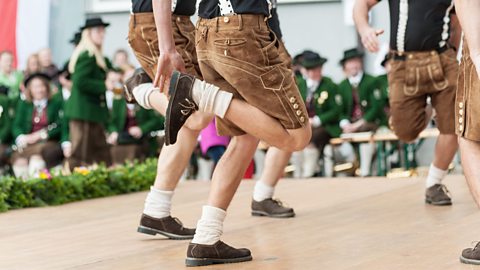
One traditional folk dance, which is particularly popular in the south of Germany, Austria and some parts of northern Italy, is the Schuhplattler. It is mentioned in a poem from the 11th century called Ruodlieb, but some people believe that the dance can be traced back even further.
The dancers stamp, clap and hit the sole of their shoe – Schuh. They also slap their thighs and their knees with their hands held flat – platt. This is why the dance is called Schuhplattler.
The dance is generally performed by men wearing a traditional costume of leather breeches known as Lederhosen.