Negating nouns - kein
Sometimes you have to use kein instead of nicht to make a sentence negative.
kein can be translated as:
- not a
- not... any
- no
It has to agree with the noun it describes, and functions just like the forms of the indefinite article ein.
Use kein in two ways:
- when you want to say 'not' about a noun which has an indefinite article:
Ich habe keine Geschwister – I have no siblings
- when you want to say 'not' about a noun that has no article:
Ich habe keine Pizza gegessen – I did not eat (any) pizza. (literally: I ate no pizza)
Examples in use
- er hat einen Hund – he has a dog
- er hat keinen Hund – he doesn’t have a dog (literally: he has no dog)
- ich trage eine Brille – I wear glasses
- ich trage keine Brille – I don’t wear glasses (literally: I wear no glasses)
- wir wollen ein Eis – we want an ice-cream
- wir wollen kein Eis – we don’t want an ice-cream (literally: we want no ice-cream)
- sie haben Hausaufgaben – they have homework
- sie haben keine Hausaufgaben – they don’t have any homework (literally: they have no homework)
Ohne Fleiß kein Preis. – No pain, no gain (literally: without hard work, no prize).
Question
What do these sentences mean?
- Er hat keine Haustiere.
- Sie tragen keine Schuluniform.
- Ich habe kein Geld.
- Wir essen keinen Kuchen.
- Er hat keine Haustiere. – He doesn’t have any pets.
- Sie tragen keine Schuluniform. – They don’t wear school uniform.
- Ich habe kein Geld. – I have no money.
- Wir essen keinen Kuchen. – We do not eat cake.
Question
Make these sentences negative using kein. What do they mean?
- Ich habe Zeit.
- Er isst Marmelade.
- Sie sucht einen grünen Pulli.
- Wir haben ein neues Auto gekauft.
- Ich werde Äpfel kaufe.
- Ich habe keine Zeit. – I have no time.
- Er isst keine Marmelade. – He does not eat jam.
- Sie sucht keinen grünen Pulli. – She is not looking for a green jumper. (literally: She is looking for no green jumper.)
- Wir haben kein neues Auto gekauft. – We have not bought a new car. (literally: We have bought no new car.)
- Ich werde keine Äpfel kaufen. – I will not buy any apples. (literally: I will buy no apples.)
Did you know?
Despite sharing borders with a number of EU countries – Frankreich, Deutschland, Österreich, Italien – as well as the principality of Liechtenstein, Switzerland is not actually an EU member – Die Schweiz ist kein EU-Mitglied.
In 1992, 50.3% of the Swiss population voted against membership and in 2001 76.8% rejected reopening negotiations for entry to the EU.
However, the country did set up a number of agreements with the EU, in particular the free movement of people, air and road traffic, agriculture, science, trade barriers as well as the pursuit of fraud.
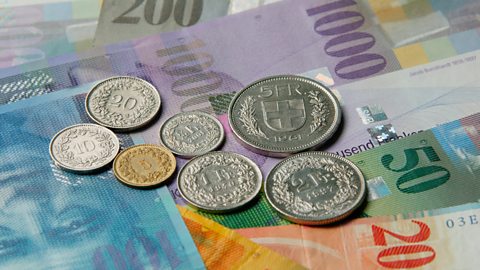
The currency in Switzerland is the Swiss franc – der Schweizer Franken. The Euro is sometimes accepted in larger shops, but prices will be inflated and change will always be given in Swiss francs.