Words with negative connotations - kaum and doch
kaum
kaum means hardly or scarcely. It is not a true negative. It expresses a limit.
It can be used with verbs, adjectives or nouns.
- Ich habe kaum Zeit zum Üben. – I hardly have time to practise.
- Es ist kaum hörbar. – It is hardly audible.
- Ich kann kaum Chinesisch. – I can hardly speak any Chinese.
- Ich habe kaum geschlafen. – I hardly slept.
- Es ist kaum zu glauben. – It is hardly believable. (NB It is almost unbelievable/incredible is a better way to translate this into English)
doch
doch and ja both mean 'yes' in German.
The usual word for 'yes' is ja when it's the opposite of nein – no.
- Kommst du mit? Ja. – Are you coming? Yes.
- Hast du Hunger? Nein. – Are you hungry? No.
But doch must be used to mean 'yes' in response to a negative question, or to contradict a negative statement.
- Sie ist nicht zufrieden. – She's not pleased. Doch – Yes, she is.
- Du bist nicht intelligent. – You aren't intelligent. Doch – Yes, I am.
- Hast du kein Geld mehr? – Do you have no money left? Doch. – Yes, I do.
- Kommt er nicht? – Isn't he coming? Doch. – Yes, he is.
- Bist du nicht satt? – Aren't you full? Doch. – Yes, I am.
It is also used to stress a contrast or a certainty.
- Er war doch der Star des Filmes. – He was indeed/actually the star of the film.
- Hast du das gemacht? Ich habe es doch gemacht – Did you do it? Indeed I did do it.
Question
Check your understanding of doch and kaum by putting the correct word into the gap in the sentence. What do the finished sentences mean?
- Du hast die Hausaufgaben nicht gemacht. _____, ich habe sie gemacht.
- Das Essen war _____ auf dem Tisch, als der Telefon geklingelt hat.
- Spielst du morgen nicht? _____, ich spiele.
- Du hast die Hausaufgaben nicht gemacht. Doch, ich habe sie gemacht. – You haven't done your homework. Yes, I have [done it].
- Das Essen war kaum auf dem Tisch, als der Telefon geklingelt hat. – The meal was scarcely on the table when the phone rang.
- Spielst du morgen nicht? Doch, ich spiele. – Aren't you playing tomorrow? Yes, I am playing.
Did you know?
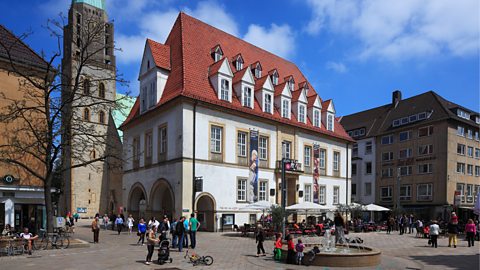
Bielefeld is a large town in the German federal state of Nordrhein Westfalia which dates back to the ninth century.
In the 1990s, a running joke was spread via the internet that the town does not actually exist – die Stadt existiert nicht. Even the German Chancellor, Angela Merkel, joined in the fun when she questioned Bielefeld’s existence in a speech.
Far from being annoyed by the Bielefeld conspiracy, the town’s council decided to play along by releasing a press statement entitled Bielefeld gibt es doch (Bielefeld actually does exist) – on April Fool’s Day.