Internment of Japanese Americans
In December 1941, the Japanese military attacked Pearl Harbor. This stirred a wave of anti-Japanese attitudes across the USA.
Anti-Japanese sentiment in America
Official Information, often biased or misleading, designed to persuade people to adopt a particular point of view. consistently portrayed Japanese people as cruel and untrustworthy. The US commander John DeWitt showed this anti-Japanese sentiment in a speech:
I don’t want any of them here. They are a dangerous element. There is no way to determine their loyalty… It makes no difference whether he is an American citizen, he is still a Japanese.
The USA’s Japanese population was made up of both Japanese immigrants (Issei) and American-born Japanese people (Nisei). They mostly lived on the West Coast of the USA. Both groups were treated with suspicion, especially after a false government report blamed Japanese Americans in Hawaii for helping with the attack on Pearl Harbor by advising the Japanese armed forces. However, this reaction was not a surprise, as there had been much prejudice and intolerance towards Japanese immigrants for many years. Some Americans were worried about increased competition for jobs and houses on the West Coast.
Internment
Pressure from politicians and the army led to President Franklin D Roosevelt issuing An order signed by the US president directing government departments to do certain things. Executive orders do not require approval from Congress. 9066 in February 1942. This allowed people to be removed from areas of military importance if they were seen as a threat to the government.
The executive order led to the eviction of around 120,000 people of Japanese descent from their residences on the West Coast. They were sent to Putting someone in prison or confinement, usually during wartime. camps.
The camps:
- consisted of wooden huts
- were surrounded by barbed wire and guard towers
- were generally located in the most remote parts of the West Coast
Many of those detained were forced to sell their property to American citizens at low prices. Some lost property and received no compensation. An estimated $2 billion in property and possessions was taken away from Japanese Americans.
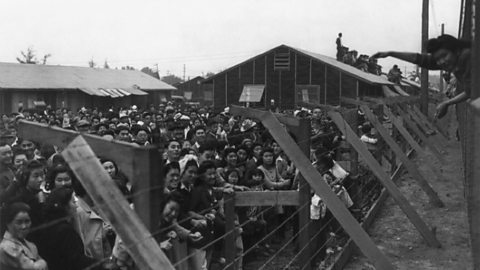
Roosevelt’s executive order allowed for the removal of any people who might be a military threat. However, there was little internment of German or Italian Americans, despite the fact that Germany and Italy, like Japan, were at war with the USA. Some historians have suggested that racism was at the heart of this policy rather than military threat.
Japanese patriotism
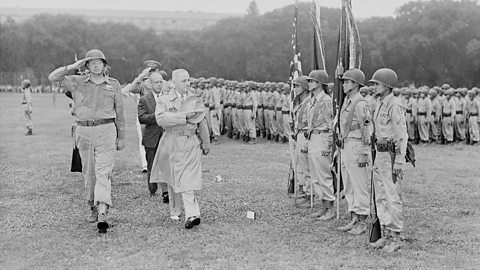
In the camps, conditions were poor. Those who were detained were not allowed to speak their own language, yet they showed their patriotism by raising the American flag each morning. There were education facilities for children but they lacked teachers and equipment. Despite the conditions, Japanese people responded with acts demonstrating their patriotism and resilience. The camps produced food for the American war effort as well as materials for other internment camps, including mattresses and clothing.
In 1943, Congress allowed Japanese Americans to join the army. Around 33,000 Japanese Americans volunteered and 18,000 served in military units. These units, made up of only Japanese American troops, were segregated this meant that the troops were kept separate from the other military units. One such unit, the 442nd Regimental Combat Team, became the most decorated unit in American military history.
