First New Deal - the ‘hundred days’ and the Alphabet Agencies
Explore the impact of the New Deal on America through animation and archive footage.
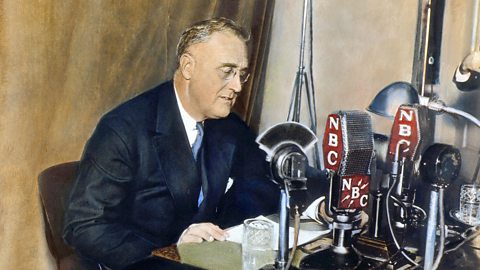
Franklin D Roosevelt’s electoral campaign of a New Deal for the American people could be put into practice once he had won the 1932 presidential election. His plan was to restore confidence in the economy with an extensive programme to solve the Great Depression. He made a point of explaining his reforms in his The name given to a series of radio broadcast addresses by President Franklin D Roosevelt to explain his policies in simple terms to the American people. during which the American people could hear him speaking to them on the radio. He tried to show how all Americans were working together to make life better.
Two of his earliest reforms demonstrated this. First, he ended Prohibition and allowed alcohol to be produced and sold again. Second, he showed empathy to the people by organising a pay cut for The legislative body of the US government, made up of the Senate and the House of Representatives. as well as for himself. Roosevelt then embarked upon his famous The first 100 days of Franklin D Roosevelt's presidency, in which he passed a large number of reforms to tackle the impact of the Great Depression. As part of this, he created many of what became known as US government agencies - with shortened names such as PWA, TVA - that were founded to create jobs and provide services to help recovery from the Great Depression. to help solve the problems left by the Great Depression.
The reforms of the First New Deal
| Government action | Impact of government action |
| Agricultural Adjustment Administration (AAA) | This body was set up by the 1933 Agricultural Adjustment Act. Its aim was to end overproduction and falling prices in farming. Farmers were paid to destroy some crops and livestock to force up prices. Farmers earned around one and a half times as much in 1936 as they had in 1933. |
| Civilian Conservation Corps (CCC) | Men aged 18 to 25 were offered work on environmental projects such as planting trees. Around 3 million men were given work by this agency. |
| 1933 Emergency Banking Act | All banks were closed for four days. The government supported around 5,000 banks and promised people they would not lose all of their money if the banks failed again. They would get at least $2,500 of their savings back. |
| Federal Emergency Relief Administration (FERA) | This agency was given $500 million to provide food, clothing and housing for the poor. |
| National Recovery Administration (NRA) | This agency was set up to improve wages, working hours and conditions. Businesses that signed up to its scheme were allowed to display the NRA symbol of the blue eagle and people were encouraged to use these companies. |
| Public Works Administration (PWA) | This agency spent around $3.3 billion on public building projects to provide work for the unemployed. This included the building of schools, hospitals and roads. |
| Securities Exchange Commission | This ensured that companies that wanted to sell shares on the stock market had to provide truthful accounts of their business before people could invest in them. |
| Tennessee Valley Authority (TVA) | This agency built and acquired dams along the Tennessee Valley. The dams helped to prevent flooding and provided water for irrigating farms. Power-plants were also built to produce hydro-electric power. The construction new dams created many jobs. |
| Government action | Agricultural Adjustment Administration (AAA) |
|---|---|
| Impact of government action | This body was set up by the 1933 Agricultural Adjustment Act. Its aim was to end overproduction and falling prices in farming. Farmers were paid to destroy some crops and livestock to force up prices. Farmers earned around one and a half times as much in 1936 as they had in 1933. |
| Government action | Civilian Conservation Corps (CCC) |
|---|---|
| Impact of government action | Men aged 18 to 25 were offered work on environmental projects such as planting trees. Around 3 million men were given work by this agency. |
| Government action | 1933 Emergency Banking Act |
|---|---|
| Impact of government action | All banks were closed for four days. The government supported around 5,000 banks and promised people they would not lose all of their money if the banks failed again. They would get at least $2,500 of their savings back. |
| Government action | Federal Emergency Relief Administration (FERA) |
|---|---|
| Impact of government action | This agency was given $500 million to provide food, clothing and housing for the poor. |
| Government action | National Recovery Administration (NRA) |
|---|---|
| Impact of government action | This agency was set up to improve wages, working hours and conditions. Businesses that signed up to its scheme were allowed to display the NRA symbol of the blue eagle and people were encouraged to use these companies. |
| Government action | Public Works Administration (PWA) |
|---|---|
| Impact of government action | This agency spent around $3.3 billion on public building projects to provide work for the unemployed. This included the building of schools, hospitals and roads. |
| Government action | Securities Exchange Commission |
|---|---|
| Impact of government action | This ensured that companies that wanted to sell shares on the stock market had to provide truthful accounts of their business before people could invest in them. |
| Government action | Tennessee Valley Authority (TVA) |
|---|---|
| Impact of government action | This agency built and acquired dams along the Tennessee Valley. The dams helped to prevent flooding and provided water for irrigating farms. Power-plants were also built to produce hydro-electric power. The construction new dams created many jobs. |
