Reactions to the New Deal
President Franklin D Roosevelt passed a significant number of reforms in his first 100 days. Despite the popularity of many of them, criticism of the New Deal did emerge after 1934. Criticism came from both the left and the right of the A way of classifying different political opinions from 'Left' to 'Right'.
Right-wing critics
Republicans
The One of the two major American political parties. Republicans tend to hold a more conservative viewpoint on politics and society. believed that the New Deal had gone too far, pushing government control beyond what the US A set of laws by which a country is governed. allowed.
- They felt America was becoming a The economic idea of running a country in which all means of production, such as tools and raw materials, are owned by the community as a whole. This means that everybody contributes and receives according to their ability and needs. country, like the Soviet Union, and Roosevelt was seen as behaving like Joseph Stalin.
- The Republican Party argued that Roosevelt had given the The central government in the USA, including the president, Congress and the Supreme Court. too much power.
- There were even some Political party in the United States. Democrats tend to hold a more liberal viewpoint on politics and society. who agreed with this view.
Business leaders
The New Deal faced some opposition from business leaders who were worried about the growing costs of Roosevelt’s reforms.
- They also thought that enormous amounts of money were being wasted on creating temporary jobs that had little long-term value.
- They did not like how Roosevelt tried to interfere in how they ran their businesses or how much power he gave to the A trade union is a type of organisation whose main purpose is to represent the interests of employees in a specific type of business.
- Some people believed that Payments and other benefits, such as education, health care, and unemployment payments, given to a population free at the point of use, although paid for by general taxation. payments would make people too dependent on the government.
Conservatives, in business and politics, came together to form the American Liberty League. They campaigned against the costs of the New Deal and the power of the president. They also demanded a return to the old idea of Personal liberty and free competition, and the idea that people should be self-reliant.
The Supreme Court
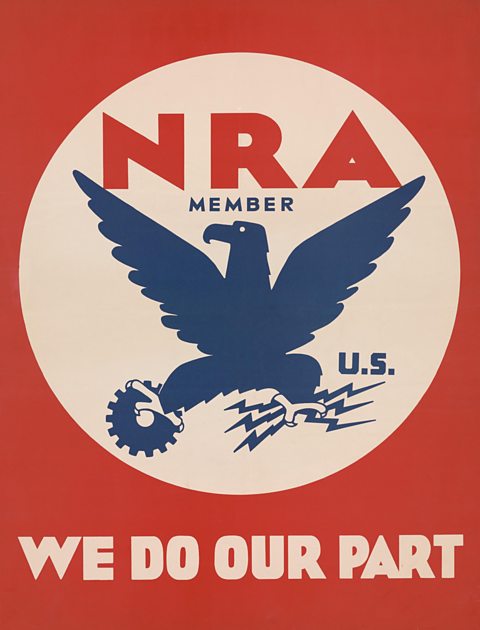
Roosevelt had implemented many reforms during his presidency, such as laws that increased the power of the government and blurred the traditional boundaries between state and central government. The The ultimate court of appeal in the USA. It makes the final decision on whether a law is permitted by the US Constitution. challenged many of the US government agencies - with shortened names such as PWA, TVA - that were founded to create jobs and provide services to help recovery from the Great Depression. including the National Recovery Administration (NRA) and the Agricultural Adjustment Administration (AAA), as its members believed they were If something is unconstitutional, it means that it breaks rules about how the US government should be run. They argued that Roosevelt did not have the power to create these laws, as the laws interfered with the powers of individual states.
Roosevelt’s solution to the Supreme Court’s challenge was to reform it. He wanted to allow himself to appoint up to six extra judges, knowing that he could choose judges who would make the court more likely to vote for his plans. His solution was extremely unpopular, as there was a fear that he was trying to become more powerful. His plan was not allowed to proceed.
Despite Roosevelt’s plan not being accepted, the threat made to alter the Supreme Court was effective. It made the court more accepting of his other New Deal policies, including the 1935 Wagner Act.
Left-wing critics
Those on the left of politics thought that the New Deal had not gone far enough.
- They thought it did not do enough to solve the causes of America’s economic problems, especially the huge gap between the rich and the rest of the population.
- Other people pointed out that some agencies discriminated against African Americans. For example, some agencies, including the Civilian Conservation Corps (CCC), This meant that white people and black people had to live separately. The areas of society affected by segregation included churches, hospitals, theatres and schools. African Americans from white Americans by having separate CCC camps.
Charles Coughlin
One critic on the left was Father Charles Coughlin.
- He was a priest from Detroit who had his own radio show that reached between 30 and 40 million people.
- Initially he was a supporter of the New Deal, but he gradually changed his mind as he felt that the New Deal did not go far enough to help the poor.
- He set up the National Union for Social Justice.
- He wanted to take power away from the banks by An industry or business being taken over by the government. them.
- His views were anti-New Deal and anti-Semitic. His radio show ceased to be broadcast, his regular magazine publications ended in 1942 and his influence declined.
Francis Townsend
Dr Francis Townsend argued that not enough was being done to help the elderly and that they should receive a generous pension.
- His plan was to offer $200 per month to all those who had retired. They would have to spend that sum every month and not save anything.
- This would help the economy and encourage retirement - to free up jobs for younger people.
- Townsend set up an organisation called the Old Age Revolving Pension Plan, also known as the Townsend Clubs.
- The scheme was unaffordable and Townsend’s plans came to nothing.
Huey Long
One of Roosevelt’s rivals was Huey Long, A person who is elected to lead a state’s government in the USA. of Louisiana and then senator from 1932.
- He said that more should be done to share America’s wealth equally.
- He proposed his Share Our Wealth scheme, which would have taxed 100 per cent of incomes over $1 million as well as removing the wealth of anyone who had more than $5 million. This would have allowed the government to provide an income to all families.
- Long promised to make “every man a king” and attracted the support of millions of the poor. He was accused of A political system in which all property and wealth is owned by the whole community and not by individuals.
- His influence ended when he was assassinated in 1935.
