Years
Forming years is not complicated in German.
All you do is separate the four digits of the year into two pairs – one pair for the century and another pair for the year, then place the number hundert in between both pairs.
Example
Break up the year 1981 as follows:
- Century = 19 - neunzehn
- Year = 81 - einundachtzig
Now place the word hundert between both these digits:
Remember that when all the numbers are joined together, they have to be written as one word. So the completed form is:
1981 - neunzehnhunderteinundachtzig
After the year 2000, it is common to say zwei tausend and then the year, eg 2015 – zweitausendfünfzehn.
German speakers would never say zwanzig neunzehn for 2019.
Question
What are the following years in digits.
Don’t be put off by how long the word is – just break it down into two pairs of numbers that you recognise, separated by hundert. One pair is the century and the other pair is the year.
- neunzehnhundertneunzig
- achtzehnhunderteinundsiebzig
- neunzehnhundertneunzehn
- neunzehnhundertneunundvierzig
- zweitausendsechs
- siebzehnhundertvierzig
- neunzehnhunderteinundsechzig
- neunzehnhundertneunzig – 1990
- achtzehnhunderteinundsiebzig – 1871
- neunzehnhundertneunzehn – 1919
- neunzehnhundertneunundvierzig – 1949
- zweitausendsechs – 2006
- siebzehnhundertvierzig – 1740
- neunzehnhunderteinundsechzig – 1961
Did you know?
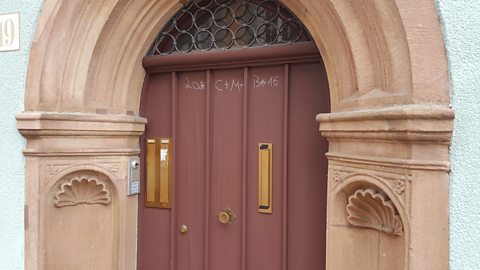
In Austria, Switzerland and the Catholic parts of Germany, you will often see chalk inscriptions on people's front doors. This old practice is done during the 12 days of Christmas (vom 25. Dezember bis zum 6. Januar) by people dressed as the Three Kings – die Drei Könige. They are known as the Sternsinger (star singers).
The Sternsinger collect money for charity, then write the inscription to bless the house for the coming year by noting the letters C+M+B, which stand for the names of the Three Kings - Caspar, Melchior and Balthazar. The letters also stand for the Latin Christus mansionem benedicat – may Christ bless this house.
They write the first two digits of the year (the century) at the beginning of the inscription and the last two digits of the new year at the end. People keep the chalk inscriptions on their doors all year round until the next visit.