Travel
Numbers also play an important part in travel and getting around when you're abroad, especially by car.
In Germany alone there are almost 13,000 kilometres of motorway, ranking it amongst the most well-connected countries in the world, alongside the USA and China despite its hugely different geographical area.
Understanding numbers will help you to know if there is a delay on the roads and how long a traffic jam or tailback – Stau – might be.
Germans refer to the Autobahn with numbers, eg A5, A8 etc in the same way that in English we refer to motorways with numbers, eg M62, M25, M4.
Question
Listen to these short traffic announcements from various radio stations across Germany, and fill in the gaps.
Nordrhein-Westfalen: Auf der A___ Dortmund Richtung Hannover gibt es einen ___ Kilometer langen Stau.
In Bayern auf der A___ Passau Richtung Nürnberg ist die Autobahn in beiden Richtungen bis ___ Uhr geschlossen.
Baden-Württemberg: Auf der A___ Stuttgart Richtung München gibt es einen ___ Kilometer langen Stau.
Hamburg: Auf der A___ Richtung Hamburg-Süd gibt es einen ___ Kilometer langen Stau und die Autobahn ist blockiert.
Die A___ Autobahn Salzburg Richtung Villach ist in der Nacht von ___ bis ___ Uhr wegen einer Baustelle gesperrt.
- On the A2 in Dortmund towards Hannover there is a three km long traffic jam.
- In Bavaria on the A3 between Passau and Nuremberg the motorway is closed in both directions from 7:00 pm.
- On the A8 between Stuttgart and Munich there is a five km long traffic jam.
- On the A252 in the direction of Hamburg South there is an eight km long traffic jam and the motorway is blocked.
- The A10 motorway between Salzburg and Villach is closed at night between the hours of 10 pm and 7 am for roadworks.
Whereas in English we split the numbers of a road up into single digits, eg 'the A four-five-four', in German road numbers are said as a complete number, eg die A vierhundertvierundfünfzig.
Answer the following questions:
- Wie alt bist du? – How old are you?
- Wie groß bist du? – How tall are you?
- Wie ist deine Handynummer? – What is your mobile number?
- Was kostet das? – How much is that?
- Wie spät ist es? – What time is it?
- Wann hast du Geburtstag? – When is your birthday?
- In welchem Jahr bist du geboren? – In what year were you born?
- Wie viel haben deine neuen Turnschuhe gekostet? – How much were your new trainers?
- Wie lange ist der Stau auf der A5? – How long is the traffic jam on the A5 motorway?
- Welche Schuhgröße hast du? – What shoe size are you?
The following phrases may also help you:
- Ich bin X Jahre alt. – I am X years old.
- Ich bin ein Meter sechsundsechzig groß. – I am 1 metre 66 cm tall.
- Meine Handynummer ist... – My mobile number is... (numbers as single digits or said in pairs)
- Das kostet zwanzig Euro neunundneunzig. – It costs €20,99
- Es ist... – It is...
- Mein Geburtstag ist am X. – My birthday is on the X.
- Ich bin im Jahr zweitausend… geboren. – I was born in 20...
- Es hat/sie haben ... gekostet. – It cost.../they cost...
- Auf der A5 gibt es einen drei Kilometer langen Stau. – There is a three km long traffic jam on the A5 motorway.
- Meine Schuhgröße ist... – My shoe size is...
Did you know?
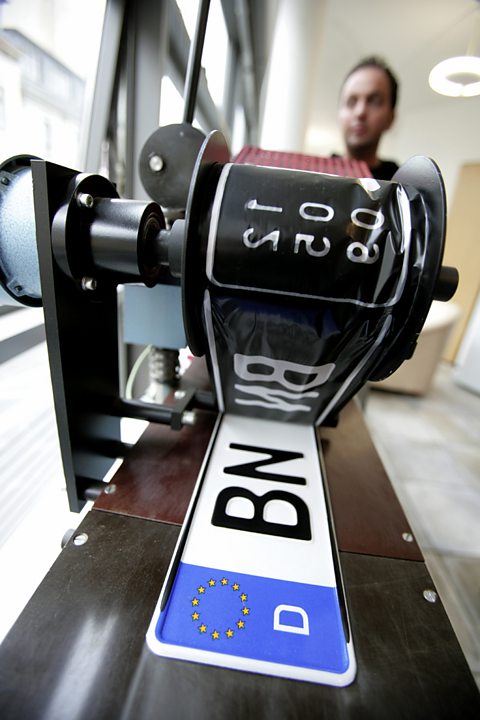
German vehicle registration plates – Nummernschilder – are made up of numbers and letters, just like in the UK.
However, the letters at the start of each number plate indicate in which town or city a car was originally registered. It's usually a good indicator as to where the car owners come from, but not always the case.
Spotting where cars are from from the number plate is a good way to while away a long journey on German motorways.
Here are some abbreviations to look out for:
- B - Berlin
- BN - Bonn
- DD - Dresden
- F - Frankfurt
- GI - Gießen
- LK - Lübbecke
- M - München
- ROS - Rostock
- Z - Zwickau
