Money
Be careful when you write numbers or see numbers written in German, as the decimal point and comma are used differently from English. In fact, they are just swapped around from the English way of using them.
- In English, you write - £1.99
- In German, you write - 1,99 €
- In English, you write - 1.99 %
- In German, you write - 1,99 %
You swap the comma and decimal points when you get to larger numbers too.
- In English, you write - £1,999.00
- In German, you write - 1.999,00 €
This is how you include the use of the comma in speech:
eins Komma neunundneunzig Euro - 1,99 €
Question
Here are some numbers written out in words. Can you match them to the price tags?
- neunzehn Komma fünfundneunzig
- zwei Komma fünfzig
- sieben Komma neunundvierzig
- neunundneunzig Komma fünfundsiebzig
- vier Komma achtzig
- dreißig Komma neunzig
- neunzehn Komma fünfundneunzig – E. 19,95 €
- zwei Komma fünfzig – C. 2,50 €
- sieben Komma neunundvierzig – F. 7,49 €
- neunundneunzig Komma fünfundsiebzig – A. 99,75€
- vier Komma achtzig – D. 4,80 €
- dreißig Komma neunzig – B. 30,90 €
Did you know?
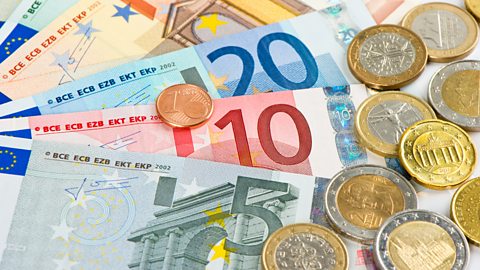
The Euro is the official currency of Germany and Austria. The symbol for the Euro is €, and it is often placed after the number, unlike the pound sign - £ - which is placed before the number. One Euro is divided into 100 cents.
Originally called the ECU (European Currency Unit), the name 'Euro' came into being in 1995. However, it wasn't until 1st January 2002, that the physical coins and banknotes were introduced for common use in shops and restaurants etc.
Before the introduction of the Euro, Germany's currency was the Deutsche Mark, which was abbreviated to DM. One Mark was divided into 100 Pfennig (a cognate with 'penny').
Austria's pre-Euro currency was the Österreichischer Schilling (a cognate with 'shilling'). One Schilling was divided into 100 Groschen.