Commercial processes
There are three main methods of shaping metal by a machine in a Associated with business and profit. setting:
- A method of spinning a material so that a cylindrical shape or bowl can be produced.
- The process of using a machine with a rotary cutter to cut and shape material.
- A method of producing a form by pouring molten liquid into a mould.
Metal can be turned in a A machine used to turn material so that it can be shaped to a cylindrical shape or bowl., which can be hand operated or controlled via a computer on a The use of computers to control cutting and shaping machines and a key computer aided manufacture (CAM) technique. lathe. A lathe spins the work at high speed as a cutting tool is introduced to the metal to produce round and cylindrical shapes.
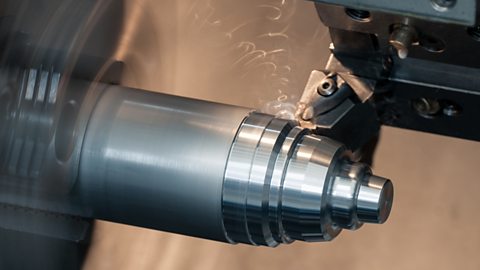
Round pieces of metal are held in a lathe using a three-jaw chuck, and metal that is not round is held by a four-jaw chuck.
Metal can be shaped using a A machine with a rotary cutter, used in cutting and shaping. - a very versatile tool for smoothing a surface or edge and for cutting grooves and profiles. Milling machines can work either horizontally (horizontal milling machine) or vertically (vertical milling machine) - both machines perform the same tasks; the main difference is the direction the cutting tool is held.

If a part is too complex to shape by hand or on a milling machine, it can be Molten material poured into a mould. by melting metal and then pouring it into a mould. It is possible to cast A soft alloy of tin and copper. quite easily. The melting point is low, around 200°C, and moulds can be made from laser-cut or hand-shaped A type of engineered wood made of compressed wood and fibre particles held together with glue..
A process of making a mould in sand so that a molten metal can be poured to take a form. can be used to cast larger and more complex shapes as it uses a two-part mould:
- a A solid shape that is often used to make a mould. is made, usually by hand, and is placed in the Sand used for sand casting - it is not green in colour but is used in a wet state so stays in position in the casting box., which is packed tightly around the former before it is removed
- this is repeated on the other part of the mould
- two holes are made in the sand, one for the molten metal to be poured into (the runner) and one for the metal to come up and out the other side (the riser)
- once they are both ready, parting powder is applied to the sand and the two moulds are placed together, one on top of the other
- the molten metal, often A chemical element often used for making drinks cans. in schools, is poured into the runner until it comes up to the riser when the cavity in the sand is full of metal
