Accuracy and quality control
Unlike metal, materials such as timber, paper and board change shape easily depending on temperature or the amount of moisture they are holding. Metal can change shape and expand in the heat, but it is not prone to the same amount of movement as timber is. It is often the case that engineers can work to a fine The amount by which a measurement can vary without affecting the ability of the product to be manufactured accurately. when using metal.
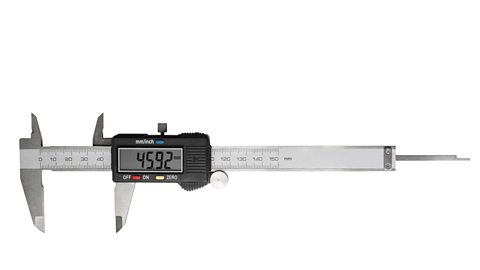
A precision tool used to measure thickness. can be used to measure the width of a material and A digital device for measuring with accuracy. can be used to measure the outside width, inside dimensions and depth of holes. Both tools measure to 1/100 of 1 millimetre (mm) and can be read quickly because of the digital screen.
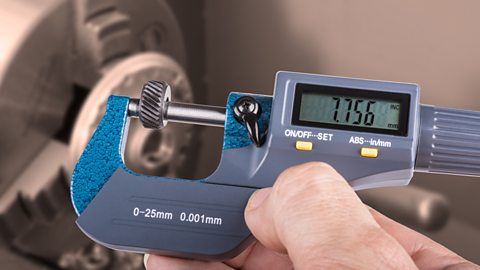
Image caption, Digital micrometer
1 of 2
A set of checks intended to ensure that a product will meet the specified customer requirements once it has been manufactured. These procedures are followed before work is complete, as opposed to afterwards. takes place during the manufacture of any product, but, since metal parts are engineered to a fine tolerance, there are specific quality control tools to ensure that metal parts have been made correctly - one such tool is called a A quality control tool used to check tolerance.. The ‘go-no-go gauge’ has a ‘go’ side and a ‘no-go’ side - when testing the product one side must pass and one side must fail.
Example
It is common to hear engineers say they can work to a tolerance of ‘one thou’, meaning 1/1,000th of an inch.
1 inch = 25.4 mm
25.4 ÷ 1,000 = 0.0254 mm, so:
‘one thou’ = 0.03 mm (to 2 decimal places)
If an engineer was asked to mill a 50-mm slot in a block of A chemical element often used for making drinks cans. to the tolerance above, it would be possible to check whether the slot was correct by using a ‘go-no-go gauge’:
50 mm - 0.03 mm = 49.97 mm
This side of the gauge must be able to slide into the milled slot.
50 mm + 0.03 mm = 50.03 mm
This side of the gauge must not be able to slide into the milled slot.
Question
If 1 m lengths of steel bar were cut +/- 5%, what would the range of tolerance be?
1 m = 1,000 mm
5% = 1,000 × 0.5 = 50 mm
Range of tolerance = 50 mm either side of the 1 m mark:
50 mm + 1,000 mm = 1,050 mm maximum
1,000 mm - 50 mm = 950 mm minimum
= 100 mm range
