Forces and stresses
Forces act on materials all the time - even if a material appears stationary it still has a force acting on it. There are five terms used to describe what type of force can act on a material:
- Pulling force exerted by each end of an object such as a string or rope. - a pulling force
- Being squashed. - a pushing force
- A bending force is applied at an angle causing a material to be in compression and tension at the same time. - forces at an angle to the material
- A twisting force. - a twisting force
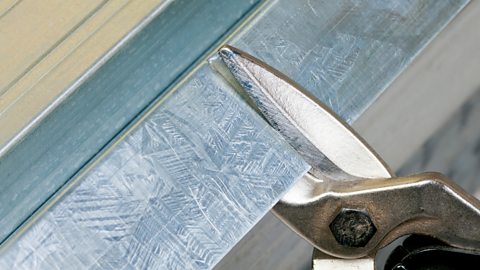
- A force across a material, eg scissors cut by applying a shear force. - forces acting across the material
Each metal type has different The mechanical, physical or optical properties of materials that define how they behave in use. in relation to the way they react to each of the five forces. It is therefore important to know how to test a metal so the correct one can be chosen for the specific task.
Tension
Tension can be tested by pulling opposite ends of the metal. The The tension a material can withstand without breaking. can be tested to see if the chosen metal will be fit for purpose by fixing a piece of metal to a point and then loading it with a pulling force.
Compression
Compression can be tested by applying a force on top of the piece of metal. If the metal compresses, then To strengthen a material that could weaken when a force is applied. the metal could be an option.
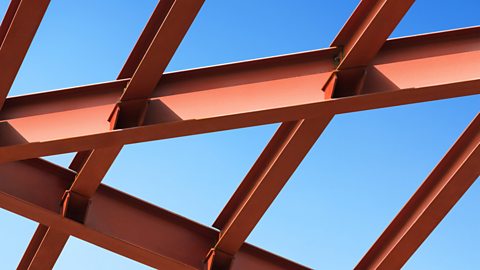
Often the shape of the metal plays a big part in how it will react to a force. A ‘rolled steel joist’ (RSJ) is used in construction work as the shape withstands bending and compression.
Torsion
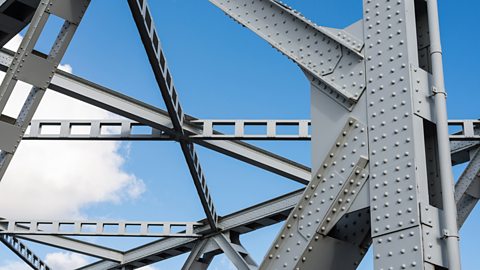
Torsion can be tested by securing the end of the metal in a A tool for clamping material while it is worked on.. The other end can then be twisted to see if the metal can withstand the force. If there is a twist, bracing one piece of metal to another can prevent deformation due to both torsion and shear forces.
Shear
Shear forces act in different directions and cut across a material, but a huge amount of force is needed to shear through a piece of metal. If a piece of metal is cut using A tool for cutting metal by providing a shear force., the cut will have been made by a shear force.