Tools, equipment and processes
Metal is a popular material to use in schools within Design and Technology lessons as it is generally not too expensive in comparison with other materials that are available.
There are many different tools for marking out on metal:
- A sharp object used to scratch a line. - a sharp point to put a fine scratch on the surface of the metal that is being marked
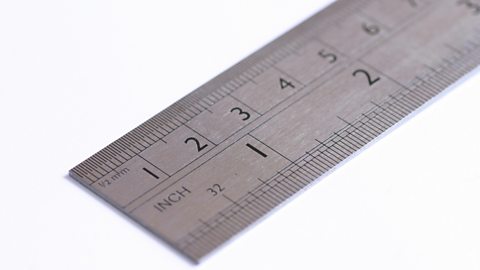
- A precision-made rule that has engraved measurements. - more accurate than a plastic ruler and often has half millimetres as well as millimetres
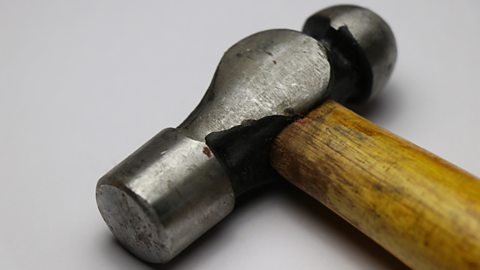
- A hammer used for metalwork that has a hemispherical head. - used for tapping a centre punch before drilling a hole
- A sharp object used for making a dent, so a drill bit can find a centre point in preparation for drilling. - used to create a drill point before a hole is drilled into metal so that the drill bit does not slip on the surface
- A tool used to make 90 degrees. - used for marking out at 90° to an edge or face
- A coloured fluid that is applied to metal and then scratched so that a mark can be seen clearly. or A coloured fluid that is applied to metal and then scratched so that a mark can be seen clearly. - dye used to coat the surface to be marked, and if it is hard to see the line made with a scriber then it will be easier to scratch a fine line through the blue dye
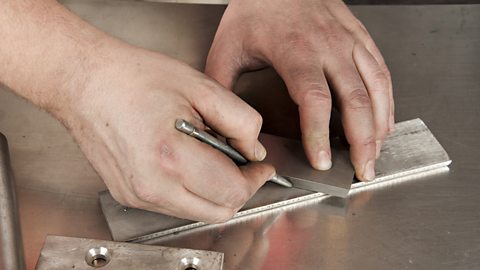
Image caption, Scriber

1 of 4
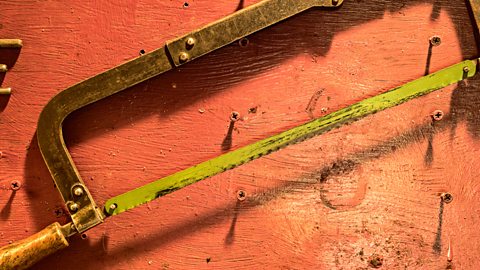
A A common tool used for cutting metals and polymers. is normally used to cut metal by hand. If a smaller piece of metal is being cut, then a junior hacksaw can be used. Once the metal is cut close to a marked line, a A common tool used for finishing and shaping. can be used to remove material up to the desired line. Files can be bought in different shapes, sizes and cutting grades - a rough-cut file can remove metal faster than a smooth-cut file and should always be used first.
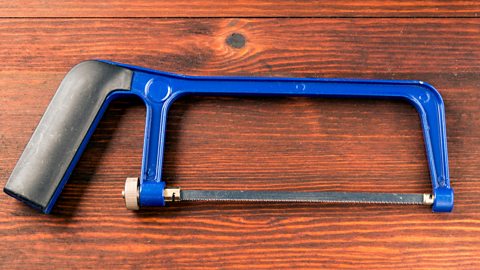
Image caption, A junior hacksaw has a smaller blade used for more precise cutting
1 of 2
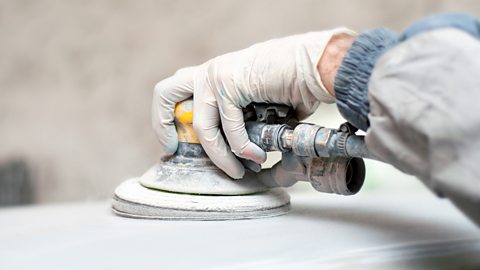
Once filing has been done and the profile of the metal is at the desired shape, the file marks can be removed with abrasive papers such as An abrasive cloth used for finishing and cleaning. and An abrasive paper used for finishing and cleaning. (often called A waterproof abrasive paper with latex-bonded silicon carbide. as it can be used both wet and dry). A buffing machine can be used to polish the metal to achieve a mirror-like finish.
Metal can also be drilled by using a variety of different drill bits, which work by twisting into a piece of metal:
- twist drills - used to simply drill a hole of fixed diameter into a piece of metal
- countersink bits - used to profile a hole so that a screw can sit flush with a surface
There are many different joining methods for fixing metal in place. Non-permanent methods include nuts and bolts, screws and A metal plug used to hold sheet material together. They expand when the central plug is pulled upwards through the body of the rivet.. Whilst many would consider a rivet a permanent method of joining, it is possible to drill out an old rivet so that a new one can be used.
Permanent methods of joining metals are listed in the table below:
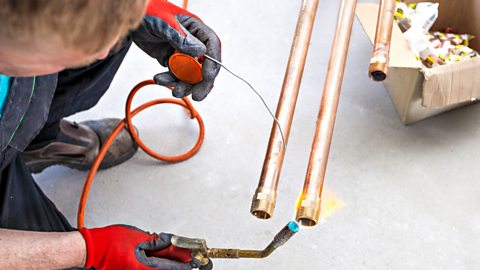
| Soft soldering | Used to solder printed circuit boards (PCBs) and electronic components. Plumbing application where copper pipes are joined together. |
| Brazing | Used for joining steel by melting a brass rod on the hot steel. As the brass melts, it forms a joint. Brazing is a slow and safe way to learn about joining metal with heat. |
| Gas welding/Oxyacetylene welding | Oxygen and acetylene are used to produce a flame with a temperature of over 3,000°C. A filler rod is melted so that pieces of metal can be joined together. Gas welding/Oxyacetylene welding is faster than brazing and can also be used to cut metal. |
| Arc welding | Heat is produced by a high current that is passed down the filler rod. When the filler rod melts, it fuses the pieces of metal together. Arc welding is fast and portable. |
| Soft soldering |
| Used to solder printed circuit boards (PCBs) and electronic components. Plumbing application where copper pipes are joined together. |
| Brazing |
| Used for joining steel by melting a brass rod on the hot steel. As the brass melts, it forms a joint. Brazing is a slow and safe way to learn about joining metal with heat. |
| Gas welding/Oxyacetylene welding |
| Oxygen and acetylene are used to produce a flame with a temperature of over 3,000°C. A filler rod is melted so that pieces of metal can be joined together. Gas welding/Oxyacetylene welding is faster than brazing and can also be used to cut metal. |
| Arc welding |
| Heat is produced by a high current that is passed down the filler rod. When the filler rod melts, it fuses the pieces of metal together. Arc welding is fast and portable. |
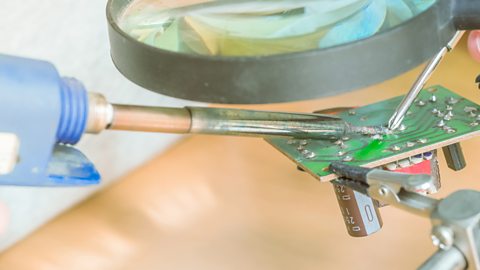
Image caption, Soft soldering electronic components
1 of 2
