Alternative methods of dealing with prisoners in the 20th century
In the 20th century, prisons became the main form of punishment used in Britain. A form of punishment during the 18th and 19th centuries, in which convicted criminals or other people considered undesirable were sent, or 'transported', to work in colonies in Australia, America or the Caribbean islands. ended in the 19th century, and corporal punishment was used less frequently, with flogging limited in 1914 then finally abolished in 1948. The death penalty, as a punishment for murder, was abolished in 1965.
Modern prisons
The harsh regimes in prisons began to change significantly after 1922. Prisoners were allowed to associate with each other, arrow-marked uniforms and shaved hair were abolished, and heating, better food and access to education were provided.
The aim became to reform and rehabilitate prisoners through education and training. However, as prisons have become more overcrowded since 1960, access to training and courses has been more limited.
Prisoners are categorised according to the risk they present to security, safety and public protection.
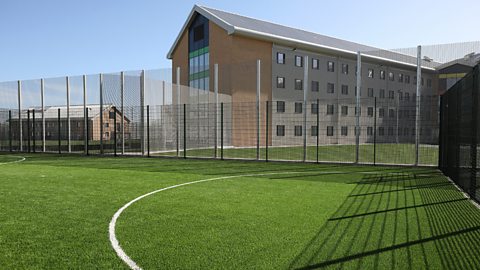
Prisoners must be held in a prison that provides levels of security that are appropriate for the prisoner. In England and Wales, adult male prisoners are either held in closed prisons, that have a secure perimiter and a range of internal security measures (category A-C prisons) or open prisons (category D prisons).
The table below lists categories assigned to adult male prisoners in England and Wales as described in the Ministry of Justice, Security Categorisation Policy Framework, 2011. Prisoners in Scotland and Northern Ireland are categorised using different frameworks. In England and Wales, young adults (aged 18-20) and women are also categorised using different frameworks.
| Category | Description | |
| Category A | Offenders whose escape would be highly dangerous to the public or the police or the security of the state and for whom the aim must be to make escape impossible | |
| Category B | Offenders whose assessed risks require that they are held in the closed estate and who need security measures additional to those in a standard closed prison | |
| Category C | Offenders who are assessed as requiring standard closed conditions, and do not need additional security | |
| Category D/Open | Offenders who have been assessed as presenting a low risk, or whose risk factors are assessed as manageable in low security conditions |
| Category | Category A |
|---|---|
| Description | Offenders whose escape would be highly dangerous to the public or the police or the security of the state and for whom the aim must be to make escape impossible |
| Category | Category B |
|---|---|
| Description | Offenders whose assessed risks require that they are held in the closed estate and who need security measures additional to those in a standard closed prison |
| Category | Category C |
|---|---|
| Description | Offenders who are assessed as requiring standard closed conditions, and do not need additional security |
| Category | Category D/Open |
|---|---|
| Description | Offenders who have been assessed as presenting a low risk, or whose risk factors are assessed as manageable in low security conditions |
Open prisons
Open prisons were established in 1934 and have more relaxed rules. They differ significantly from category A, B and C prisons. HMP Kirkham, in Lancashire, is a category D open prison.
In open prisons, inmates are allowed to leave the prison in the daytime to go to work. Prisoners have keys to their own rooms and there are no large walls or fences. There is a curfew and prisoners have to return to the prison at night. There are courses and training for inmates. Many open prisons have their own farms and workshops to train inmates for careers. They became popular due to the overcrowding of prisons following World War Two. Their focus is on resettling prisoners into the community as a way of preventing reoffending.
Many inmates in an open prison are low-risk first-time offenders who have committed minor crimes. Others are transferred from higher-category prisons near the end of their sentence to prepare for life back in the community.
Open prisons have had bad publicity in recent years after some scandals about the amount of alcohol and drugs that prisoners have access to.
20th-century women prisoners
HMP Holloway in London became a female-only prison in 1903. It was the largest female prison in Western Europe until it was closed in 2016.
Family liaison in women’s prisons is held as a priority, but the geographical spread of women’s prisons can make maintaining family links difficult.
Young offenders
Borstals were introduced as an alternative to prison for young offenders, and the first one opened in Kent in 1902. Boys aged between 15 and 21 were imprisoned there. Borstals were designed to educate and reform young offenders, so inmates had access to education and training courses. There were strict rules in borstals, and until 1962 boys in borstals were whipped. In 1969 the minimum age boys could be sent to borstal was raised to 17 years. They were abolished in 1982.
Around 60 per cent of those released from borstals went on to reoffend. Therefore, in 1948 the government introduced youth detention centres, which were intended to provide youth with a ‘short, sharp shock’. However, this tougher stance also failed to affect reoffending as the rates actually increased.
In 1988, young offender institutions were set up. These were for offenders aged between 18 and 21. Inmates have around 25 hours a week of education. These are considered a last resort after methods such as probation and non-custodial sentences have failed. People who are held in such places still have the highest rates of reoffending.
Young offenders can also be sent to secure training centres, secure children’s homes or juvenile prisons.
