The use of public corporal punishment up to the 19th century
The threat of corporal punishment was intended to deter people from committing crimes at a time when there was no professional law enforcement organisation. Punishments were carried out in public to humiliate criminals. It was hoped that other people would not commit crimes to avoid this humiliation.
Stocks and pillory
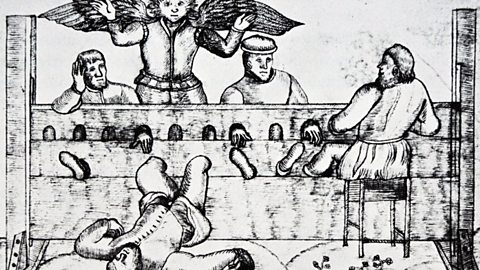
The stocks and pillory were used to punish people for crimes such as swearing or drunkenness. Criminals would sit (for the stocks) or stand (for the pillory) with some of their limbs, and their neck if in the pillory, held in a wooden frame. The local people would throw rotten food or even stones at them.
The stocks and pillory were used as punishments throughout the 16th and 17th centuries. Their use declined in the 18th century. It is thought that, in the UK, stocks were last used as punishment in 1872.
Flogging
Flogging was a common punishment in Tudor and Stuart times. It was used for crimes such as refusing to attend church and stealing.Homeless, unemployed person who wandered the streets. were publicly flogged.
Flogging continued to be a sentence that could be passed by courts until the mid-20th century. However, it ceased to be used for non-attendance at church or vagrancy.
