The use of public capital punishment up to the 19th century
There was an increased use of capital punishment from the 17th century. This corresponded with a rise in the crime rate, especially for crimes against property. Increasing the number of offences that could be punished by execution and carrying out those executions in public were intended to deter people from committing crimes.
Public capital punishment
Serious crimes were punished with Punishment resulting in death. throughout the 16th, 17th, 18th and 19th centuries.
The most common method of execution was hanging. Almost all towns and cities had a place of execution, with a scaffold. In Tyburn, London, near where Marble Arch stands today, was where most criminals were hanged. Prisoners were often dragged there from Newgate Prison. In 1537, Henry VIII used Tyburn to execute the ringleaders of the Pilgrimage of Grace. Also during Henry VIII’s reign, Bishop Rowland Lee was tasked with bringing law and order to Wales and had over 5,000 people publicly hanged.
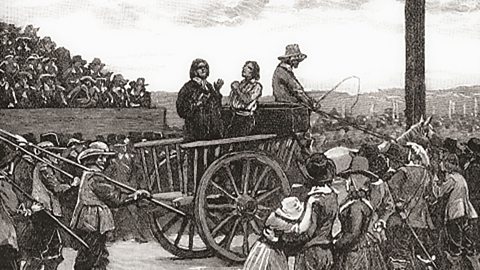
Criminals were usually taken to the A wooden structure used to execute people by hanging. on the back of a cart. On the way, people could throw things at the criminals and often shouted or jeered. A vicar would often encourage the condemned criminal to apologise for their crimes. The criminal would then be hanged. Often the criminal’s relatives would pull on their feet to speed up the death.
Other methods of execution included burning at the stake, which was the punishment for A belief or opinion which disagrees with the teachings of the Church. Offenders would be tied to a stake and a fire would be set around them. Often gunpowder would be put between the condemned person’s legs to speed up the death.
Catherine Murphy, a counterfeiter, was the last woman in England to be officially burned at the stake, on 18 March 1789. The punishment of burning at the stake, which at the time applied to women and not to men, was abolished a year later.
The method of execution for the crime of The crime of betraying one's country, sovereign or government. was either beheading or hanging, drawing and quartering; (known as a To die through being hanged (until near death), drawn (have their intestines pulled out) and quartered (body chopped into four pieces).) Royalty and nobles were beheaded, usually with an axe. Mary Queen of Scots was executed in this way in 1587.
Commoners found guilty of treason were hanged but cut down while still alive. They would then have their entrails (intestines) pulled out before being beheaded. Then their body would be chopped into four parts (hence the term ‘quartered’). The traitor’s lands and money would be confiscated by the monarch. Guy Fawkes was sentenced to be executed in this way in January 1606, but the execution was never carried out as he jumped or fell from the hanging platform, broke his neck and died.
